Banks create more value for credit cards to raise competitive edge
Banks create more value for credit cards to raise competitive edge
Product personalisation, digitisation of the entire user journey and connection with consumer ecosystems are predicted to become the dominant trend of the credit card market in the coming years.
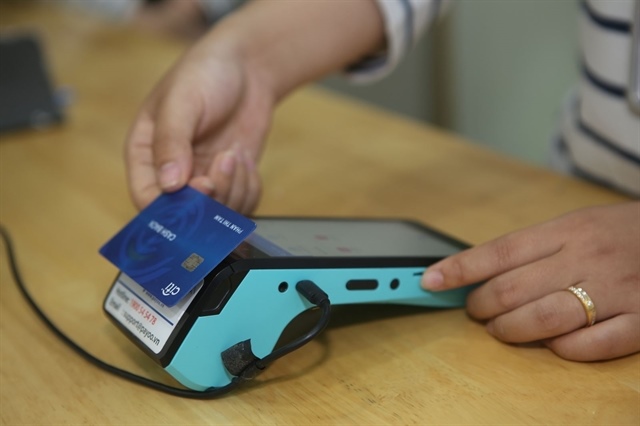
Việt Nam had over 98 million domestic cards and nearly 57 million international cards in circulation by the end of the second quarter of 2026. — VNA/VNS Photo |
Instead of racing to issue more new credit cards, banks are shifting to tailoring products to specific customer groups to create more value for the cards, making ecosystems and customer experiences their new competitive advantages.
Statistics from the State Bank of Vietnam showed that by the end of the second quarter of 2026, Việt Nam had 98.05 million domestic cards and nearly 57 million international cards in circulation.
The growing market means that competition among banks will no longer be about how many more cards are issued, but about who can create more value for each card that customers use.
Product personalisation, digitisation of the entire user journey and connection with consumer ecosystems are predicted to become the dominant trend of the credit card market in the coming years. The bank credit card is being repositioned from a means of payment to a gateway leading customers to a comprehensive service ecosystem.
To capitalise on this trend, in the first half of 2026 multiple banks launched new card products focused on specific customer segments rather than mass-market offers. Instead of issuing a single type of card, banks are opting to tailor products to the spending behaviour, lifestyles and needs of each customer group.
Several banks have leveraged their ecosystems to develop credit cards. For example, NCB partnered with real estate and hospitality developer Sun Group to develop the NCB Visa Sun Signature card. Instead of focusing solely on financial benefits, this card aims to connect payment benefits with services within the Sun Signature ecosystem, such as travel, resorts, entertainment and aviation.
VPBank also developed a co-branded card with electronics retailer Điện Máy Xanh to target customers who frequently purchase electronics and tech products.
This trend is evident in banks' increased collaboration with consumer ecosystems to make credit cards more prevalent in daily activities.

Việt Nam had over 98 million domestic cards and nearly 57 million international cards in circulation by the end of the second quarter of 2026. — VNA/VNS Photo |
Meanwhile, LPBank recently upgraded four international credit card lines: LPBank Visa Platinum, LPBank Visa Standard, LPBank JCB Platinum and LPBank JCB Standard.
The upgrades to the four product types aren’t about adding more benefits, but rather about the bank restructuring its card portfolio according to customer segments. Instead of applying the same benefits mechanism to all customers, each card type is positioned for a distinct group of consumer behaviours.
ACB focused on digitising its entire card management process, allowing customers to convert to installment payments directly through its application.
In the corporate segment, the trend towards specialisation is also strong. Techcombank has developed a type of card specifically for businesses, with long interest-free periods and large credit limits to support cash flow management. VietinBank uses cards as a tool for managing internal expenses, gradually replacing traditional advance payment and settlement processes.
According to experts, this shift reflects the Vietnamese credit card market moving beyond competition based on quantity to understanding customer needs.
Credit cards are increasingly integrating more value beyond the ‘buy now, pay later’ function. Banks are expanding cooperation with businesses in retail, transportation, tourism, entertainment and aviation, aiming to make cards a key connecting customers to an entire ecosystem of services.
Competitive pressure from fintech companies and the ‘buy now, pay later’ model is forcing banks to adapt. According to assessments by international card organisations, users now prioritise a simple, transparent experience with better control over spending, narrowing the gap between bank credit cards and digital credit products.
Competition between domestic and international cards is also becoming increasingly fierce as the number of international cards continues to grow. In the first half of the year, credit institutions issued approximately 1.12 million additional international cards. Conversely, the issuance of domestic cards showed signs of stagnation, decreasing by 10.22 million cards compared to the end of the previous year, the lowest level in the past year.
However, Phạm Trung Thành, head of the report analysis team at FiinGroup's Market Research and Consulting Department, believes that with the advantage of a young population, continuously improving incomes and the boom in e-commerce, the Vietnamese market still has room for growth.
Amid rapidly shifting consumer behaviour and digital payments, domestic credit cards with low fees and increasingly competitive features are emerging as a potential player that can challenge the dominant position of international card brands, he said.
- 13:48 22/07/2026