ASEAN's EV race shifts gears, Việt Nam keeps pace
ASEAN's EV race shifts gears, Việt Nam keeps pace
As Southeast Asia shifts its focus from boosting electric vehicle sales to building local manufacturing and supply chains, Việt Nam is well placed to remain one of the region's fastest-growing EV markets while expanding its production base.
Passenger EV Sales across ASEAN markets. — Infographic by BIM |
Southeast Asia's electric vehicle (EV) market is entering a new phase as governments shift their focus from boosting sales to building domestic manufacturing and supply chains, with Việt Nam well positioned to benefit from the transition.
A report by BMI, published on July 16, forecasts passenger EV sales across ASEAN to more than double from 419,547 units in 2025 to 916,997 units by 2035, lifting EV penetration to 22.7 per cent of total passenger vehicle sales.
For several years, Thailand and Việt Nam have dominated ASEAN's EV market, supported by government incentives and a growing range of affordable models, particularly from Chinese automakers.
BMI expects the two countries to remain the region's largest EV markets, accounting for more than 72 per cent of passenger EV sales in 2026.
That dominance, however, is expected to gradually ease as other markets catch up.
By 2035, Malaysia and Indonesia are projected to account for a larger share of regional sales, reducing the combined share of Việt Nam and Thailand to 64 per cent.
Rather than signalling tougher competition, the changing market shares reflect a broader regional expansion. Rising incomes, improving affordability and supportive policies are creating multiple growth centres.
BMI forecasts Việt Nam is expected to remain one of ASEAN's strongest EV growth markets, with passenger EV sales forecast to rise from around 175,000 units in 2025 to 287,379 in 2030 and 366,204 by 2035.
The outlook is supported by structural trends in the domestic market, where car ownership remains relatively low compared with more mature ASEAN economies. Meanwhile, rising incomes continue to encourage households to shift from motorcycles to passenger vehicles.
The favourable market outlook is also reinforced by increasingly consistent government policies.
Earlier this year, the Government extended the registration fee exemption for battery electric vehicles by 2030, maintaining one of the region's strongest purchase incentives.
Besides stimulating demand, policymakers are also beginning to address the infrastructure needed to support wider EV adoption.
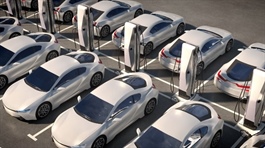
The Ministry of Industry and Trade is working with Việt Nam Electricity (EVN) to review urban power grid planning for dedicated EV charging stations under the revised National Power Development Plan, helping prevent localised overloads as electricity demand from EVs is projected to increase by an estimated 3–4 billion kWh annually.
Plans to introduce low-emission zones in major cities are also expected to further encourage the transition towards cleaner transport while supporting longer-term demand for electric vehicles.
|
Passenger EV Sales across ASEAN markets. — Infographic by BIM |
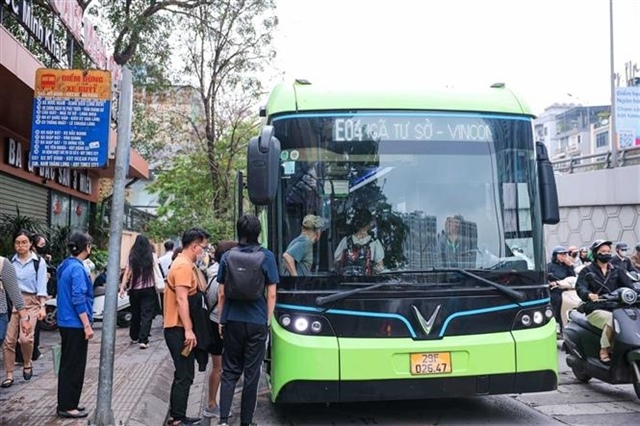
Beyond demand, Việt Nam also stands out for having a home-grown EV manufacturer.
VinFast has helped expand local production while accelerating EV adoption through its vehicle lineup and the Green SM taxi fleet, giving the country an advantage as ASEAN increasingly shifts its focus towards manufacturing and supply chains.
That policy shift is taking place across Southeast Asia.
Instead of boosting sales, the region is increasingly seeking to build a manufacturing and supply-chain hub, with governments linking incentives more closely to local production, supply chains and industrial development.
During the early stages of EV adoption, governments focused primarily on stimulating demand through import duty exemptions, tax reductions and registration fee incentives. Those measures successfully lowered vehicle prices and encouraged consumers to switch to electric cars.
They also helped Chinese manufacturers rapidly expand across Southeast Asia as intense price competition at home pushed them to seek new overseas markets.
Now, Thailand and Indonesia both link EV incentives directly to local production requirements. Malaysia is shifting support from fully imported models toward local completely knocked down (CKD) assembly
ASEAN governments increasingly want to develop local supply chains covering batteries, electronics, components and vehicle assembly.
ASEAN already possesses several competitive advantages across the EV value chain, including abundant nickel resources in Indonesia and the Philippines, rare earth reserves in Việt Nam, established electronics manufacturing and expanding semiconductor capabilities.
According to BMI, combined with growing automotive production capacity, these strengths could allow the region to capture a greater share of EV value-added rather than serving only as a consumer market.
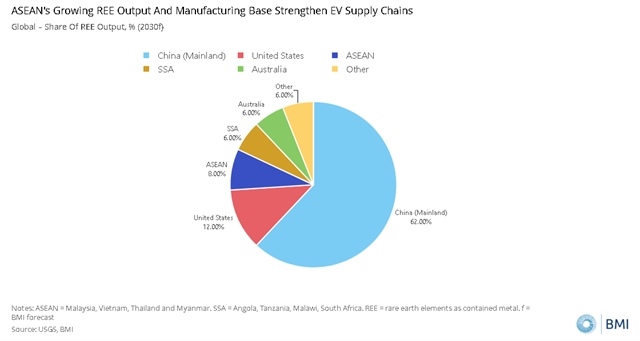
Passenger EV Sales across ASEAN markets. — Infographic by BIM |
Việt Nam's industrial strategy is broadly aligned with that regional direction.
The country has identified semiconductors as a strategic industry while continuing to expand advanced electronics manufacturing, creating opportunities to participate more deeply in the EV supply chain.
BMI also describes Việt Nam as the "next major growth story" in regional passenger vehicle production, forecasting output to reach more than 343,000 units by 2035. VinFast's rapid expansion and growing domestic production capacity have contributed significantly to that outlook.
The transition, however, is unlikely to be straightforward.
BMI cautions that requiring manufacturers to localise production too quickly could increase costs if supply chains are not yet sufficiently developed.
New factories across ASEAN still face relatively low utilisation rates, raising the risk that higher production costs could slow improvements in vehicle affordability.
The success of ASEAN's EV ambitions will depend on how quickly manufacturers and supplier networks can achieve the scale needed to make locally produced EVs both competitive and affordable, the report said.
- 08:33 24/07/2026