VCCI works with NA committee to remove difficulties for private sector
VCCI works with NA committee to remove difficulties for private sector
A survey by the VCCI found that 51.4 per cent of business complaints in early 2026 related to unclear, impractical or overlapping regulations.

Egg collection and sorting lines at QL VietNam Agroresources Co., Ltd. Tây Ninh Province. — VNA/VNS Photo Minh Phú |
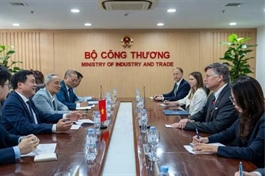
The Vietnam Chamber of Commerce and Industry (VCCI) called for stronger institutional reforms and a more predictable legal environment to promote the development of the private sector during a meeting with the National Assembly (NA)'s Economic and Financial Committee on June 15 in Hà Nội.
VCCI Chairman Hồ Sỹ Hùng said Việt Nam's economic reform agenda was moving at an unprecedented pace, driven by the Politburo’s Resolution No 68, which identifies the private sector as one of the country's most important growth engines.
Rapid legislative changes were necessary to remove bottlenecks and support economic development, but the quality of legislation remained equally important, he stressed, adding that the economic law must be assessed based on whether it works in practice, reflects the realities businesses face and provides the stability they need to plan and invest with confidence.
What businesses want the most is a more stable and predictable legal framework, greater consistency among regulations and more effective implementation of policies, he said.
VCCI’s deputy general secretary Đậu Anh Tuấn said companies were facing a significant burden from both long-standing structural weaknesses and external economic shocks, in which small and medium – sized enterprises (SMEs) and household businesses are the most vulnerable.
According to Tuấn, although the private sector now accounts for more than one million enterprises, representing 96.6 per cent of all operating businesses in Việt Nam, nearly 70 per cent have registered capital of less than VNĐ10 billion (US$382,000).
Access to finance remained a chronic challenge, with 75.5 per cent of businesses unable to secure bank loans without collateral, he said.
For the household businesses, the removal of the lump-sum tax regime from January 1, 2026, could increase compliance costs and discourage expansion, he said.
Adding to the pressure, the outbreak of conflict in the Middle East in March 2026 sharply increased production costs, pushed up prices of raw materials and fertilisers, as well as international logistics costs.
The VCCI also pointed out that many projects continue to face delays because of overlapping planning regulations, slow land clearance procedures, delays in land valuation approvals and inconsistent implementation by local authorities.
A survey by the VCCI found that 51.4 per cent of business complaints in early 2026 related to unclear, impractical or overlapping regulations.
About 25 per cent of businesses said administrative procedures were not carried out as publicly prescribed, while 33.3 per cent reported delays beyond official timelines and 38.2 per cent said they still face informal costs. As a result, 24 per cent of firms said they had cancelled or postponed business plans.
“In that context, timely and well-designed legislative measures could play a critical role in strengthening business resilience,” Tuấn said.
"It is time for provincial reforms to shift their focus from simply speeding up administrative procedures to creating a fairer and more competitive business environment," Tuấn stressed.
VCCI proposed priorities on the quality rather than the quantity of reforms, shift from pre-approval controls to post-audit supervision, improving policy consistency and predictability, strengthening business consultation, and enhancing implementation and accountability across government agencies.
Discussion on SME support law

Egg collection and sorting lines at QL VietNam Agroresources Co., Ltd. Tây Ninh Province. — VNA/VNS Photo Minh Phú |
At the working session, participants also discussed proposed amendments to the Law on Support for SMEs.
The VCCI proposed raising revenue thresholds used to classify SMEs in certain sectors, including a threshold of VNĐ1 trillion (US$38.2 million) for electronics firms, and introducing a three-year transition period for companies that exceed SME criteria.
It also proposed expanding eligibility for preferential corporate income tax rates to medium-sized enterprises in manufacturing and supporting industries, while introducing incentives for investment in technological upgrades and production expansion.
To improve access to finance, the VCCI recommended allowing intangible assets such as intellectual property rights to be used more effectively in lending, and proposed an annual interest-rate support mechanism of at least 2 percentage points.
The organisation also called for stronger support for digitalisation and green transformation, including covering at least 50 per cent of technology adoption costs, increasing interest-rate subsidies for green projects to 3 per cent per year, and allowing 150 per cent of ESG consultancy and certification costs to be deducted when calculating taxable income to help firms comply with international sustainability standards.
The chamber further proposed extending the principle of "guidance before penalties" to all SMEs and introducing monitoring and enforcement mechanisms to ensure that at least 20 per cent of public procurement contracts are allocated to SMEs.
Strategic cooperation proposals
At the meeting, the VCCI also proposed strategic cooperation with the NA’s Economic and Financial Committee.
The proposals included establishing a formal mechanism for lawmakers to use VCCI research and surveys in policy appraisal to strengthen consultation with the business community on economic legislation, and making consultation with the VCCI mandatory for economic laws.
The chamber also proposed that the NA allocate funding for the VCCI to conduct policy impact assessments and organise consultations on draft legislation.
Other proposals included cooperation on parliamentary oversight missions, policy forums and joint publications such as an annual report on business legislation.
The VCCI said closer cooperation between lawmakers and the business community would help remove institutional bottlenecks and support the development of the private sector as a key driver of Việt Nam's economic growth.
- 18:14 15/06/2026