Building a sustainable ecosystem for private sector growth: From policy to action
Building a sustainable ecosystem for private sector growth: From policy to action
A significant gap remains between technologies available in the market and their practical application in production and business activities.

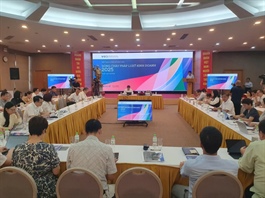
Overview of the forum. — Photo thitruongtaichinhtiente.vn |
Building a sustainable ecosystem and strengthening links among government agencies, support organisations, research institutes, science and technology enterprises, and the business community has become increasingly critical to accelerating private sector development in Việt Nam's next growth phase.
The message was highlighted at the forum on building a sustainable ecosystem to support and develop the private sector, held in Hà Nội on Saturday.
One year after the implementation of Politburo's Resolution 68 on private economic development, Việt Nam's private sector has continued to record positive momentum, with a sharp increase in newly-established businesses and firms returning to the market.
The number of active enterprises has risen to approximately 1.06 million, while the sector now contributes more than a quarter of total state budget revenue.
Speaking at the forum, Nguyễn Xuân Thọ, deputy director general of the Agency for Private Enterprise and Cooperative Economic Development (APED) under the Ministry of Finance (MoF), said the results underscored the increasingly important role of the private sector in Việt Nam's growth model.
According to Thọ, business support policies have become more coordinated in recent years, with a stronger focus on innovation, digital transformation and green transition.
Collaboration models linking Government agencies, businesses, researchers, universities and financial institutions have also expanded, helping create a more stable environment for private sector development.
He noted that business support policies were undergoing a significant shift. Previously, support programmes were often implemented in a fragmented manner.
They were now moving toward a more focused approach, backed by specific policy tools, ecosystem data and measurable outcomes, he added.
Nguyễn Hoàng Bách, a representative of the Small and Medium Enterprise Support Division under APED, said the current policy framework is built on Resolution 68 and National Assembly Resolution 198/2025/QH15, offering support across areas including finance, credit, taxation, land access, innovation and technology.
Rather than providing broad-based support, key programmes are increasingly targeting businesses with strong growth potential and the capacity to generate wider economic impact. These include initiatives to develop 1,000 leading enterprises between 2026 and 2030, train 10,000 chief executives, and support technology-driven firms with the ability to influence broader value chains.
According to Bách, the approach is intended to ensure public resources are allocated more efficiently.
At the same time, proposed amendments to the Law on Support for Small and Medium-Sized Enterprises would shift the focus from company size to the different stages of business development, including start-up, growth and international expansion.
The change is expected to create a more flexible policy framework tailored to different stages of business development.
From the perspective of businesses, the challenge is not necessarily a lack of technology, but rather access to technology that matches operational capabilities, available resources and market demand.
Nguyễn Văn Thanh, director of the Center for Vietnam Science and Technology Commercialisation Development, under the Department of Innovation, Ministry of Science and Technology, said many small and medium-sized enterprises continued to struggle with selecting and absorbing appropriate technologies.
The obstacles stemmed not only from limited financial resources but also from information gaps and a shortage of suitable advisory services, he said.
As a result, a significant gap remains between technologies available in the market and their practical application in production and business activities.
In response, support policies are increasingly moving beyond research and development to cover technology transfer, practical application and the commercialisation of research outcomes.
"The key issue is not how much technology is introduced into businesses, but how technology creates real value through lower costs, higher productivity and stronger competitiveness," Thanh said.
- 19:09 06/06/2026