Vietnam tightens price controls and boosts public investment
Vietnam tightens price controls and boosts public investment
The Ministry of Finance is intensifying its dual approach of tightening price controls and accelerating public investment disbursement to counter rising inflationary pressures and sustain national growth targets.
Minister of Finance Ngo Van Tuan highlighted these priorities at a regular government meeting on May 4, stressing the need for administrative vigilance as external shocks from global energy markets and scheduled hikes to state-managed service fees continue to weigh on domestic price stability.
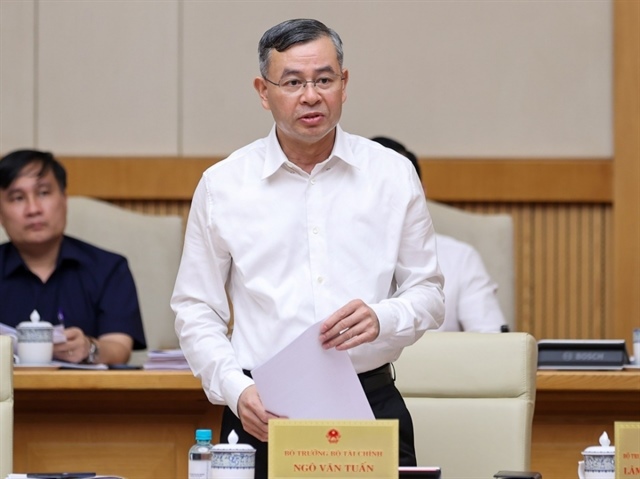
Minister of Finance Ngo Van Tuan at the government meeting |
According to the National Statistics Office, the Consumer Price Index (CPI) climbed to 5.46 per cent in April on an on-year basis, accelerating sharply from the 4.65 per cent recorded in March and approaching the 5.5 per cent worst-case scenario the Ministry of Finance (MoF) presented on April 23.
The primary driver is cost-push pressure from global crude oil prices, which have surged since March amid heightened geopolitical tensions in the Middle East.
“These global disruptions have not only inflated energy costs but also caused a surge in international logistics and transportation expenses, creating a cascade effect across various domestic sectors including transport services, food, and construction materials,” Minister Tuan said.
These categories account for over half of the CPI basket and recorded the sharpest rises in the first four months of 2026, with the food category up 5.2 per cent on-year and transportation climbing 11.1 per cent in April.
The government is now bracing for additional domestic price pressures, including increased electricity demand during the peak summer heat and scheduled adjustments to state-managed service fees.
Healthcare service prices are projected to rise by approximately 8.9 per cent, driven by the inclusion of management costs and a significant hike in medical staff allowances.
This adjustment alone is estimated to add around 0.28 percentage points to the national CPI. In the education sector, tuition caps for the 2026-2027 academic year are slated for an average rise of 12.7 per cent for public universities and 18 per cent for public vocational training institutions.
To mitigate these pressures, the MoF has called for a coordinated response between ministries, urging the Ministry of Industry and Trade to ensure a stable domestic energy supply through continued management of the Fuel Price Stabilisation Fund, while the Ministry of Construction provides clear guidance on adjusting construction contracts to account for material price volatility.
Each ministry is required to maintain strict market surveillance to prevent speculative hoarding and unreasonable price hikes, particularly in essential commodities such as rice, pork, and construction supplies, while localities instructed to implement market stabilisation programmes suited to their specific economic conditions.
On the growth front, the government is focusing on public investment as a key engine to achieve high growth in 2026.
Total social investment Q1 reached $29.8 billion, a 10.7 per cent rise on-year. Foreign direct investment (FDI) remains a bright spot, with registered capital in the first four months of the year estimated at $18.2 billion, a 32 per cent increase on-year, while implemented FDI rose by 9.8 per cent to $7.4 billion.
Issues persist in the deployment of state capital, however, with approximately $1.85 billion of the 2026 investment plan remaining unallocated across 14 ministries and 17 localities as of late April.
Minister Tuan mandated that these entities expedite their allocation processes and finalise regional mining plans by Q2 of this year to ensure an adequate supply of raw materials for key infrastructure projects.
As part of its forward-looking strategy, the MoF has asked all government agencies and local authorities to submit revised growth indicators this week to facilitate a comprehensive report to the central government on achieving targets for the 2026-2030 cycle.
- 17:36 06/05/2026