Vietnamese businesses must operate differently to enter the next phase of competition
Vietnamese businesses must operate differently to enter the next phase of competition
Amid market volatility and rising costs, Vietnamese businesses are growing, but not more efficiently. For SMEs, limited resources are widening the gap between revenue and profitability, making new, more efficient ways of operating essential.
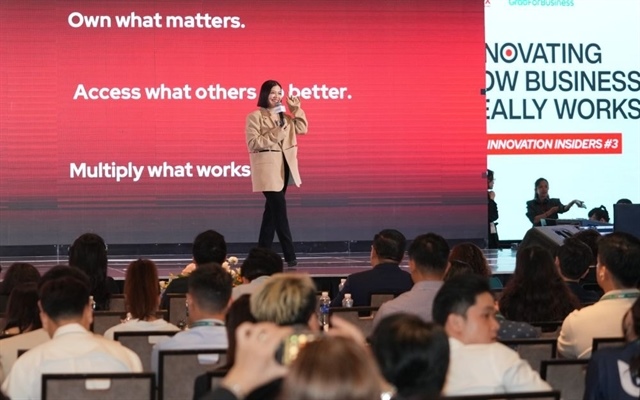
In an increasingly competitive and demanding environment, efficiency, data-driven operations and adaptive leadership are key to long-term business success, according to Trương Lý Hoàng Phi, Chairwoman and CEO of the InnoEx International Innovation Alliance. — Photo courtesy of InnoEx |
Amid market volatility and rising costs, many Vietnamese businesses are facing a growing paradox: revenues are increasing but efficiency is not, leaving profitability under pressure.
For small- and medium-sized enterprises (SMEs) in particular, limited resources and capabilities are widening the gap between growth and earnings. Industry insiders say developing more efficient and fundamentally different operational models is now essential for survival.
According to Trương Lý Hoàng Phi, chairwoman and CEO of the InnoEx International Innovation Alliance and the Investment and Business Promotion Corporation, Việt Nam aims to have two million active enterprises by 2030 and five million by 2045 alongside a surge in innovative start-ups. While this expansion creates opportunities, it also significantly narrows the competitive landscape. In this new context, traditional growth drivers such as low labour costs or broad market upswings are gradually losing their effectiveness.
She noted that the next phase of the economy will be shaped by four key pillars: the private sector as the central driver, technology and innovation as engines of growth, business operations grounded in transparent legal and governance frameworks and deeper international integration.
These shifts require businesses not simply to do better but to do differently at a fundamental level. In this new playing field, competitive advantage no longer stems from scale or speed of expansion but from operational efficiency and internal execution capability, she said.
These pressures are intensifying as input costs from logistics and raw materials to labour continue to fluctuate amid global economic uncertainty. Without optimising operating models, businesses risk falling into a cycle where revenues grow but profits are steadily eroded. In this context, digital transformation is no longer a long-term strategic option but a prerequisite for survival.
The Government has set targets for 60 per cent of businesses to adopt digital platforms and 40 per cent to use shared digital services while accelerating the digitisation of administrative processes such as taxation and business management. Digital capability is becoming a baseline requirement.
“The new game does not just eliminate weak businesses; it eliminates outdated operating models,” Phi said.
Nguyễn Phi Vân, chairwoman of Go Global Holdings, highlighted a striking reality: many businesses achieve revenue growth without securing profitability. This is largely due to cash flow leakages caused by operational inefficiencies from unoptimised processes and hidden costs to small errors that accumulate over time.
“If businesses are constantly struggling with revenue and profit, they will have little capacity to pursue larger opportunities such as innovation or business model transformation,” she said.
From an international perspective, Pakornkit Chanwanityotin, senior business director for ASEAN at Salesforce, noted that the new reality is defined by three factors: speed, experience and trust. Customer expectations have shifted dramatically. Where customers once tolerated delays, they now expect near-instant responses. Moreover, they no longer compare companies solely with direct competitors but with the best experiences they have encountered anywhere.
Customers now expect personalised and relevant interactions, which require businesses to analyse and use data effectively.
However, one of the most significant barriers is fragmented data, he noted.
Departments such as sales, marketing and finance often operate in silos despite serving the same customers. Without a unified data foundation, businesses struggle to generate meaningful insights or make timely decisions. Building an integrated data system is therefore essential to improving speed, experience and trust, he said.

In an increasingly competitive and demanding environment, efficiency, data-driven operations and adaptive leadership are key to long-term business success, according to Trương Lý Hoàng Phi, Chairwoman and CEO of the InnoEx International Innovation Alliance. — Photo courtesy of InnoEx |
From a practical operations standpoint, Erika Oktora, regional lead of Self-Serve Business at Grab, stressed that small operational leaks can lead to significant consequences. Manual approval processes, fragmented systems and a lack of real-time data all contribute to rising costs and slower decision-making. When scaled across large organisations, these inefficiencies become a considerable burden. The solution lies not in increasing headcount but in simplifying processes, reducing friction and building systems that enable more efficient operations, she noted.
Offering a more optimistic perspective, Khôi Lê, country director of Meta in Việt Nam, said the new reality also presents opportunities for breakthrough growth. Rapid advances in artificial intelligence (AI), particularly AI agents, are enabling businesses to scale without being constrained by traditional resources. The role of managers is evolving accordingly from direct execution to designing systems and training digital tools to optimise performance.
Phi stressed the need for a systematic shift from awareness to action. Businesses must redefine growth by focusing on value creation rather than expansion alone while building internal sandboxes to test and scale new ideas. At the same time, operational restructuring is essential, streamlining processes, reducing manual work and adopting data-driven decision-making to improve speed and coordination.
Technology should be applied selectively, targeting areas with clear impact on cost, efficiency and decision quality. Ultimately, success also depends on a shift in leadership mindset from control to enablement where competitive advantage comes from faster decision-making, effective delegation and stronger organisational alignment, she added.
- 09:54 05/05/2026