Việt Nam eyes globally competitive economic groups
Việt Nam eyes globally competitive economic groups
After 40 years of Đổi mới (1986–2026), Việt Nam has seen the emergence of major economic groups across many sectors.
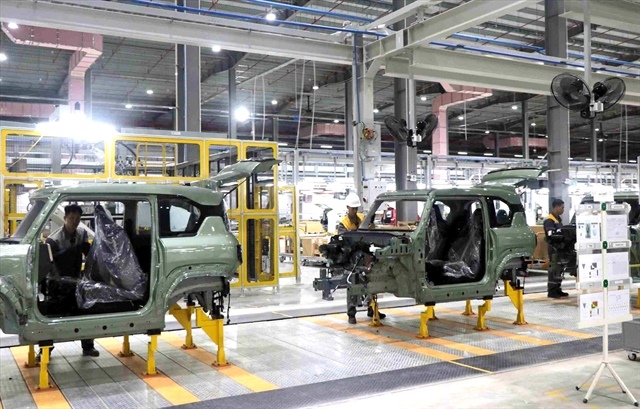
A corner of VinFast factory in the central province of Hà Tĩnh. — VNA/VNS Photo |
Ambitious targets set out in the Politburo’s recent resolutions show that Việt Nam is no longer aiming merely for an economy with a large number of enterprises, but is now aspiring to build corporations capable of competing at the regional level and gradually entering the global arena.
Resolution No. 68-NQ/TW issued by the Politburo in May last year on private sector development, sets a target for 2 million active enterprises in the economy by 2030, including at least 20 large corporations participating in global value chains.
Subsequently, Resolution No. 79-NQ/TW issued by the Politburo in January this year on state-owned enterprise development aims for 50 state-owned enterprises to be ranked among Southeast Asia’s top 500 companies and between one and three state-owned enterprises among the world’s top 500 companies by 2030.
The resolution also seeks to build several strong state-owned economic groups and enterprises with large scale, modern technology, and regional and international competitiveness, playing a pioneering role in leading domestic enterprises to participate more deeply in global production and supply chains, especially in strategic and key sectors of the economy.
After 40 years of Đổi mới (1986–2026), Việt Nam has seen the emergence of major economic groups across many sectors, said Đậu Anh Tuấn, deputy secretary-general of the Vietnam Chamber of Commerce and Industry (VCCI).
In manufacturing, for example, THACO has built an automobile and mechanical engineering production ecosystem in Quảng Nam Province on a scale considered among the largest in Southeast Asia.
Meanwhile, VinFast has become a particularly notable case as Việt Nam’s first electric vehicle manufacturer, establishing a large-scale factory in Hải Phòng, listing on the Nasdaq stock exchange, and selling vehicles in multiple international markets, including North America, Europe, and Southeast Asia.
In addition, Hòa Phát Group has grown from a small furniture workshop into one of Southeast Asia’s leading steel manufacturers, producing millions of tonnes of steel annually and competing directly with international steel corporations in export markets.
In technology, FPT has become one of the region’s largest information technology companies, operating in dozens of countries and providing digital transformation services to multinational corporations.
In consumer goods, Vinamilk has built a dairy brand present in more than 50 countries, with internationally standardised farms and factories. Masan Group has developed a consumer ecosystem spanning food, beverages, and retail, serving tens of millions of consumers daily.
These enterprises have demonstrated that private businesses are fully capable of building national brands with regional competitiveness.
In infrastructure and real estate, Vingroup has carried out projects on an unprecedented scale in the history of Việt Nam’s private sector, ranging from urban developments and hospitals to schools and electric vehicle production.
Sun Group, BRG Group, and many other corporations have also invested billions of dollars in tourism infrastructure, resorts, and airports, contributing to the transformation of many economic regions.
Statistics show that Việt Nam had nearly 1.1 million active enterprises across multiple sectors by the end of last year. However, according to Đậu Anh Tuấn, “the business sector is broad in scale but not yet strong in capacity or depth.”
Meanwhile, Nguyễn Đức Hiển noted that most enterprises still relied heavily on capital, whereas achieving the goal of becoming a modern industrialised country by 2045 required economic groups focused on industrial sectors.
Sharing the same view, economist Trần Đình Thiên said international development experience showed that becoming an economic powerhouse required strong economic groups capable of leading the economy and competing globally.
These enterprises must not only withstand global economic fluctuations but are also expected to become among the most important drivers of the economy.
Vietnamese enterprises are still relatively young, small, and weak, and if they continue to face limitations in development space, it will be difficult for them to mature into corporations capable of leading the economy.
Việt Nam, therefore, needed to change the way it supported businesses, said Thiên. The previous broad-based support model often resulted in the growth of only small enterprises, making it difficult for large corporations to emerge.
In the new phase, policies should shift toward targeted support, focusing on businesses capable of leading and creating spillover effects across entire production chains.
Discussing industrial development orientation, Trần Đình Thiên emphasised that mastering technology was essential for becoming an economic power.
However, selecting priority industries and specific development directions required careful calculation and a focused, strategic approach, he said.
Sharing international experience, Nguyễn Cảnh Cường, expert lecturer at the VNU University of Economics and Business, said Japan achieved breakthroughs by choosing the right strategic industries and maintaining long-term investment.
South Korea built leading conglomerates such as Samsung and Hyundai, which in turn fostered an entire industrial ecosystem.
China leveraged its market scale and strong policies to develop large industrial clusters and gradually gain control over value chains.
It can be said that Resolution 68 on private sector development and Resolution 79 on state-owned enterprise development are creating a relatively synchronised policy framework for the growth of Vietnamese enterprises.
Opportunities are already emerging, and the foundations have been laid. The remaining challenge lies in implementation capacity and consistency in pursuing the chosen development path.
If this period is utilised effectively, the next decade could see Việt Nam forming economic groups with regional stature, gradually affirming their position in global industrial value chains and realising the economy’s aspiration to “rise strongly” on the international stage.
- 08:21 19/05/2026