Việt Nam, China boost cooperation in green industry development
Việt Nam, China boost cooperation in green industry development
The Vietnamese Embassy in China and the International Cooperation Centre under China’s National Development and Reform Commission on May 18 held a green industry cooperation programme in Beijing to boost policy exchanges and practical cooperation amid climate and environmental challenges.
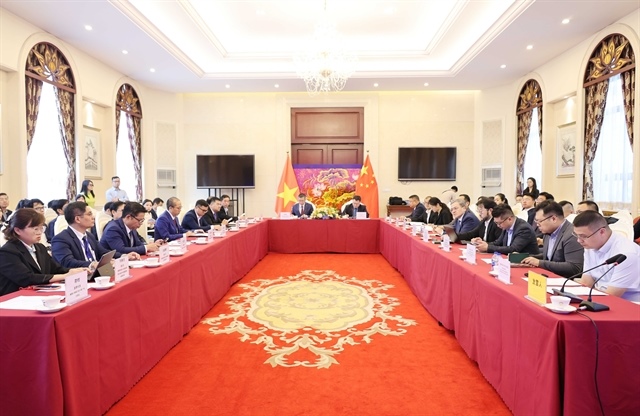
An overview of the Vietnam-China Green Industry Cooperation and Exchange Programme held in Beijing. — VNA/VNS Photo Công Tuyên |
The programme drew around 80 delegates, including Vietnamese Ambassador to China Phạm Thanh Bình, Minister Counsellor Hoàng Văn Tuấn, Director General of the International Cooperation Centre under the NDRC Wu Hongliang, representatives from Việt Nam’s Ministry of Finance, Ministry of Agriculture and Environment, and Ministry of Industry and Trade, along with guests from training institutions, industrial parks and leading green industry enterprises of both countries.
In his opening remarks, Ambassador Bình stressed that the Communist Party of Việt Nam and the State consistently regard green and sustainable development as a strategic orientation.
He noted that the 14th National Congress of the Communist Party of Việt Nam elevated environmental policy to the same level of importance as economic and social policy, opening up a new policy space for the 2026-30 period. Green development is viewed as a key driver for restructuring the growth model while improving growth quality and national competitiveness.
He also highlighted China’s achievements in renewable energy, environmental management and carbon market development, affirming that the two countries have substantial potential to expand mutually beneficial cooperation in green industry.
For his part, Wu said that based on the memorandum of understanding on green development cooperation signed in December 2023 between the NDRC and Việt Nam’s former Ministry of Natural Resources and Environment, the two sides should focus on three major areas of cooperation in the coming time.
They include harmonising regulations towards common green standards, promoting cooperation in green manufacturing, clean energy and the circular economy, and improving long-term support mechanisms for technology and human resources.
Wu noted that this year marks the beginning of China’s 15th Five-Year Plan, which prioritises ecological security and green, sustainable development. He affirmed that the NDRC is ready to serve as a bridge to elevate Việt Nam – China cooperation in green industry to a new level.
At the programme, representatives from Việt Nam’s FPT Group and Vietnam Joint Stock Commercial Bank for Industry and Trade (VietinBank), along with China’s Tianjin Ziya Economic and Technological Development Zone, China Urban and Rural Holding Group Co Ltd, Jiangsu Bodao Intelligent Thermal Engineering Co Ltd and Shanghai SUS Environment Co Ltd, shared practical experience in green industrial connectivity, circular economic zone models, wastewater treatment, green finance, solid waste treatment and waste-to-energy conversion.
Delegates also held discussions on issues of common concern.
Participants said the programme opened up promising opportunities for cooperation and marked a meaningful new starting point for bilateral collaboration.
They noted that the event would help strengthen friendship, enhance strategic connectivity, promote complementary strengths, facilitate exchanges, and boost high-quality projects, green technology and green finance cooperation. These efforts are expected to contribute to deepening the Việt Nam – China Comprehensive Strategic Cooperative Partnership and advancing the building of a Việt Nam - China community with a shared future that carries strategic significance in the new era.
- 17:43 18/05/2026