Next-generation FDI to prioritise technology transfer
Next-generation FDI to prioritise technology transfer
Vietnam’s approach to attracting next-generation FDI is shifting, with the participation of domestic enterprises in global supply chains becoming a central measure of investment quality.
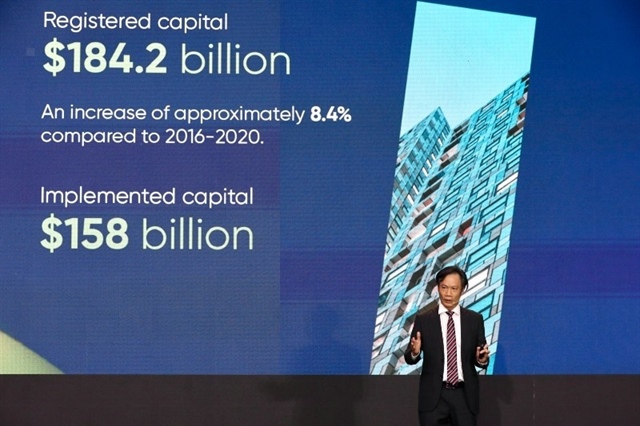
Dr Le Duy Binh, director of Economica Vietnam speaks at Vietnam Connect Forum 2026 |
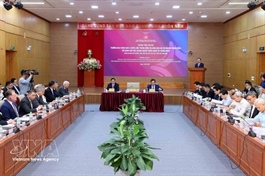
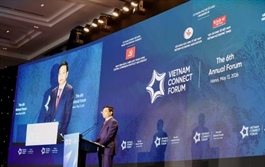
The stark contrast between more than one million active Vietnamese enterprises and only around 5,000 firms directly connected to global supply chains or multinational corporations became a key focus at the Vietnam Connect Forum 2026 held on the afternoon of May 13.
“The concern is not merely that too few Vietnamese companies are participating in global supply chains,” said Le Duy Binh, director of Economica Vietnam, during the forum.
According to Binh, among the 5,000 Vietnamese enterprises linked to multinational corporations, only around 300 serve as tier-1 or tier-2 suppliers, while just 100 are capable of directly supplying large global groups as tier-1 vendors.
He attributed the situation largely to internal weaknesses within domestic enterprises. Labour productivity in Vietnam remains only around half that of Thai firms and roughly one-quarter that of Malaysian companies. Meanwhile, 60-70 per cent of Vietnamese enterprises still use outdated technologies, while management capabilities often fall short of international standards.
“We cannot rely solely on the goodwill of foreign-invested enterprises or government support. Domestic companies themselves must improve their management capacity and technological capabilities,” Binh said.
For Do Thi Thuy Huong, vice chairwoman of VEIA, these figures were hardly surprising.“Domestic businesses have long been concerned about this issue. Linkages between local enterprises and foreign-invested enterprises (FIEs) are not a short-term matter, but a long-term development strategy for shared growth and prosperity,” Huong said.
However, she stressed that the issue could not be resolved by Vietnamese enterprises alone. In the electronics sector, multinational corporations are not merely seeking suppliers offering competitive prices, but partners capable of meeting stringent requirements relating to product quality, international-standard governance, delivery precision, data security, continuous improvement, and scalability.
“These are extremely demanding requirements for Vietnamese enterprises,” Huong said.
Most Vietnamese companies remain small- and medium-sized enterprises with limited resources for research and development, uneven governance quality, and insufficient levels of digital transformation and automation. While some firms can produce strong prototypes, maintaining consistent quality and stable long-term supply capacity remains a challenge.
Vietnamese enterprises also face difficulties in linking with one another within the domestic ecosystem.
“Many investors say that when they enter Vietnam, they need an integrated supply chain covering components, materials, and logistics. However, Vietnamese firms still lack the ability to form such coordinated supply chains together,” Huong said.
According to Dau Anh Tuan, deputy secretary-general of VCCI, the issue reflects not only individual business limitations but also the structure of the broader economy.
Recent VCCI surveys indicate that the proportion of small-scale FIEs in Vietnam has increased. Tuan explained that alongside major multinational corporations entering Vietnam, numerous smaller foreign satellite firms are also following, reducing opportunities for domestic private enterprises to join supply chains.
Against this backdrop, Vietnamese policymakers are increasingly redefining the country’s FDI strategy.
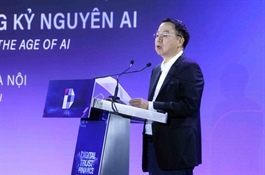
Speaking at the forum, Deputy Prime Minister Nguyen Van Thang stressed that next-generation FDI is no longer solely about manufacturing or market expansion.
“Next-generation FDI must work together with Vietnam to create new value, new capabilities, and a new position within global value chains,” he said.
According to the deputy prime minister, Vietnam’s previous advantages centred largely on low labour costs and investment incentives. Today, however, investors are placing greater emphasis on institutional quality, policy stability, strategic infrastructure, high-quality workers, green energy, data infrastructure, innovation capability, and the reliability of the investment environment.
For Vietnam, this represents both a challenge and a major opportunity to reposition itself within regional and global value chains while transitioning towards a growth model driven more strongly by sci-tech, innovation, digital transformation, green transition, and private-sector development.
Under Vietnam’s next-generation FDI planning, domestic enterprises are no longer viewed as separate from the foreign investment agenda, but instead as a critical indicator of investment quality.
Vietnam’s future FDI strategy will prioritise technology, innovation, added value, efficient land use, environmental protection, and linkages with domestic enterprises as key evaluation criteria for investment projects.
Alongside this, the government is encouraging policies to strengthen domestic enterprises and supporting industries to help Vietnamese firms participate more deeply in global value chains.
“The objective is not only to increase the number of enterprises joining supply chains, but more importantly to gradually develop Vietnamese companies capable of becoming tier-1 and tier-2 suppliers in regional and global value chains,” the DPM Thang said.
According to Bui Thu Thuy, deputy director-general of the Foreign Investment Agency, implementing the next-generation FDI strategy will require coordinated efforts from both the government and the business community.
She said FIEs need to become more open in sharing standards, governance requirements, and operational expectations to help Vietnamese companies integrate into value chains. At the same time, domestic enterprises must also strengthen their own capabilities and readiness.
According to Thuy, the implementation of Resolution No.68-NQ/TW on private-sector development is expected to support Vietnamese enterprises in improving their competitiveness, while the next-generation FDI strategy will introduce mechanisms encouraging closer cooperation between foreign-invested and domestic enterprises.
- 10:11 15/05/2026