New approach to resource management needed for sustainable growth: top leader
New approach to resource management needed for sustainable growth: top leader
Double-digit growth cannot simply be achieved by extending old growth models, said General Secretary and President Tô Lâm, adding that this target means high-quality development rather than growth at all costs.
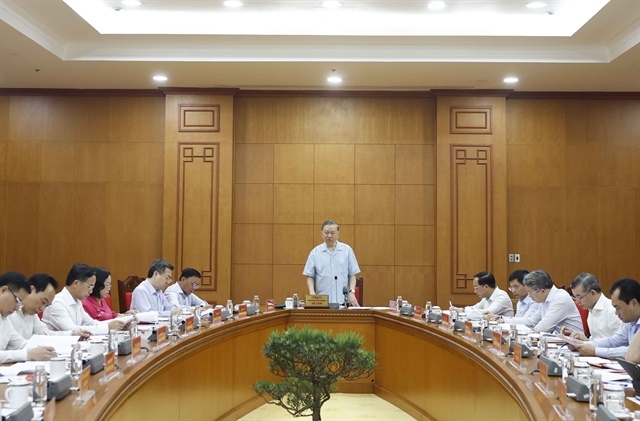
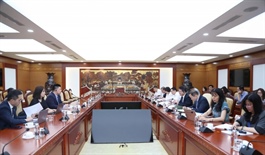
Party General Secretary and State President Tô Lâm chairs the working session with the Central Policy and Strategy Commission and relevant departments on Wednesday. — VNA/VNS Photo Thống Nhất |
Party General Secretary and State President Tô Lâm has called for a fundamental rethink of how Việt Nam manages and mobilises national resources to meet its growth ambitions, as he chaired a working session with the Central Policy and Strategy Commission and relevant departments on Wednesday.
At the session, representatives of the commission presented assessments of national development resources in line with the country’s double-digit growth target and emerging growth models.
The top leader noted that while continued credit expansion, increased foreign direct investment (FDI) and the use of land and low-cost labour remain necessary, these traditional drivers are no longer sufficient in the current context.
He warned that such an approach may deliver short-term gains but would make it difficult to achieve sustainable growth, improve productivity, strengthen self-reliance and avoid the middle-income trap.
Instead, he said resources should be created, enriched, connected and multiplied. The State, he added, should not only allocate resources but also build an enabling environment for growth, reduce initial risks and mobilise social, private, intellectual and cultural resources.
The leader noted that Việt Nam already has a critical foundation to move to a higher stage of development. To achieve the goals set out in the resolution of the 14th National Party Congress and the 2026–30 five-year socio-economic development plan, the top leader said, fundamental changes in resource management are required.
Double-digit growth cannot be achieved simply by extending old models, he said, stressing that the target must reflect high-quality development rather than growth at any cost. Stability must not be sacrificed for growth, quality must not be overlooked for speed, efficiency must not be ignored for scale and long-term outcomes must not be undermined for short-term gains.
He called for a comprehensive and accurate assessment of the country’s development resources, identifying both those that can be mobilised immediately and those that remain untapped.
Highlighting both strengths and shortcomings, he outlined the need to mobilise and use resources more effectively, particularly in areas including the economy and finance, land, public assets, infrastructure, human resources, science, technology and innovation, culture, national branding, social trust, institutions and governance.
He stressed that mechanisms for mobilising, allocating, leveraging and using resources must be treated as a priority.
In addition to addressing untapped resources, he said authorities must review, classify and resolve assets that have been slow to be put into use, ensuring that national resources are not left idle due to administrative procedures, disputes, risk aversion or weak coordination between agencies.
Resource allocation, he added, must shift away from fragmented and locally driven distribution towards a model based on efficiency, productivity, impact and measurable outcomes.
Public resources should lead private capital, public investment should stimulate social investment, FDI should support domestic enterprises, infrastructure should open new development space and science and technology must be translated into products, revenue, productivity, quality and competitiveness.
He also stressed the need to define the conditions required for resources to contribute to double-digit growth and to clarify a new growth model and its implementation mechanisms.
The new model, he said, must rely more heavily on productivity, science and technology, innovation, digital transformation and data, which should act as real drivers of growth rather than slogans.
It must also place greater emphasis on strong Vietnamese enterprises. The private sector was underscored as one of the country’s key growth drivers, while State-owned enterprises should focus on core sectors, strategic infrastructure and major investments.
Meanwhile, FDI should shift from quantity-based attraction to quality-oriented engagement, with greater emphasis on technology transfer and linkages with domestic firms.
On key tasks and solutions, he called for institutional reform to unlock resources, including more coherent regulations, streamlined administrative procedures and stronger post-inspection mechanisms, alongside transparent, consistent and forward-looking legal frameworks.
He also urged a nationwide inventory, digitalisation and release of trapped resources, with investment concentrated in growth poles, high-impact projects and priority sectors. Greater attention should be given to developing businesses, capital markets and mobilising resources from the public.
The Central Policy and Strategy Commission is tasked with finalising its report for submission to the Politburo, which may consider issuing an updated resolution on improving the management and use of economic resources.
- 16:15 20/05/2026