IPO wave forms among brokers as firms gear up for market upgrade
IPO wave forms among brokers as firms gear up for market upgrade
Deloitte has estimated the upgrade could attract up to US$6 billion in foreign inflows, bolstering liquidity, market depth and demand for IPOs in coming years.

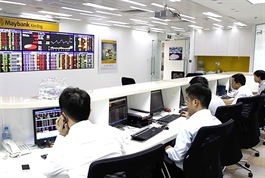
VPS Securities' traders work at its office. — Photo vps.com.vn |
A fresh wave of IPOs and capital raises among securities firms is underway as market participants position to capture opportunities from the country's recent market upgrade, though structural weaknesses in many brokerages' business models remain visible.
Việt Nam's stock market recorded two major IPO waves in the past, 2007-2009 and the explosive 2017-2018 cycle, both of which contributed to expand market scale and improve product quality, paving the way for deeper foreign participation.
Today's backdrop presents similar, and in some respects, more favourable conditions: regulators are pushing comprehensive reforms in trading, clearing and disclosure, and FTSE Russell approved Việt Nam's reclassification to a secondary emerging market in October 2025. Deloitte has estimated the upgrade could attract up to US$6 billion in foreign inflows, bolstering liquidity, market depth and demand for IPOs in coming years.
Despite that positive macro narrative, deals completed at the end of 2025 underperformed expectations.
Still, many securities houses pressed on with IPO plans, listing moves and aggressive capital increases to be ready for the next cycle.
The common thread running across recent transactions is a heavy reliance on proprietary trading and financial activities rather than retail brokerage franchises.
Bao Minh Securities Company (BMS) offers a clear illustration. After a private placement of 125 million shares to 11 investors, BMS raised its charter capital from VNĐ789.3 billion (US$30 million) to more than VNĐ2 trillion and approved a move from UPCoM to the Hochiminh Stock Exchange (HoSE).
The new investors now hold 61.86 per cent of equity, including parties linked to the Hoan Cau Group ecosystem.
Yet BMS's revenue mix underlines the company's dependence on trading income: in 2025 brokerage revenue was VNĐ15.5 billion, just 2.9 per cent of total revenue, while gains from financial assets measured at fair value through profit or loss (FVTPL) amounted to VNĐ470.6 billion, or 89 per cent of profit.
On the balance sheet at year‑end 2025, FVTPL assets totalled more than VNĐ1.1 trillion (43.7 per cent of total assets) and held‑to‑maturity long‑term investments stood at VNĐ1 trillion (39.8 per cent), underscoring a model centred on investment activities rather than client services.
Kafi Securities presents a similar case. After boosting charter capital to VNĐ7.5 trillion in 2025 and announcing plans to list on UPCoM, Kafi reported brokerage revenue of VNĐ158.9 billion (5.6 per cent of total revenue) for 2025.
The bulk of its earnings stemmed from FVTPL gains of nearly VNĐ1.8 trillion (62.5 per cent of revenue) and lending and receivables income of VNĐ775.9 billion (27.3 per cent), indicating that proprietary trading and financing dominate its business.
Kafi's year‑end asset mix: nearly VNĐ11 trillion in loans (41.7 per cent of total assets), VNĐ8.1 trillion in FVTPL assets (31 per cent), and VNĐ5 trillion in financial assets available for sale (19.5 per cent), further reflects this orientation.
The pattern repeats among several firms preparing market debuts: limited brand recognition and modest brokerage market share, coupled with business models heavily exposed to market swings.
While such a model can deliver elevated profits in bullish conditions, it also concentrates risk during market corrections.

VPS Securities' traders work at its office. — Photo vps.com.vn |
Capital raising
In contrast, other securities houses are pursuing IPOs and capital raises with clearer strategic intent and larger balance‑sheet expansion.
LPBank Securities plans an offering of 141,868,000 shares, about 11.2 per cent of its outstanding shares, at VNĐ30,000 per share between the first and third quarters of 2026, subject to State Securities Commission approval, followed by a planned HoSE listing.
LPBank Securities has already completed a rapid capitalisation: in October 2025, it issued 878 million shares, lifting charter capital from nearly VNĐ4 trillion to VNĐ12.7 trillion, making it one of the fastest capital‑growing players in the sector.
As of 31 December 2025, the company reported total assets of VNĐ29.9 trillion, a 490.8 per cent increase year‑on‑year, with FVTPL assets of VNĐ11.3 trillion (38.03 per cent), loans of VNĐ10.5 trillion (35.2 per cent) and held‑to‑maturity investments of over VNĐ6.2 trillion (21.03 per cent).
HD Securities, part of the HDBank ecosystem, is also actively preparing an IPO for 2026.
Bank leadership stated during an investor conference that HD Securities aims for profit above VNĐ4 trillion and charter capital exceeding VNĐ10 trillion, positioning itself as a core component of the banking group's financial ecosystem.
By year‑end 2025, HD Securities' total assets reached VNĐ6.1 trillion, with FVTPL assets of VNĐ2.2 trillion (36.5 per cent), loans of VNĐ1.8 trillion (28.8 per cent) and cash of VNĐ1 trillion (17 per cent).
Like many peers, its revenue mix remains concentrated in proprietary trading, lending and financing services, while brokerage contributes a smaller share.
A key comparative advantage for LPBank Securities and HD Securities is their integration within banking ecosystems, offering ready customer bases, funding access and cross‑selling potential that could help them scale up brokerage operations post‑listing more rapidly than stand‑alone brokers.
Market experience has highlighted the timing and market‑cycle sensitivity of such transactions. IPOs executed in the October 2025 upswing, including Techcom Securities (TCX), VPBank Securities (VPX) and VPS Securities (VCK), failed to meet price expectations when they listed in late December 2025 amid cooling market conditions, forcing extended consolidation periods.
That episode underscores the importance of timing and valuation for IPO success.
The emerging IPO wave among securities firms is thus being shaped by multiple drivers: expectations around market reclassification, potential foreign capital inflows and the need for larger capital bases to expand business.
Yet many candidate issuers still face substantive structural challenges, small brokerage market share, limited brand visibility and business models skewed to proprietary activities, which could affect investor appetite in a market where investors are increasingly selective.
- 11:06 06/04/2026