Durian trade stalls in Mekong Delta as inspection bottlenecks tighten
Durian trade stalls in Mekong Delta as inspection bottlenecks tighten
The fruit has become a major export earner, generating over US$1.5 billion in the first quarter of this year.
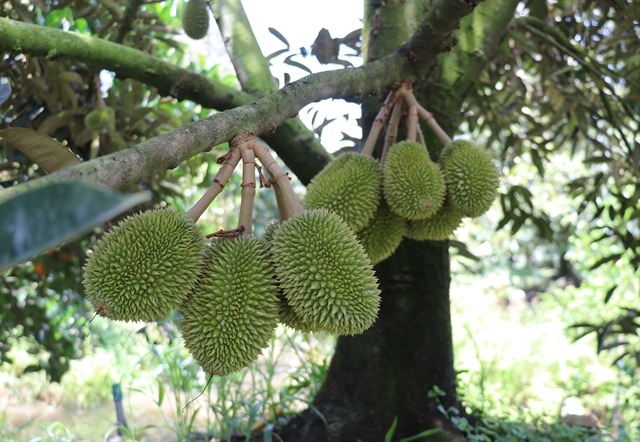
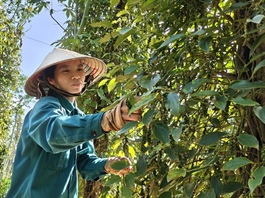
Durian growing in Đồng Tháp Province. — VNA/VNS Photo |
Limited inspection capacity, rather than market forces, is constraining the durian trade in the Cửu Long (Mekong) Delta region, disrupting procurement and driving sharp price swings as exporters struggle to secure approvals.
When export permits are delayed or denied, activity across the supply chain – from traders to exporters – slows, leaving prices highly sensitive to testing constraints, industry officials said.
The Mekong Delta is Việt Nam’s main durian-growing region, with rapidly expanding acreage. In Đồng Tháp Province alone, cultivated area exceeds 32,100ha, producing more than 557,000 tonnes annually, according to local authorities.
Nationwide, durian plantations now cover more than 200,000ha, yielding about two million tonnes a year. The fruit has become a major export earner, generating over US$1.5 billion in the first quarter of this year.
However, testing capacity has failed to keep pace with production growth, creating a critical bottleneck, particularly as China tightens import controls.
According to Trần Thanh Tâm, director of Đồng Tháp’s sub-department of crop production and plant protection, only 13 laboratories nationwide are approved by China to test for cadmium and Auramine O (Basic Yellow 2) residues.
In Đồng Tháp, four facilities had completed applications but were still awaiting accreditation, Tâm told saigontimes.vn.
Testing risks are also high, according to Tâm. If shipments pass domestic certification but fail re-inspection in China, exporters could lose their packaging codes, while laboratories could also face penalties.
In Đồng Tháp, 80 out of 111 durian packing facilities have temporarily halted operations due to issues related to cadmium and Auramine O residue levels.
Shipments found to contain Auramine O would be immediately recalled, while those exceeding cadmium thresholds might face recall after repeated warnings, Tâm said.
The risks have made testing laboratories more cautious, further tightening capacity and amplifying market volatility.
Tô Mộng Hồng, director of the Hà Nội-based Khai Hoan Trading Development Co., said prices could swing sharply on testing-related news.
She cited an incident on April 12, when the price of RI6 durian dropped by nearly 20 per cent, from VNĐ82,000 to VNĐ65,000 per kilogramme, on reports that a laboratory was unable to conduct tests.
The volatility caused businesses to incur losses of hundreds of millions of đồng in a single day, she told saigontimes.vn.
Hồng added that limited testing capacity also forced exporters to wait between two and seven days for test scheduling before purchasing fruit, slowing transactions.
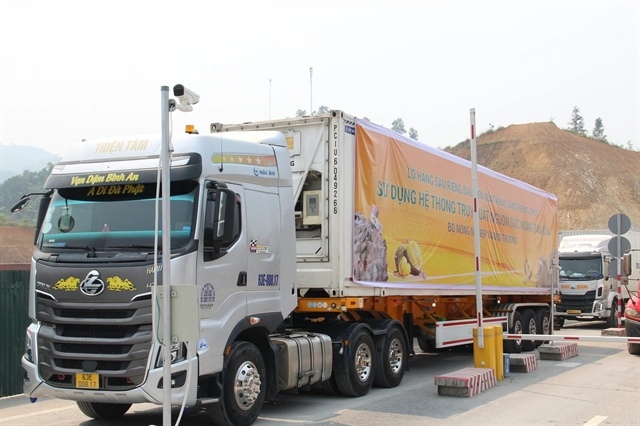
Chairman of the Đồng Tháp Province Durian Association Võ Tấn Lợi said testing bottlenecks had at times left hundreds of containers stranded and unable to clear for export.
At the cooperative level, delays could stretch even longer. Trần Hữu Toàn, director of the Ngu Hiep Durian Cooperative, said shipments sometimes waited up to 15 days, reducing quality and increasing the risk of rejection.
Removing testing bottlenecks
Durian growing in Đồng Tháp Province. — VNA/VNS Photo |
Industry players are calling for urgent measures to ease testing constraints and restructure the supply chain.
Hồng said exporters and testing laboratories were both under pressure from the risk of licence revocation.
If laboratories remain cautious and limit operations, exporters will be unable to purchase fruit, leaving farmers without buyers, according to the company director.
It takes businesses six to 12 months to restore packaging codes if revoked due to violations.
"But if firms don’t proceed, no one will buy from farmers," she said, urging closer coordination.
Trần Minh Châu, deputy director of the technical department at Vinacontrol Hochiminh City, said his firm would adopt more flexible sampling procedures to support businesses.
However, he added that a longer-term solution required shifting from end-product inspection to full supply chain control.
A traceability programme led by the Ministry of Agriculture and Environment aims to monitor the entire production process, from soil and water conditions to cultivation and harvesting.
Under this system, compliant shipments can be cleared through a 'green channel' by China, enabling faster customs procedures.
Châu said two containers of durian were exported under the pilot scheme on April 10.
Industry representatives also called for tighter management of cultivation areas. Chairman Lợi of Đồng Tháp Province Durian Association said newly established orchards should be prioritised, as they carry a lower risk of cadmium contamination than long-established farms, alongside improved technical training and stricter adherence to cultivation protocols.
Another key issue is supply chain integration. Traders, who account for more than half of supply, remain largely outside formal management systems.
Industry participants said authorities should consider introducing professional certification requirements to improve quality control.
At the cooperative level, producers are seeking clearer technical guidance.
Toàn said farmers lacked concrete instructions on how to handle cadmium contamination.
He said farmers were asking what to do about cadmium contamination, but there had been no clear answer.
- 11:11 20/04/2026