Capital is reshaping Vietnam’s real estate sector
Capital is reshaping Vietnam’s real estate sector
Rather than collapsing, Vietnam’s property market is undergoing a quiet but profound shift in which access to capital, not demand, is determining who survives. Jerry Nguyen, a board member and deputy general director of Investment and International Market Development at Hoa Binh Group, delves into the situation.

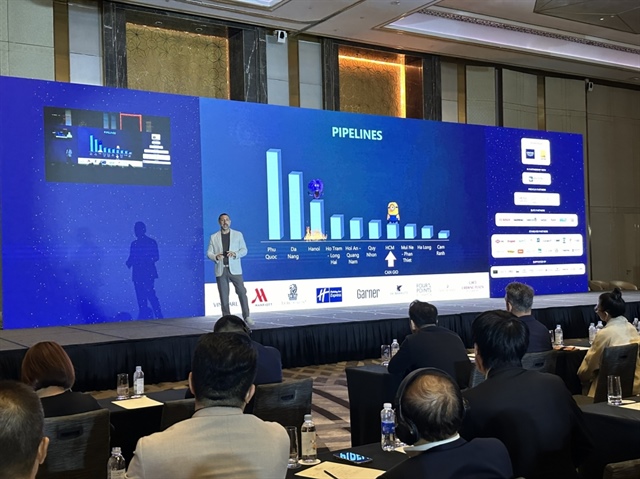
Jerry Nguyen, a board member and deputy general director of Investment and International Market Development at Hoa Binh Group |
Vietnam’s real estate market is often described as frozen or awaiting recovery. Yet, a closer look suggests a different reality: transactions continue, genuine housing demand persists, and capital is still circulating. What has changed is not the market itself, but how capital chooses its participants.
Rather than exiting, capital is being selectively reallocated to a small group of developers with strong balance sheets and the ability to deliver products aligned with real demand.
The current phase should not be seen as a typical downturn, but as a structural reset. Instead of eliminating companies through abrupt shocks, the market is quietly filtering them out by restricting access to funding. Increasingly, the issue is not a lack of demand but a shortage of companies capable of surviving under tighter financial conditions.
In previous cycles, the sector operated on a familiar logic: cheap capital fuelled expansion, expansion generated liquidity, and liquidity attracted even more capital. This feedback loop allowed many developers to grow rapidly, often beyond their intrinsic capabilities.
That model has now broken down. Capital is no longer a growth engine; it has become a screening mechanism. Investors and lenders are no longer asking whether a project can sell, but whether a company can withstand delayed cash flows and still remain solvent.
As a result, many developers are not immediately forced out of the market, but are gradually excluded from capital access. Once financing tightens, liquidity weakens, placing sustained pressure on their entire operating model.
The market is thus entering a new phase: a capital selection cycle. In this cycle, capital does not necessarily flow to the largest or most visible players, but to those perceived as carrying the lowest risk. This explains a growing divergence within the market, where some developers continue to maintain sales and project execution, while others effectively fade from activity.
This divergence is driven less by demand than by capital confidence. In reality, capital has not left the market; it is being concentrated into a limited number of developers with credible execution, sound financials, and products that meet real housing needs. These may not be the largest firms, but they are seen as the safest.
When scale becomes a liability
One of the clearest shifts in this cycle is the changing perception of land banks. Previously regarded as a core competitive advantage, large land holdings are no longer inherently positive.
Land banks that are misaligned with real demand, lack supporting infrastructure, or require excessive development capital are increasingly viewed as capital traps. The larger such holdings, the more they constrain financial flexibility. The challenge today is not a shortage of assets, but a shortage of assets capable of generating cash flow.
Similarly, another long-standing assumption has been dismantled: liquidity cannot be manufactured through marketing alone. Buyers are no longer driven by expectations of price appreciation, but by affordability, income stability, and product suitability. Poorly designed products struggle regardless of marketing spend, while well-positioned ones can still achieve steady absorption even in difficult conditions.
Liquidity, therefore, is no longer a function of sales effort, but of product–market fit established from the outset.
At the same time, financial leverage is being fundamentally redefined. Once a tool for rapid expansion, leverage has become the most vulnerable point in many developers’ capital structures. Companies that relied heavily on refinancing, expanded aggressively, and lack stable cash flow are now under mounting pressure. When access to new borrowing is cut off, their growth model begins to contract.
More broadly, the sector is shifting from a project-driven model to one centred on corporate operating capability. Companies are no longer evaluated by the number of projects or the size of their land banks, but by their ability to generate and sustain cash flow across the entire system.
In this new paradigm, a real estate company must function as a capital platform, where decisions revolve around efficient capital allocation, product strategy aligned with real demand, and disciplined risk management. These factors are increasingly reflected in measurable indicators such as capital turnover, leverage, absorption rates, and execution consistency.
Within this structural filtering process, three groups of developers are most at risk over the next 24-36 months: Those with high leverage but no sustainable cash flow; Those holding land banks misaligned with real demand; Those dependent on marketing-driven sales models.
What they share is not size or brand, but incompatibility with how capital is allocated in the new cycle. In many cases, the weakness lies not in the market, but in business models that were never truly sustainable.
This cycle does not create vulnerabilities; it exposes them. Ultimately, this is not a temporary slowdown, but a prolonged test of survival. The market no longer rewards rapid expansion, but resilience and the ability to maintain cash flow under pressure. The key question is no longer how fast a company can grow, but whether it can survive without continuous access to new capital.
In a market where capital may be concentrated in the hands of a few for years to come, the defining question for every developer is increasingly stark: are they still being chosen by capital, or have they already been quietly excluded?
- 08:00 08/04/2026