Vĩnh Long strengthens collective economy
Vĩnh Long strengthens collective economy
The Cửu Long (Mekong) Delta province plans to expand co-operatives and co-operative groups to support agricultural restructuring, new-style rural development and the expansion of domestic and export markets for farm produce.
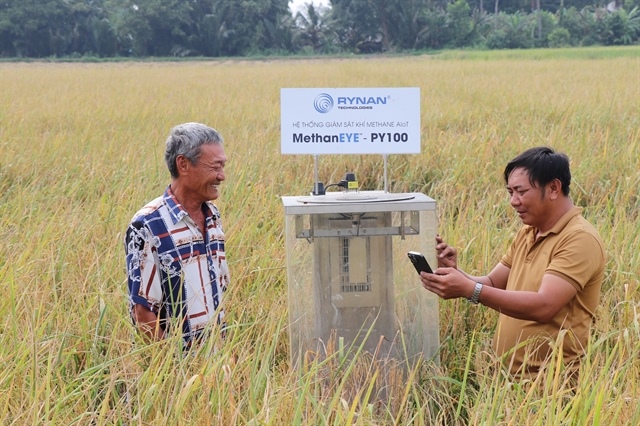
The Phước Hảo Agricultural Co-operative’s high-quality, low-emission rice field in Vĩnh Long Province’s Hưng Mỹ Commune is equipped with a methane monitoring system. — VNA/VNS Photo |
Vĩnh Long Province is stepping up development of its collective economy, identifying co-operatives as a key driver of agricultural restructuring, rural development and market expansion.
The Cửu Long (Mekong) Delta province plans to expand co-operatives and co-operative groups to support agricultural restructuring, new-style rural development and the expansion of domestic and export markets for farm produce.
Thái Phước Lộc, chairman of its Co-operative Alliance, promised to step up communications this year to raise awareness of the collective economy’s role.
It will also implement support policies for the 2026–30 period, prioritising access to capital, workforce training, technology application, and market linkages.
The province aims to establish 80 co-operative groups and 30 new co-operatives this year across various sectors, with priority given to agriculture, services, tourism, craft villages, and rural industry.
In 2026–30 the alliance plans to establish 500 new co-operative groups, 150 co-operatives and five co-operative unions.
It also aims to ensure all co-operative managers receive professional training.
Underperforming co-operatives will be reorganised to improve efficiency.
Last year the province set up 35 new co-operatives and 80 co-operative groups, taking the total to 640 and 3,250, with more than 88,200 members.
It also has five co-operative unions with 36 members.
The province’s collective economy has expanded in both scale and performance.
More than 65 per cent of co-operatives operate effectively. They generate average annual revenue of about VNĐ3.2 billion (US$123,000), while workers earn around VNĐ60 million ($2,300) a year.
Many have built value chains, adopted high technology and joined the country’s “One Commune – One Product” (OCOP) programme.
The province now has 1,083 OCOP products made by 625 entities, including 105 co-operatives and 14 co-operative groups.
“In recent years the Co-operative Alliance has introduced and replicated effective production and business models,” Lộc said.
“This shows that developing the collective economy is a sustainable direction. It helps farmers raise incomes and promotes modern, efficient and integrated agriculture in the province.”
Many co-operatives have become strong support for farmers.
Established nearly 10 years ago, the Rạch Lọp Agricultural Co-operative in Hùng Hòa Commune now has 519 members growing more than 350ha of rice and 119ha of coconut.
Huỳnh Đăng Khoa, its chairman, said the co-operative earned more than VNĐ500 million ($19,200) in annual profits thanks to lower input costs and higher output value.
Co-operatives in the province are also increasing their use of high technology and digital tools.
The Bình Hòa Phước Rambutan Co-operative in An Bình Commune has adopted electronic record-keeping, secured growing area codes and traded on e-commerce platforms, expanding markets and strengthening its brand.
“Applying high technology reduces costs and improves product quality while making production more environmentally friendly,” Nguyễn Ngọc Nhân, its director, said.
He added that members are paying greater attention to brand building and product reputation.
The Phước Hảo Agricultural Co-operative’s high-quality, low-emission rice field in Vĩnh Long Province’s Hưng Mỹ Commune is equipped with a methane monitoring system. — VNA/VNS Photo |
Support
The province is supporting 15 agricultural co-operatives in building pilot models under the Government’s Resolution 106, passed in July 2023, on developing agricultural co-operatives in line with restructuring and new-style rural development.
They are encouraged to apply technology, promote innovation and carry out digital transformation in production, processing and sales, while prioritising green growth, the circular economy and climate adaptation.
They have received more than VNĐ21.3 billion ($815,000) from the Government and other sources for building pilot models under Resolution 106.
They grow crops, raise livestock and aquatic creatures and provide agricultural services, and have more than 4,100 members.
Most agricultural co-operatives in the province produce key products such as coconut, rice, vegetables, green-skin and pink-flesh grapefruit, durian, King orange, seedless lemon, honeydew melon, cattle and clams.
Many produce to VietGAP and GlobalGAP standards and use organic methods.
They are also applying technology, developing growing area codes, ensuring traceability, and expanding OCOP products.
For example, the Tân Phú Agricultural Service Co-operative in Phú Phụng Commune grows durian to VietGAP standards and has linked with businesses to secure stable outlets.
It has more than 300 members who have 320ha under cultivation.
Nguyễn Thị Diễm, a member, said she had grown durian for decades but earned only enough to cover living costs. After joining the co-operative, attending extension courses and learning orchard management techniques, she began growing durian to VietGAP standards.
To secure higher prices, she and other members produce off-season durian from September to February.
During this period the Ri6 variety of the fruit sells for VNĐ90,000-130,000 ($3.5–5) per kilogramme.
With an average yield of 20 tonnes per hectare per year, each hectare could generate billions of đồng in revenue, higher than many other crops, Diễm said.
- 09:40 11/03/2026