Resilient Vietnam economy faces Middle East headwinds
Resilient Vietnam economy faces Middle East headwinds
Despite escalating tensions in the Middle East, Vietnam's economy remains resilient with strong growth prospects, according to Nguyen Dieu Huyen, deputy head of the National Accounts System Department at the National Statistics Office.
|

How exposed is Vietnam's economy to the Middle East conflict, and what buffers exist to sustain growth?
As Vietnam is deeply integrated into the global economy, any global impact – whether negative or positive – will affect our economy to some degree.
The Middle East serves as both the global economy's oil hub and one of its most critical maritime arteries, with the Strait of Hormuz currently under blockade. The hostilities involving Iran, the US, and Israel will therefore affect Vietnam's production, business operations, investment activities, and international tourism.
The National Statistics Office will conduct assessments of the conflict’s impact on the country’s economy and propose recommendations and response measures to relevant competent authorities.
The world has never been free from instability, and Vietnam has always sought ways to adapt and grow. The country’s economic growth continues to be supported by traditional drivers – investment, production and exports, and domestic consumption – which remain decisive factors.
New growth drivers – including science and technology, innovation, the digital economy, and institutional reform – began demonstrating their effectiveness in 2025, laying the foundation for medium- and long-term growth.
Investment is expected to serve as the economy's primary growth driver in 2026, with public investment taking the lead through the largest planned capital allocation on record: more than one quadrillion VND, equivalent to over $40 billion. In the first two months of the year, state budget investment grew 11.5 per cent, reaching 9.4 per cent of the full-year plan – a rare pace for this early stage.
Full disbursement of the $40 billion in planned capital in 2026 is considered essential to achieving double-digit GDP growth,
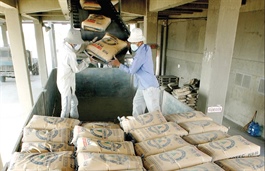
Accelerating disbursement of major infrastructure projects this year will boost construction, directly increase asset accumulation, and generate spillover effects for material production industries and related services.
Will Vietnam's export momentum be affected if Iran blocks the Strait of Hormuz, disrupting international maritime transport in the region?
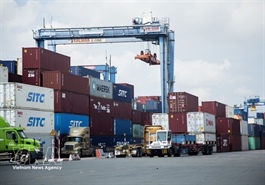
Vietnam's total import-export value reached $155.7 billion in the first two months of the year, a record for the period and an increase of $28.3 billion on-year. Exports rose 18.3 per cent, while imports climbed 26.3 per cent.
With double-digit import-export growth sustained over many years, Vietnam has entered the top 15 global trading powers by total trade volume – a major step affirming its position as a key manufacturing and trade hub in the Asia-Pacific.
Vietnam's six largest trading partners – the US, China, Japan, South Korea, ASEAN, and the European Union – account for 80-85 per cent of total trade value. China remains the largest import market, with nearly $32 billion in imports during the first two months, up 36.5 per cent on-year. The US is the largest export market, with $23.8 billion, up 22 per cent.
Even if the Strait of Hormuz is blocked, Vietnam's trade with China, ASEAN, South Korea, and Japan will not be directly affected. Trade with the US and the European Union also does not pass through the strait. However, Vietnam will still face indirect impacts from the Middle East conflict, as prices of raw materials – particularly fuel and fertilisers – and global maritime freight rates are likely to rise.
With the government pursuing double-digit growth this year, external shocks have emerged from the outset. What gives you confidence the country can overcome these immediate challenges?
Around this time last year, US President Donald Trump announced reciprocal tariffs on goods imported into the United States, creating global shockwaves. Many analysts at the time issued pessimistic forecasts regarding trade, investment, and import-export activities.
Looking back over the past year, however, private investment and foreign direct investment inflows into Vietnam have continued to increase. Manufacturing and exports have remained solid growth pillars, reaffirming the resilience and adaptability of Vietnam's economy, even as global recovery remains slow, protectionist policies intensify, and tariff barriers become more stringent.
The Industrial Production Index rose 10.4 per cent in the first two months of 2026, compared to 7.5 per cent in the same period of 2025, continuing to demonstrate this adaptability. The processing and manufacturing sector expanded by 11.5 per cent, up from 9.1 per cent growth a year earlier, reflecting the recovery of production and domestic supply capacity despite external uncertainties.
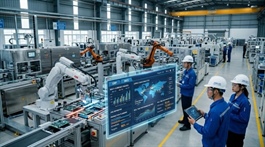
For 2026, the government has identified a fundamental shift in the growth model towards productivity and innovation. Enhancing productivity, improving workforce quality, and placing science, technology, and innovation at the centre of development strategy are key priorities.
The economy is also being restructured towards green, digital, and circular models while accelerating industrialisation and modernisation. Sci-tech, innovation, and digital transformation are positioned as main drivers to improve productivity, quality, efficiency, competitiveness, and economic resilience – a core government task that extends across the entire current term.
Institutional reform serves as another growth driver, helping improve the investment and business environment, reduce compliance costs, and strengthen confidence among enterprises and investors. However, the effectiveness of such reform often comes with a time lag. Its positive impacts in 2025 played a primarily supportive role, helping create room for stronger growth in 2026 and the years ahead.
- 12:16 10/03/2026