Việt Nam aims to promote derivatives market with a dedicated law
Việt Nam aims to promote derivatives market with a dedicated law
The Ministry of Industry and Trade is seeking public feedback on a proposed Law on Commodity Derivatives Trading to close regulatory gaps and establish a comprehensive legal framework for the country’s fast-growing derivatives market.
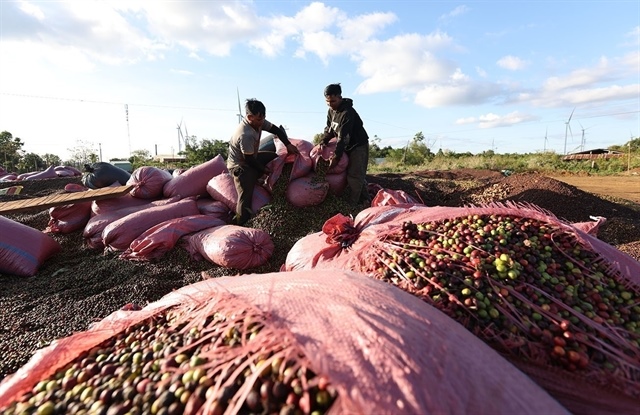
Coffee harvested in Gia Lai Province. Derivatives markets have recently emerged in Việt Nam, allowing trading in commodities like agricultural products, metals and energy. — VNA/VNS Photo Vũ Sinh |
The law would replace fragmented regulations currently scattered in the 2025 Commercial Law and related decrees with a specialised and modern legal framework aimed at ensuring transparency, fairness and safety in derivatives trading, while strengthening investor protection and limiting systemic risks.
It would also provide an important legal foundation for developing commodity derivatives into an effective price risk management tool for firms and the wider economy, promoting development of major commodities, supporting industrialisation and global integration, the ministry said.
The ministry added that the law would prioritise derivatives based on agricultural commodities, one of Việt Nam’s key export sectors, to help guide production, improve quality and create more transparent and stable distribution channels. It would also allow a gradual expansion into new products such as energy, metals, carbon credits and digital asset-linked commodities.
According to the draft, commodity derivatives are financial instruments whose value is linked to underlying commodities and can include futures, options, swaps and contracts for difference.
Closing regulatory gaps
Derivatives markets have recently emerged in Việt Nam, allowing trading in commodities like agricultural products, metals and energy.
However, officials say existing regulations are general and do not fully address the complexity of derivatives trading, including margin requirements, clearing mechanisms and systemic risk management.
The current legal framework lacks clear definitions of commodity derivatives, comprehensive risk controls, investor protection provisions and rules governing cross-border trading, the ministry said, adding that it does not provide adequate legal grounds for emerging products such as carbon credits, green finance instruments or digital asset-linked commodities.
Maintaining derivatives provisions within the 2025 Commercial Law would make it difficult to establish a specialised and consistent regulatory system aligned with international standards and compatible with newer laws governing securities, credit institutions and anti-money laundering, the ministry said.

Coffee harvested in Gia Lai Province. Derivatives markets have recently emerged in Việt Nam, allowing trading in commodities like agricultural products, metals and energy. — VNA/VNS Photo Vũ Sinh |
Việt Nam currently has only one licensed commodity exchange, the Mercantile Exchange of Việt Nam, whose scale and services remain limited. The lack of a comprehensive legal framework has constrained market expansion and reduced its attractiveness to international investors, according to the ministry.
With the new law, the Government aims to promote the development of a transparent, modern and internationally integrated commodity derivatives market.
It would also encourage products linked to Việt Nam’s key export commodities, particularly agricultural goods, to help businesses manage price volatility and stabilise production.
The draft includes policies to strengthen regulatory oversight, develop information technology infrastructure and train specialised personnel, as well as facilitating connections with international markets to attract both local and foreign investors.
Aligning with global practices
The ministry said many major economies, including China and the US, have adopted dedicated legislation governing derivatives trading to improve risk management, transparency and investor protection.
In China, the Futures and Derivatives Law, which took effect in 2022, establishes comprehensive rules covering exchange-traded and over-the-counter derivatives, including margin, clearing and risk management requirements.
Meanwhile, the US' Commodity Exchange Act provides the legal foundation for derivatives trading under the supervision of the Commodity Futures Trading Commission.
In Southeast Asia, countries like Singapore and Malaysia have adopted integrated regulatory models combining commodity and capital markets oversight, with clear licensing, reporting and supervisory requirements.
International practices highlight the need for Việt Nam to establish a specialised legal framework aligned with global standards and capable of supporting cross-border regulatory cooperation and market development, the ministry stressed.
- 08:05 02/03/2026