Stocks post mixed performance amid rising oil prices
Stocks post mixed performance amid rising oil prices
The airline sector appears particularly vulnerable, as higher oil prices inflate fuel costs and travel demand tends to weaken amid geopolitical instability.

Investors watch stock performances on a digital board at a securities firm. — Photo vietnamplus.vn |
As geopolitical tensions escalate in the Middle East, global energy supply chains are facing disruptions, prompting a flight of capital towards safer assets in financial markets and affecting the Vietnamese stock market.
Domestic stocks are experiencing mixed performances across various sectors, with investor sentiment heavily influenced by the volatility of oil prices.
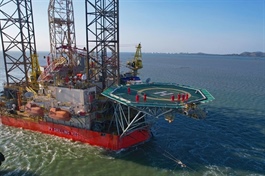
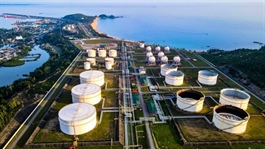
A report by Mirae Asset Securities Vietnam notes that conflicts in the Middle East typically lead to increased oil prices, due to concerns about potential disruptions in supply from major producers and risks associated with the Strait of Hormuz, a critical shipping route that handles approximately 20 per cent of the world's oil supply.
This scenario generally supports oil and gas stocks, while rising shipping costs might benefit select transportation companies. However, investors are wary of sectors that could suffer adverse effects if geopolitical unrest persists.
The airline sector appears particularly vulnerable, as higher oil prices inflate fuel costs and travel demand tends to weaken amid geopolitical instability. Firms like Vietnam Airlines (HVN) and VietJet Air (VJC), for which fuel represents a large portion of operating expenses, may face significant challenges.
Meanwhile the transportation and logistics sector faces a medium to high level of impact, as companies will likely deal with increased fuel costs, insurance premiums and supply chain disruptions. Key players such as VTP, HAH, GMD, SKG and VNS could see their profitability affected.
In the steel industry, the impact is deemed moderate. Mirae Asset's analysis suggests companies like Hoa Phat Group (HPG), Hoa Sen Group (HSG) and Nam Kim Steel (NKG) may face indirect pressures from rising energy, transportation and raw material costs.
Similarly, the cement and building materials sectors, including firms like Vicem Ha Tien Cement (HT1), Bim Son Cement (BCC) and Petrolimex Petrochemical Corporation (PLC), are likely to experience higher input costs stemming from increased fuel and transport expenses.
According to Mirae Asset analysts, the plastics sector will experience an average impact due to the direct link of various raw materials to petroleum products.
Companies like Binh Minh Plastics (BMP), Tien Phong Plastic (NTP) and An Phat Bioplastics (AAA) may feel pressure if oil prices remain elevated for an extended period.
In the retail and tourism spaces, non-essential retailers like Mobile World Investment Corporation (MWG), Digiworld (DGW) and FPT Digital Retail (FRT) could be affected if consumers tighten their spending in response to rising energy prices.
According to VPBank Securities market strategy director Trần Hoàng Sơn, historical data tends to show temporary market declines following geopolitical shocks due to concerns over rising oil prices, inflationary pressures and geopolitical risks.
Nonetheless, markets typically recover quickly if conflicts do not escalate globally. The Vietnamese market's reactions are predominantly short term, unless significant indirect impacts arise through oil prices or global economic growth.
Dr Nguyễn Duy Phương, investment and strategy director at DG Capital, said that domestic interest rate pressures might be localised at first and trend downward as the year progresses.
However, if the Middle East conflicts drag on, both oil prices and input costs could surge, leading to increased inflation.
"When inflation returns and high interest rates like those seen in 2022 recur, the stock market may become less attractive," Phương cautioned.
According to VinaCapital, a prolonged conflict in the Middle East could drive up oil and gold prices and heighten shipping costs, applying upward pressure on interest rates in Việt Nam through inflationary channels, resulting in pronounced sectoral divergence in the market.
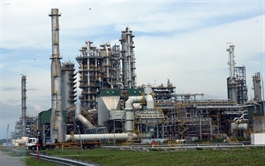
Oil refining companies with solid crack spreads may benefit, whereas the airline and tourism sectors could face mounting fuel cost pressures. Additionally, if rising interest rates prompt inflation, interest-sensitive sectors, particularly real estate, could be negatively impacted.
In its March strategy report, SSI Securities stated that the early months of 2026 reflect uneven growth dynamics in Việt Nam's economy. However, investment remains a crucial support factor, buoyed by positive trends in public investment expenditure and foreign direct investment.
Inflationary pressure is expected to rise in the short term due to oil price fluctuations, yet the average Consumer Price Index for the year is anticipated to remain within the Government's target range of 4-4.5 per cent.
Looking ahead, the market may receive support as valuations become more attractive following this adjustment, with the outlook for earnings seeing improvement in several sectors for the first quarter and many companies forecasting profit growth of 20-30 per cent for 2026. The ongoing potential for market upgrading remains a significant mid-term catalyst.
However, the market is still confronted with short-term risks, including liquidity pressures and the narrowing gap between equity market returns and prevailing interest rates.
- 09:38 17/03/2026