Crude rally, land conversions drive momentum in rubber stocks
Crude rally, land conversions drive momentum in rubber stocks
Since early March, the rubber sector has shown positive momentum, with a string of rallies in names such as Phuoc Hoa Rubber JSC (PHR), Tan Bien Rubber JSC (RTB), Vietnam Rubber Group (GVR), Doruco (DPR) and Casumina (CSM).
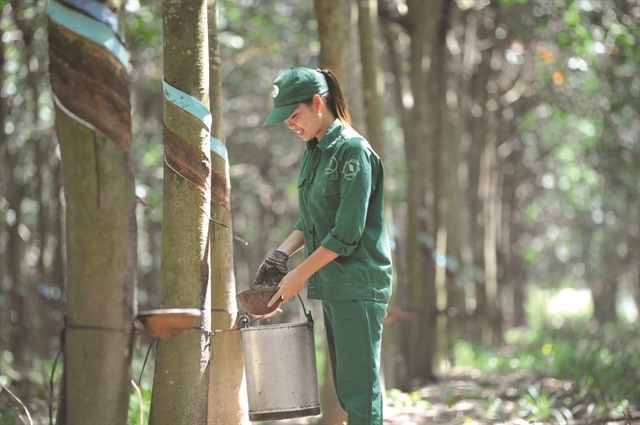
A Vietnam Rubber Group worker collects rubber latex at a plantation. — Photo vrg.vn |
Rubber stocks in Việt Nam have received a dual boost as rising oil prices and land use conversion toward industrial zones combine to support sector fundamentals and corporate earnings prospects, according to industry insiders.
Since early March, the rubber sector has shown positive momentum, with a string of rallies in names like Phuoc Hoa Rubber JSC (PHR), Tan Bien Rubber JSC (RTB), Vietnam Rubber Group (GVR), Doruco (DPR) and Casumina (CSM).
Horuco (HRC) notably recorded 15 consecutive sessions at the ceiling price before a subsequent correction.
Market observers highlight two main forces underpinning the move: a tighter natural rubber supply globally and higher prices for crude oil, which feeds into the cost of synthetic rubber.
Research from KB Securities Vietnam (KBSV) points to three supporting factors for natural rubber prices this year.
First, global natural rubber production is forecast to remain in deficit this year. The Association of Natural Rubber Producing Countries estimates 2026 output at about 15.3 million tonnes, up 2.2 per cent year‑on‑year, but still below forecast demand of roughly 15.6 million tonnes, with output in Thailand and Indonesia expected to continue declining.
Renewed geopolitical tensions in the Middle East have also pushed crude oil prices higher, increasing production costs for synthetic rubber and indirectly lifting natural rubber prices. Chinese natural rubber prices have approached 2025 peaks and are expected to rise further if oil holds above US$80 per barrel.
Finally, demand from China is projected to edge up as automobile production improves, driven largely by exports, notably new energy vehicles, partially offsetting any weakness in domestic consumption. Overall industry sales are forecast to increase by about 1 per cent year‑on‑year, with exports rising faster.
Analysts at KBSV estimate GVR could see an average rubber selling price of VNĐ44 million ($1,670) per tonne in 2026, a roughly 5 per cent increase year‑on‑year supported by the above trends. GVR's production is projected at about 577,871 tonnes for this year, up 3.8 per cent, assuming average tapping yields of 1.6 tonnes per hectare.
The end of La Niña in February is also expected to improve tapping conditions and extend harvest windows.
Vietcombank Securities (VCBS) observed in the first quarter of 2026 that global rubber prices showed a solid recovery, hovering near early 2025 highs around $2,000 per tonne, while major supply sources face the risk of shortages entering the low‑harvest season.
VCBS singled out Phuoc Hoa Rubber as a potential beneficiary of higher rubber prices given constrained supply and improving production dynamics. The company's productivity could improve as replanting of older, low‑yield cohorts completes and new plantations, including those in Cambodia, enter stable production phases.
Higher selling prices are expected to expand margins for rubber producers and underpin 2026 growth expectations, supporting the sector's share price performance. Investor interest in HRC has been driven in part by expectations of State divestment. GVR is reported to hold more than 55 per cent of HRC's shares.
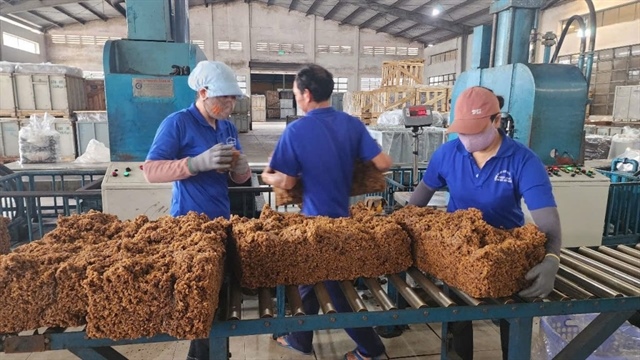
A Vietnam Rubber Group worker collects rubber latex at a plantation. — Photo vrg.vn |
Industrial parks
Beyond core rubber business, industrial land conversion offers a supplementary profit lever for major rubber groups.
VCBS estimates PHR could record about VNĐ700 billion in compensation income from land use conversions tied to projects like the HCM City - Thủ Dầu Một - Chơn Thành Expressway and a Thaco‑led mechanical industrial park.
Before it merged into HCM City, the former province of Bình Dương signalled plans to convert nearly 10,868ha of PHR rubber land to urban industrial use, suggesting a potential for up to 300ha of handovers per year at compensation of roughly VNĐ3 billion per hectare.
GVR's growth outlook similarly benefits from its industrial land portfolio in Đồng Nai.
By the end of 2025, Đồng Nai authorities were processing recovery procedures of close to 1,900ha for three industrial parks: Long Đức (phase 2), Bàu Cạn‑Tân Hiệp (phase 1) and Xuân Quế‑Sông Nhạn. Meanwhile, nearly 500ha had approved compensation plans pending handover due to valuation disputes.
Progress on resolving those impediments could accelerate land handovers and revenue recognition in 2026 as Đồng Nai advances infrastructure linked to the Long Thành Airport.
GVR's long‑term plan envisages converting some 40,000ha of rubber land to other uses by 2040, with over 22,000ha already included in industrial development zoning for 2021–2030.
Dong Phu Rubber is another example. SSI projects DPR's 2026 revenue to rise about 26 per cent to nearly VNĐ1.5 trillion, driven by an 8 per cent volume increase and a 3 per cent price rise, with additional proceeds expected from rubberwood liquidation for internal infrastructure and new industrial park projects.
DPR's extensive land bank and strategic location in Đồng Nai position it to capture rising demand for industrial park leases as neighbouring provinces' vacancy rates exceed 80 per cent.
Market reports said that timely and fairly priced compensation and fast land recovery will be critical to translating land banks into near-term profits and supporting equity valuations.
Over the medium to long term, the rubber producers' combination of stable core operations and sizeable land assets provides a potential channel to unlock incremental value as industrial park demand and infrastructure rollouts continue.
- 08:34 26/03/2026