Vietnamese coffee exporters urged to revamp supply chains for stricter EU rules
Vietnamese coffee exporters urged to revamp supply chains for stricter EU rules
From December 30, 2025, every coffee shipment to the EU must prove it was not grown on land subject to deforestation after December 2020.
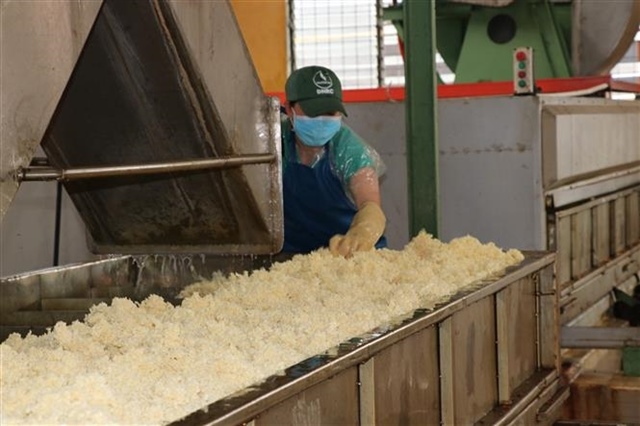
Production at Đồng Nai Rubber Corporation meet EU EUDR standards, with QR codes enabling full traceability from plantation to processing plant. — VNA/VNS Photo Hồng Nhung |
The EU is tightening sustainability rules on imported coffee, triggering warnings that Vietnamese exporters will need to overhaul farming practices, record-keeping and supply chain management to maintain access to the bloc, particularly demanding Nordic markets.
The Vietnam Trade Office in Sweden, which also covers Denmark, Norway, Iceland and Latvia, said exporters, including small suppliers, must keep detailed records of farming methods, labour conditions, water and chemical use, emissions and environmental impacts from cultivation through to transport.
A central requirement is the EU Deforestation Regulation (EUDR). From December 30, 2025, all coffee shipments to the EU must prove they were not grown on land subject to deforestation after December 2020. This means full documentation and precise geo-mapping of each coffee-growing plot, a significant challenge in a sector dominated by smallholder farms.
Beyond deforestation controls, the EU has rolled out two directives that extend corporate responsibility across entire supply chains.
The Corporate Sustainability Due Diligence Directive (CSDDD), in force since July 2024, applies to large companies with more than 1,000 employees and annual revenue exceeding 450 million euros, with phased compliance from 2027 to 2029. The Corporate Sustainability Reporting Directive (CSRD), effective from 2025, requires detailed reporting on environmental protection and fair labour practices. Smaller firms are not directly covered but must still provide data to larger partners.
Nguyễn Thị Hoàng Thúy, head of the Vietnam Trade Office in Sweden, said exporters and cooperatives must maintain comprehensive production records covering cultivation practices, labour conditions, water and chemical use, emissions and environmental impacts.
She also urged exporters to set coffee prices at levels that allow farmers to pay fair wages in line with local standards, a key factor in preventing illegal labour practices and ensuring long-term supply chain sustainability, as EU importers must demonstrate their products are free from forced labour.
From December 2027, the EU will ban products made with forced labour regardless of company size. Under EU rules, this includes coercion and harmful child labour that undermines children’s health, education and development.
To comply, cooperatives and exporters are advised to identify labour risk points in their supply chains, set clear requirements for suppliers on lawful and fair labour, train farmers and workers on labour rights and international standards, establish safe reporting channels for violations and carry out regular independent audits.
The trade office also highlighted opportunities for cacao in Nordic markets, where consumers increasingly prioritise health, environmental protection and social responsibility. Buyers in Denmark, Norway and Sweden closely scrutinise product origin, farming conditions, farmers’ rights and environmental impact and are willing to pay for certified, transparent and fair-trade goods.
For Việt Nam, cacao is not yet a major export but aligns well with Nordic consumer preferences, particularly when linked to sustainable farming, improved farmer livelihoods and deeper processing.
Although smaller than Western European markets, the Nordic region offers stable demand, high quality standards and a strong preference for value-added products, making it a useful benchmark market for exporters.
- 21:31 03/02/2026