Home loan interest rates climb sharply amid tighter credit conditions
Home loan interest rates climb sharply amid tighter credit conditions
Home loan interest rates at many Vietnamese banks have risen sharply in recent weeks, increasing from the previously common range of 6-8 per cent per year to around 12-14 per cent, as lenders tighten credit to the property sector and respond to mounting liquidity pressures.
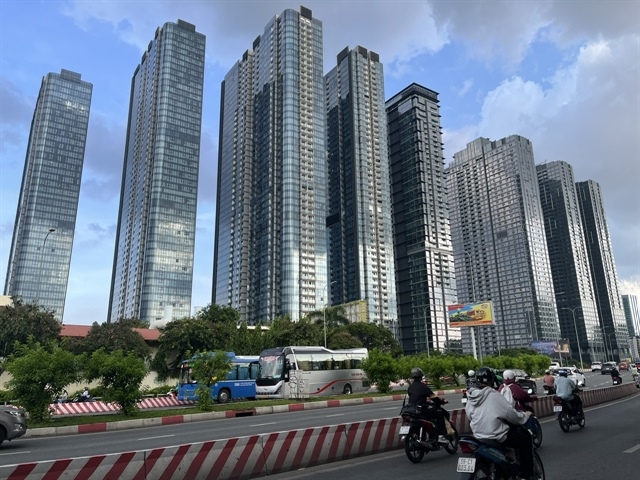
A high-end apartment complex in downtown HCM City. Home loan interest rates have recently surged at many Vietnamese banks. — VNS Photo Bồ Xuân Hiệp |
The adjustments have been particularly notable among State-owned commercial banks, which traditionally offer some of the lowest lending rates in the market.
According to a recent notice from a Vietcombank branch in HCM City, interest rates for apartment and townhouse purchases with valid ownership certificates or sale contracts, as well as refinancing loans, are now offered from 9.6 per cent per year.
This compares with fixed rates of around 6 per cent for 12 months and 7 per cent for 24 months during the same period last year.
Other State-owned lenders have made similar moves.
VietinBank has raised its 24-month fixed-rate home loan package to above 12 per cent per year.
BIDV currently offers rates starting at 9.7 per cent for the first six months, 10 per cent for 12 months and up to 13.5 per cent for 18 months.
Agribank maintains lower short-term rates at around 8 per cent for six months and 8.5 per cent for 12 months, but rates approach 9.8 per cent for longer fixed periods.
Private banks have also maintained elevated lending rates. MB offers 9-9.5 per cent for 12-24 month fixed packages, while VIB applies 9.9-12 per cent over similar terms.
ACB lends at around 9.5-10.5 per cent, and Techcombank offers 8.5-9.5 per cent for six to 12 months. Floating rates at many private lenders now range from 11 to 15 per cent per year, depending on promotional terms.
Notably, lending rates at some State-owned banks are now on par with, or even higher than, those at private institutions, an uncommon development given that State-backed lenders are typically associated with lower borrowing costs.
A senior executive at a State-owned bank told Việt Nam News and Law that the higher rates reflect policy orientation.
Credit growth quotas for the property sector have been restricted this year, prompting banks to adjust pricing in order to redirect capital toward priority areas such as production and business activities, he said.
At a recent investor conference, Lưu Trung Thái, chairman of Military Bank (MB), said higher-risk sectors cannot be offered preferentially low rates.
However, he emphasised that overall lending rates should remain at reasonable levels to balance capital mobilisation with investment and consumption.
Savings deposit rates have also risen across the system, including at State-owned banks, reaching their highest levels in two years.
Interbank rates briefly surged to 17-19 per cent before easing, though analysts expect liquidity conditions to remain tighter than in previous years at least through the end of the first quarter.
Repayment burdens
Market observers say the speed of recent adjustments has been rapid.
Võ Hồng Thắng, deputy general Director of DKRA Group, said that just four to five months ago, many banks were still offering two-year fixed rates at around 6.5 per cent per year. Since then, rates have steadily increased to the current common range of 13-14 per cent.
"Higher borrowing costs have significantly increased repayment burdens," he noted.
A VNĐ1 billion loan at an interest rate of around 14 per cent now creates an interest payment obligation comparable to that of a VNĐ2 billion loan when rates were 6.5 per cent previously. While the principal remains unchanged, effective financial pressure on borrowers has nearly doubled, according to Thắng.
Phan Thành Chương, director of TC Land Real Estate Company, said lending rates had been rising gradually since mid-2025, but the pace accelerated from last November, further weighing on market liquidity. Many buyers are delaying purchase decisions or waiting for clearer signals on interest rates and credit policy.
Experts say the current rate environment may accelerate market consolidation. Short-term speculative capital is likely to retreat, while genuine homebuyers will need to more carefully assess income stability and repayment capacity.
Higher interest rates do not necessarily signal the end of the property cycle, analysts say, but they mark the conclusion of a period characterised by easy leverage. The market is expected to shift toward a slower, more sustainable trajectory in the coming period.
- 06:51 25/02/2026