Carbon footprint emerges as new competitive edge for Việt Nam’s farm exports
Carbon footprint emerges as new competitive edge for Việt Nam’s farm exports
The carbon footprint is emerging a new benchmark of competitiveness for Việt Nam’s farm produce exports as global carbon markets take shape and environmental standards tighten.
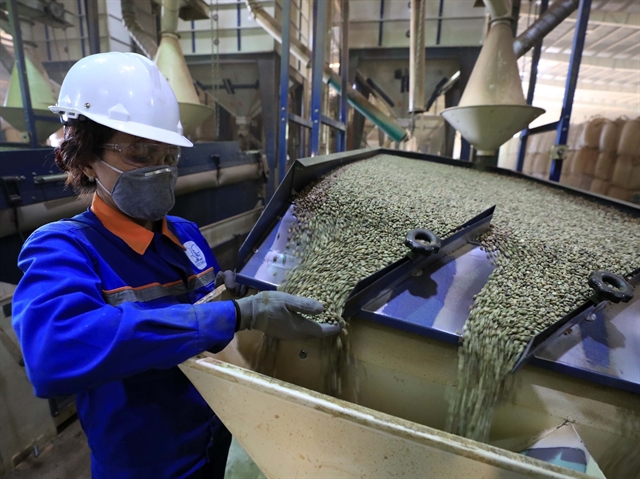
Coffee, one of the country’s key export commodities, is under significant pressure to green its entire value chain.
Lê Đức Huy, Chairman of coffee exporter Simexco Đắk Lắk, said international buyers’ decarbonisation requirements present both pressure and opportunity.
Major corporations are mapping pathways to net-zero emissions by 2050 and are willing to support farmers in transitioning, from adjusting fertiliser use to providing financial assistance.
“Changing long-standing farming practices cannot happen overnight. It requires a clear and sustained roadmap,” Huy said.
The European Union’s Regulation on Deforestation-free Products (EUDR) adds another layer of pressure, which regulated that imported goods, including coffee, must prove they are not linked to deforestation, have clear traceability, and meet environmental standards to enter the bloc.
The regulation gives a push to Việt Nam’s coffee supply chain to improve data transparency and emissions management.
Each cup of coffee can generate roughly 0.2–0.5 kg of CO₂ with greenhouse gas emissions occurring at every stage, from cultivation and harvesting to green bean processing, roasting, brewing, and consumption.
Globally, agriculture emits an estimated 18 billion tonnes of greenhouse gases annually, nearly one-third of total emissions. In the coffee value chain, more than half of emissions stem from raw material production.
Studies suggest that through improved farming techniques, optimising transport and upgrading processing technology, the coffee sector could cut emissions by up to 77 per cent.
A study on sustainable coffee production in Brazil and Việt Nam estimates an average carbon footprint of around 3.51kg of CO₂ per kg of green coffee which could be further reduced under more sustainable practices.
The trend is also pushing agricultural products towards greener production.
In a volatile global rice market, shifting from a volume-driven strategy to higher-quality segments such as fragrant, organic, and specialty rice is creating new competitive advantages for Vietnamese rice.
The Government’s project to develop one million hectares of high-quality, low-emission rice in the Mekong River Delta by 2030 reflects an effort to align production with green growth, by cutting emissions through improved fertiliser management, water control, and straw treatment.
Vũ Tấn Phương, Director of the Vietnam Forest Certification Office, said a carbon footprint represents the total greenhouse gas emissions associated with a product or activity, expressed in CO₂ equivalent.
Monitoring, reporting, and verification (MRV) in line with international standards is increasingly becoming mandatory, directly affecting market access and financing costs, he said.
Phương pointed out that in the forestry sector, there is significant carbon absorption potential with around 4–5 million hectares of planted forests.
However, not all forests automatically generate tradable carbon credits, he said, adding that credits are recognised only when projects demonstrate additionality, meaning emissions reductions or enhanced sequestration beyond business-as-usual scenarios, and pass independent validation and approval processes.
Việt Nam is gradually completing its legal framework for a domestic carbon market, including mechanisms for allocating emission quotas and operating a trading platform.
The Ministry of Agriculture and Environment recently issued an action plan to adapt to EUDR with aims to complete forest databases, boundary maps, traceability systems, and integrated technology platforms before 2026.
Trương Tất Đơ from the ministry’s Forestry and Forest Protection Department said products with low, transparent, and well-managed carbon footprints will hold long-term competitive advantages.
“When carbon footprints are properly measured and managed, they shift from being a cost burden to an intangible asset enhancing the value of Vietnamese agricultural products on the global market,” he said.
- 09:39 21/02/2026