Private sector hailed as key driver of Cambodia’s trade growth and global integration
Private sector hailed as key driver of Cambodia’s trade growth and global integration
The role of the private sector has been instrumental in promoting trade and supporting Cambodia’s broader economic momentum in regional and global supply chains.
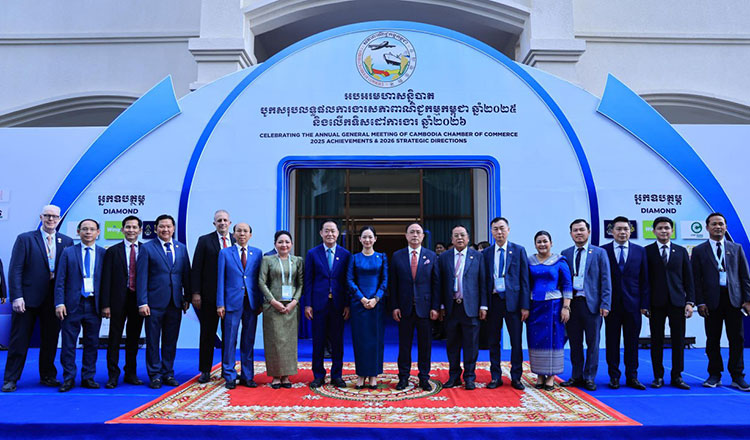
The private sector has played a decisive role in advancing Cambodia’s trade performance and underpinning national economic growth through increased investment, diversified export-import activities, stronger competitiveness and deeper integration into regional and global value and supply chains, in line with the Royal Government’s push for sustained economic integration.
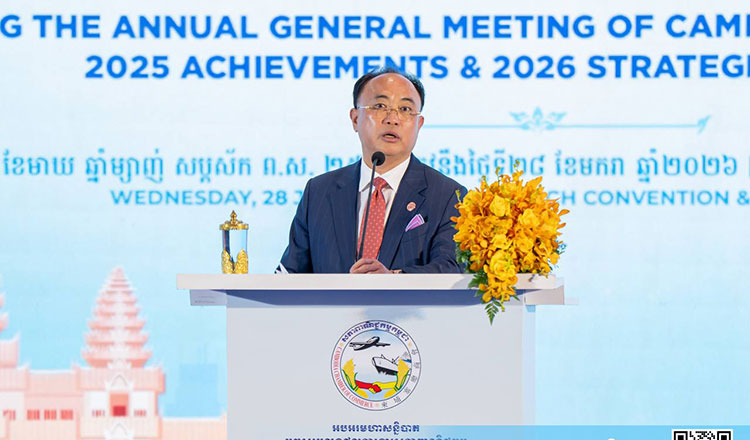
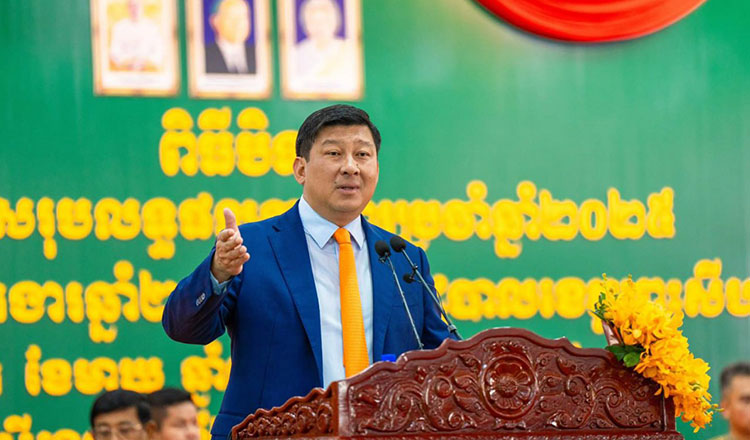
This was highlighted by Cham Nimul, Minister of Commerce, while presiding over the closing ceremony of the Annual Meeting of the Executive Board of the Cambodia Chamber of Commerce in 2025 and setting out its work directions for 2026, on Wednesday at the Koh Pich Convention and Exhibition Centre in the capital.
The ceremony brought together senior leaders from relevant ministries and institutions, the leadership of the Cambodia Chamber of Commerce (CCC), ambassadors accredited to Cambodia, presidents of capital and provincial chambers of commerce, representatives of CCC offices abroad, chamber members, and national and international guests.
In her remarks, Nimul commended the collective efforts of the CCC’s leadership and members, noting their strong sense of responsibility, effective coordination and close cooperation, which she said had resulted in many tangible achievements over the past year. She underlined that the private sector’s contribution has been instrumental in promoting trade and supporting Cambodia’s broader economic momentum.
According to the Minister, these contributions have been reflected in greater investment inflows, wider diversification of traded goods, improved competitiveness and more active participation in regional and global value and supply chains. These developments align closely with the Royal Government’s strategy to deepen economic integration, including ongoing negotiations to open up new and potential markets through both bilateral and multilateral frameworks.
Nimul also briefed participants on the Royal Government’s continued efforts to improve the business and investment climate, while diversifying export and import markets under the approach of strengthening existing markets and expanding into new ones. She noted that, as a key technical arm of the Government, the Ministry of Commerce has introduced and implemented a range of targeted reform measures, delivering notable results throughout 2025.
These efforts include the completion of ratification procedures and the signing of free trade agreements at various levels, as well as sustained engagement with private sector concerns through public–private partnership dialogues. The Ministry has also continued to modernise and simplify public service delivery and to promote the diversification, quality and reputation of Cambodian products through stronger intellectual property protection.
Looking ahead, the Minister outlined the trade work direction for 2026 and the longer-term vision for Cambodia’s trade sector. She said this vision is anchored in four defining characteristics, including dynamism, resilience, inclusivity and competitiveness, and centres on three closely linked pillars: institutional and system transformation, domestic trade development and international trade expansion.
In parallel, Nimul offered a series of recommendations aimed at enhancing the effectiveness of the CCC as it shapes its work plan for 2026. She called on the Chamber to continue implementing its roles and responsibilities under existing laws and regulations, while further strengthening cooperation with relevant ministries and institutions.
She also stressed the importance of stronger governance and more effective enforcement of laws and standards in the trade sector to safeguard integrity, compliance and the creation of a transparent, fair and competitive business environment.
Large domestic enterprises were encouraged to continue upgrading their capacity and productivity to maximise the benefits of trade preferences and regional and bilateral free trade agreements, particularly in preparation for Cambodia’s smooth graduation from least developed country status in 2029.
The Minister further urged enterprises producing similar goods or services to consider forming federations or associations to boost production volumes, strengthen supply linkages and ensure greater complementarity across supply chains.
Overseas trade representative offices were encouraged to attract more foreign partners to invest in Cambodia, especially in agro-industrial production, processing and essential consumer goods, to enhance value addition and strengthen production chains.
Nimul also called on local investors and major enterprises, through capital and provincial chambers of commerce, to play an active role in maintaining market stability in the provinces, supporting traders, entrepreneurs and small farmers, and helping absorb agricultural products. She emphasised that provincial chambers should take part in developing the unique potential and competitive strengths of each locality.
The Minister urged the private sector to continue working closely with the Royal Government to promote the use and sale of Cambodian products at home and abroad. This includes creating favourable conditions for product display and marketing, as well as active participation in trade fairs and promotional events at both national and international levels, to further elevate Cambodia’s presence in global markets.
Cambodia’s private sector is ready to deepen cooperation with the Ministry of Commerce to ensure a competitive and transparent regulatory environment as the country enters a new phase of economic development, said Kith Meng, President of the CCC.
Speaking at the event, Meng said that 2026 marked not only a new fiscal year but also “the beginning of a new era of economic development,” requiring businesses to move beyond conventional approaches.
“The private sector is ready to work closely with the Ministry of Commerce to ensure that the regulatory environment remains competitive and transparent,” he said, highlighting the importance of strong public-private collaboration in sustaining growth and attracting investment.
He noted that the CCC would prioritise supporting its members in adopting digital technologies, enabling Cambodian entrepreneurs to compete more effectively in an increasingly borderless digital marketplace. “From Phnom Penh to the provinces, our entrepreneurs must be equipped to compete in the digital economy,” he added.
Attracting foreign investment remains a top priority for the chamber, Meng said, pointing to two major international business events scheduled for 2026. The ASEAN-Cambodia Business Summit 2026 will be held in Phnom Penh on March 3-4, while the Francophone Entrepreneurship Forum (REF) is scheduled for November 15-16 in Siem Reap province, with delegates expected from nearly 90 countries.
He said the two events are expected to create new momentum in linking local businesses with regional and global partners, strengthening Cambodia’s position in international value chains.
“Together, let us leverage the vibrancy of the private sector to build a new era of shared growth and prosperity,” Meng said.
- 08:18 30/01/2026