Vietnam still has room to mobilise capital for sustainable growth
Vietnam still has room to mobilise capital for sustainable growth
As Vietnam pursues increasingly ambitious growth targets, resources for sustainable development should be understood within the broader context of the economy's financing needs, rather than confined solely to green projects.
Speaking at the "Expanding Green Finance for Sustainable Growth" conference organised by VIR on December 15, Nguyen Ba Hung, chief economist of the Asian Development Bank (ADB) in Vietnam, examined the widening gap between capital demand and mobilisation capacity, while highlighting areas where Vietnam’s financial markets remain underdeveloped.
“When discussing sustainable development, it cannot be separated from overall economic development,” said Hung.
He added that Vietnam’s capital requirements would be considerable. Public investment demand over the next five years is estimated at between $50 and $70 billion. At the same time, total social investment is projected to increase from approximately 32 per cent of GDP to around 40 per cent, implying additional funding needs of roughly $250-350 billion during the period.

Nguyen Ba Hung, chief economist of the Asian Development Bank in Vietnam. Photo: Dung Minh |
The scale of these requirements becomes clearer when viewed alongside Vietnam’s growth ambitions. From 2026 onwards, the country has set a target of 10 per cent annual economic growth, a level that, according to Hung, exceeds the historical experience of many economies in the region.
“Even South Korea and Singapore did not achieve growth rates of 10 per cent during their fastest 30-year development phases. Similarly, Thailand, Indonesia, and Malaysia recorded average growth of about 7 per cent during their most dynamic periods,” he said. “Vietnam’s highest average growth rate over the past 40 years was 6.8 per cent. These comparisons highlight the significant gap between historical performance and the current growth target.”
As growth pressures intensify, the issue of funding sources becomes increasingly important. Analysing Vietnam’s debt structure, Hung observed that the government still retains relatively comfortable fiscal space.
“Outstanding government bond debt currently accounts for around 20 per cent of GDP, which remains within a safe threshold and leaves scope for expanding investment through this channel,” Hung said. “Moreover, government bond yields are currently in the range of 3-4 per cent, well below the 6-7 per cent commonly observed in regional markets.
Public debt indicators remain broadly favourable. External debt has declined relatively rapidly over the past five years and is currently at a high safety level, indicating that Vietnam still has room to mobilise capital from both domestic and international markets.
In contrast, the corporate capital market continues to face structural limitations. The proportion of corporate bonds in total outstanding bonds remains modest compared with markets such as Singapore, Thailand, and Malaysia. In addition, foreign investor participation in Vietnamese government bonds is negligible, whereas in several other countries it can reach around 20 per cent.
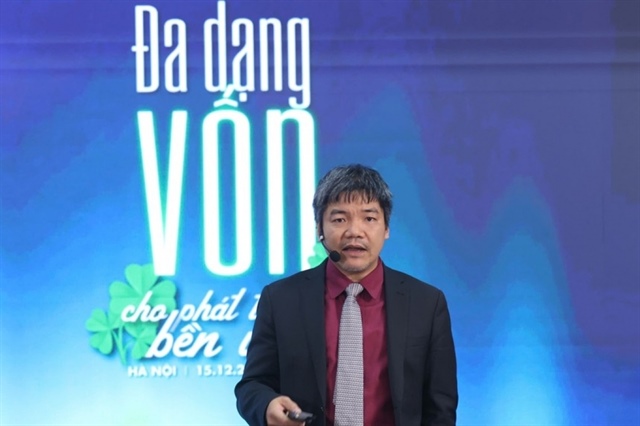
Hung shared insights at the conference "Expanding Green Finance for Sustainable Growth", organised by VIR on December 15. Photo: Dung Minh |
Another notable weakness lies in the maturity structure of the bond market. Internationally, bonds are typically used to secure medium- and long-term financing. In Vietnam, however, more than half of bond issuance is concentrated in maturities of one to three years, while issuance with tenors exceeding 10 years remains limited. Consequently, the bond market primarily supplies short- to medium-term capital. This problem is compounded by very low liquidity in the secondary market for corporate bonds, with limited trading activity increasing liquidity risks for investors.
These structural shortcomings have left the economy heavily dependent on the banking system. Hung further added that Vietnamese banks are under growing pressure, with around 40 per cent of outstanding credit tied to medium- and long-term loans.
The policy challenge, therefore, lies in sustaining credit growth to support development while gradually reducing the credit-to-GDP ratio to safeguard macroeconomic stability. Hung added that this objective can only be achieved by strengthening the role of capital markets.
“As GDP expands, greater reliance on the bond market is required if the debt ratio is to decline,” he said.
With a more developed bond market, part of bank lending can be replaced by bond financing, allowing bonds to function as an effective complementary credit channel. Over the longer term, bonds need to assume a more prominent role, as they provide the most stable source of long-term funding for businesses.
The stock market was also identified as a potential long-term financing channel that has yet to be fully utilised. While trading activity remains strong, it is largely concentrated in the secondary market.
According to Hung, there is still significant scope to enhance capital mobilisation through the primary market, particularly by encouraging more companies to raise equity via initial public offerings. Equity financing, he noted, offers a long-term capital base that can support business expansion and sustained investment.
- 08:57 17/12/2025