Green finance offers 'passport' for Vietnamese construction, building materials firms
Green finance offers 'passport' for Vietnamese construction, building materials firms
Sustainability is no longer a trend but the new operating system of the global economy. With stricter green standards sweeping across markets, Vietnamese construction companies must accelerate their transition or fall behind.
The world is entering its most extensive structural transition in modern history, a total transformation of infrastructure, materials, energy, and production systems towards sustainability. With the global construction market projected to reach $40 trillion by 2045, the pressure for green transformation is forcing businesses to reshape their operating models faster than ever.
For Vietnam, this pressure is amplified by a government commitment to achieve net-zero emissions by 2050. This pledge immediately raises the bar for the construction and building materials sectors: green standards, low-carbon requirements, supply chain transparency, and environmental, social and governance (ESG) standards are no longer optional, they are prerequisites for entering international markets.
Vietnamese construction enterprises now face an unmistakable reality: if they fail to green themselves within the next five years, they risk being pushed out of the global playing field.
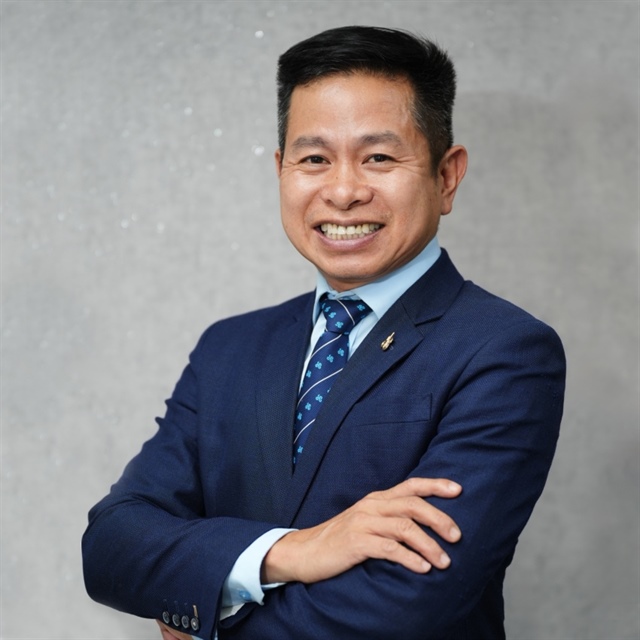
Jerry Nguyen (Nguyen Kinh Luan), chair of group restructuring board, chair of ESG Subcommittee, board member, deputy general director of investment and international market development, Hoa Binh Construction Group |
While global demand for green buildings, low-carbon materials, and sustainable infrastructure is rising sharply, the green finance market has surpassed $6.2 trillion, with cheaper and longer-term capital increasingly flowing into construction and infrastructure.
Yet only a very small number of Vietnamese companies have been able to access these capital sources. The issue is not a lack of demand for funding, but the inability to meet the basic requirements needed to unlock green capital.
The biggest gaps include:
- Lack of internationally compliant ESG reporting: existing reports are largely formalistic, lacking quantitative indicators and independent assurance.
- Absence of lifecycle emissions assessments (LCA-EPD) for materials: this prevents Vietnamese products from proving low-carbon performance in export markets.
- Insufficient carbon data transparency to demonstrate genuine emissions-reduction commitments.
- Limited green credit offerings in domestic banks make it difficult to obtain financing for green technologies.
- No dedicated guarantee fund for Vietnamese contractors, failing to meet the financial criteria for international bidding packages.
In other words, the capital is abundant, but Vietnamese enterprises do not yet possess the “green passport” needed to access it.
| “Without meeting ESG standards, Vietnamese construction firms will be eliminated at the pre-qualification stage, regardless of how strong their engineering capabilities or how competitive their pricing may be.” |
Green standards: the world's new technical barrier
In recent years, ESG has become a mandatory criterion in contractor pre-qualification, supplier evaluation, and international credit assessments. Global markets are increasingly adopting strict green requirements, while Vietnam remains at an early stage.
This gap is evident:
|
Green Requirement |
Global Markets |
Vietnam |
|---|---|---|
|
LCA–EPD for building materials |
Mandatory |
Not yet widely implemented |
|
ESG reporting |
Mandatory for large enterprises |
Not clearly required |
|
Low-carbon supply chain |
Core evaluation metric |
Not yet established |
|
Carbon market |
Fully operational |
Under the pilot phase |
The wider the standards gap, the smaller the competitive space for Vietnamese firms. Even construction contractors with strong technical capabilities can be disqualified simply for failing to meet emissions-related requirements.
Vietnam needs national-level “green pivot”
To capture the next 30-year green investment cycle and avoid falling behind, Vietnam must implement a systemic transition.
Establish a national green standards framework:
Clear standards will give businesses a roadmap for investment, compliance, and transparency. Key priorities include standardising green building certifications, mandating LCA-EPD for building materials, and implementing carbon-transparency requirements for public-sector projects.
Build a truly effective green finance ecosystem:
This should include a Green Credit Guarantee Fund dedicated to contractors and building-materials companies, the expansion of green bonds, clear green-credit taxonomies in commercial banks, and a carbon market capable of international linkages. Once green capital is unlocked, businesses can invest in low-carbon technologies, modern production lines, and market expansion.
Develop national data and independent verification systems:
A green system cannot function without reliable data. Vietnam needs a national carbon-data centre, independent reviews of ESG reports, and lifecycle assessments and EPD certifications. Standardised data is essential to building investor confidence.
Strengthen human capital for the green transition:
Vietnamese engineers must master BIM, new materials, emissions analysis, and energy efficiency. Business leaders must internalise sustainable business models. Government officials must understand global standards. Without skilled human resources, all policies remain theoretical.
Create flagship projects showcasing Vietnam's green capabilities:
Examples include net-zero industrial parks, national-level green buildings, low-carbon material factories, and official development assistance projects executed by Vietnamese contractors. These will serve as Vietnam's “national business card” when competing globally.
| “We stand at a crossroads: either become a regional hub for sustainable construction or be shut out by global green barriers.” |
A 10-15 year window of opportunity
The world is spending trillions of dollars restructuring infrastructure for net zero. This will be the largest investment cycle of the next three decades. If Vietnam moves quickly, it can build a competitive green building materials sector, elevate its construction firms to international general contractors, and attract significant green capital inflows.
But if we move slowly, the opportunity will fade as global green barriers solidify. Vietnamese enterprises will not only lose foreign markets, but they may also lose competitiveness at home as international investors choose partners with higher standards.
Surgery
Green finance and sustainable business models are no longer ethical choices or branding strategies; they are existential requirements for Vietnamese enterprises entering a $40 trillion global market.
To go global, Vietnamese companies must hold a “green passport” built on standards, data, technology, human capital, and finance. This is not merely a business challenge, it is a strategic national imperative.
In the Net Zero 2050 era, only those who move quickly and demonstrate genuine commitment will emerge as winners.
- 08:00 15/12/2025