Việt Nam needs to promote international cooperation to speed up energy transition: experts
Việt Nam needs to promote international cooperation to speed up energy transition: experts
Việt Nam needs to step up international cooperation to accelerate its energy transition as the country faces rising electricity demand, experts said at a conference held by the Institute for Brand and Competitive Strategy on Tuesday in Hà Nội.

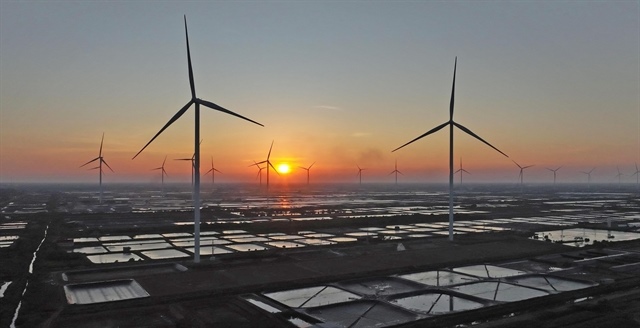
A wind farm in Vĩnh Long Province. Việt Nam needs to step up international cooperation to accelerate its energy transition, enhance national competitiveness and boost trade. —VNA/VNS Photo Phúc Sơn |
Increasing global cooperation would also help address pressure to accelerate the green transition and would enhance national competitiveness and boost trade, conference participants noted.
Việt Nam will need more than US$120 billion to implement its eighth national power development plan by 2030, while domestic resources can only cover about half of that amount, leaving a shortfall of $60–70 billion, according to former Deputy Minister of Planning and Investment Đặng Huy Đông.
The remaining funds must be raised from international capital markets, he said.
Deputy President of the Vietnam Energy Association Nguyễn Anh Tuấn said Việt Nam faces increasing pressure of meeting fast-growing power demand for double-digit growth in the next few years, while also shifting rapidly towards clean energy sources to fulfil its net zero commitments.
He estimated that Việt Nam would need more than $136 billion for investments in electricity generation sources and grid network by 2030, a huge sum.
“We are living in an era in which green standards have become the new passport for international trade,” Tuấn said.
Tuấn added that with its open economy and membership in new-generation free trade agreements, such as the Comprehensive Progressive Agreement for Trans-Pacific Partnership and the EU-Việt Nam Free Trade Agreement, Việt Nam is already feeling the impacts of the new era.
Traditional tariff barriers are gradually being replaced by increasingly stringent green technical barriers. As a result, Việt Nam’s energy transition is not only about environmental protection, but is also critical to enhance national competitiveness and boost trade, he said.
In this context, Việt Nam must enhance international cooperation to accelerate its energy transition.
“International economic cooperation on energy in the new era is not simply about sharing profits, but about sharing technology risks, financial burdens and responsibility for the shared future of our planet,” Tuấn said.
This cooperation should be built on three key pillars, according to Tuấn.
The first pillar is green finance and risk sharing. Việt Nam is calling for blended finance mechanisms that use concessional funding from international development institutions as seed capital to reduce risks, improve project bankability and attract large-scale private investment into renewable energy projects.
Cooperation in technology and research and development is second, Tuấn said, urging a shift from simple equipment sales to joint technology development and transfer.
Finally, the third pillar focuses on policy and market cooperation. Việt Nam needs to speed up the development of the legal framework for direct power purchase agreements and carbon credit markets, along with a transparent and competitive power market with a level playing field for investors.
He also stressed the importance of regional cooperation to advance the ASEAN Power Grid to enable cross-border electricity trading and optimise regional energy resources.
Nguyễn Thành Sơn, a lecturer at Hanoi University of Electricity, said international energy cooperation under free trade frameworks for regional energy integration and cross-border power trade is being driven by three key factors: economic efficiency, energy security and climate change response.
- 17:05 17/12/2025