Việt Nam boosts mobilisation of private capital for energy development
Việt Nam boosts mobilisation of private capital for energy development

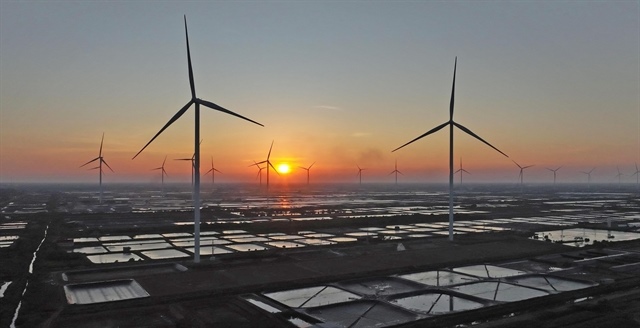
A solar power plant in Vĩnh Long Province. The electricity industry will require around US$134 billion in investment during 2021–2030 VNA/VNS Photo |
As Việt Nam accelerates its energy transition, mobilising private financial resources is becoming essential to meeting soaring investment demands, strengthening energy security and fostering green growth.
A workshop on promoting private sector participation in energy investment was held on December 3 in Hà Nội by the United Nations Office for Project Services (UNOPS) through the Southeast Asia Energy Transition Partnership (ETP) in collaboration with the Department of Finance and Sectoral Economics under the Ministry of Finance.
The event provided a platform for stakeholders to review the initial outcomes of the cooperation between the Ministry of Finance and UNOPS/ETP and to discuss international experiences, emerging financial models and strategies to attract greater private investment in Việt Nam’s energy sector, a field increasingly drawing the attention of global corporations, infrastructure funds, and domestic enterprises.
Speaking at the opening session, Lê Tuấn Anh, deputy head of the Department of Finance and Sectoral Economics, said that Việt Nam is undergoing rapid economic transformation, accompanied by robust GDP growth. National energy demand is expected to rise by 8–10 per cent annually over the next decade.
He noted that Resolution 55 issued in 2020 on Việt Nam’s National Energy Development Strategy to 2030 with a vision to 2045 sets clear goals for modernising the energy system, building a competitive and transparent energy market, and prioritising the mobilisation of all resources for renewable energy development.
In addition, Power Development Plan VIII estimates that the electricity industry will require around US$134 billion in investment during 2021–2030, much of which is expected to come from private sources to support the development of a modern, flexible low-emission power system.
Việt Nam’s commitment to achieving net-zero emissions by 2050, made at COP26, further underscores the need for large-scale mobilisation of both domestic and international capital.
“In this context, the role of the private sector becomes critically important, particularly in renewable energy, transmission systems, energy storage and green and sustainable financial models,” Tuấn Anh said.
He added that the Ministry of Finance is committed to improving financial mechanisms, developing capital mobilisation tools, and adjusting tax, fee and credit policies to create a stable, transparent investment environment aligned with international standards.
Also at this workshop, John Robert Cotton, deputy director of ETP/UNOPS, highlighted the rapid transformation of the global energy landscape. According to the International Energy Agency, emerging and developing economies must increase annual clean energy investment from $770 billion today to $2.2 trillion by 2030. This means private investment alone needs to surge nearly sevenfold, from $135 billion to around $1.1 trillion.
These figures make clear that countries capable of providing a transparent and predictable legal framework will be in the best position to attract the financial resources required for their energy transition, he said.
He also noted that although COP30 brought progress by pledging to triple global adaptation finance, the gap between needs and actual resources remains large.
In Việt Nam, the Politburo's Resolution 68 on private economic development outlines a vision for a more dynamic private sector and calls for rapid improvements in the investment environment. These reforms send strong signals to investors and enhance the private sector’s role across the economy, including in energy transition.
For the energy system, this momentum is essential, Cotton said. Achieving the ambitions of Power Plan VIII, from scaling up renewables and upgrading the grid to expanding storage and reducing industrial emissions, requires investment far beyond the capacity of public finance.
To support these goals, ETP has partnered with the Ministry of Finance to explore capital-access tools and identify strategies that enable more effective public–private partnerships, blended finance mechanisms and investment channels capable of attracting large-scale private capital.
During the workshop, leading experts shared international best practices, analysed Việt Nam’s financial legal framework, assessed major challenges, and proposed innovative financial models to encourage stronger private engagement in the nation’s energy transition.
These contributions are expected to inform the development of new policy mechanisms, remove existing barriers, and create additional momentum for the energy market, particularly at a time when Việt Nam’s demand for energy infrastructure investment continues to grow.
- 08:49 04/12/2025