State strengthens goods control on occasion of Tết
State strengthens goods control on occasion of Tết
The National Steering Committee against Smuggling, Counterfeit Goods and Trade Fraud (National Steering Committee 389) has stepped up efforts to curb the circulation of illegal, fake and low-quality products before, during and after the holiday season.
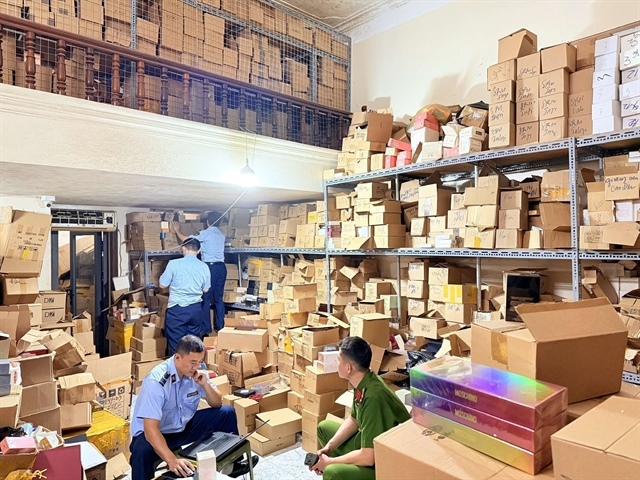
Thousands of perfume and cosmetic products of unknown origin were seized by authorities in Hà Nội. — VNA/VNS Photo |
As the Lunar New Year in 2026 approaches, the National Steering Committee against Smuggling, Counterfeit Goods and Trade Fraud (National Steering Committee 389) has intensified efforts to curb the circulation of illegal, fake and low-quality products before, during and after the holiday season.
A directive issued recently by Deputy Prime Minister Bùi Thanh Sơn, head of National Steering Committee 389, states that the nationwide peak campaign will run from December 16 to March 15, 2026.
The steering committee, which includes representatives from the Ministry of Finance, Ministry of Industry and Trade, Ministry of National Defence and Ministry of Public Security, along with its members in localities nationwide, will tighten inspections and monitoring of goods at border checkpoints on road, rail, river, sea and air routes, as well as trails and storage areas near border zones.
Enhanced oversight will also be rolled out in the domestic market and on online platforms to detect, prevent and strictly handle smuggling, trade fraud and counterfeit activities.
The campaign focuses on high-risk product groups, including prohibited items, counterfeit goods, substandard products, intellectual property-violating items, high-tariff imports and essential goods for manufacturing and consumption.
Authorities will intensify inspections of essential goods and high-demand items during the year-end shopping period. This includes strict checks at warehouses, logistics centres, industrial zones, wholesale markets and shopping malls, as well as closer surveillance of e-commerce platforms.
Customs offices under the Ministry of Finance have been instructed to track market information, strengthen border control and apply synchronised measures to detect smuggling, transfer pricing, tax evasion and money laundering. Customs forces will also step up patrols at high-risk checkpoints and coordinate closely with other enforcement units.
Departments of industry and trade in localities are required to monitor supply and demand for essential goods, particularly items facing strong price fluctuations, to maintain market stability and prevent hoarding or sudden price spikes during Tết.
The Ministry of Industry and Trade’s Market Surveillance Agency is directed to intensify inspections of product origins, quality and circulation in the domestic market while strengthening cooperation with police, customs, border guards, the coast guard, brand owners, industry associations and e-commerce platforms.
The ministry will also require the E-Commerce and Digital Economy Agency to monitor cross-border e-commerce platforms, particularly low-cost marketplaces, as well as websites and social media apps such as Facebook, Zalo and TikTok to detect illegal online business activities.
Local steering committees nationwide are increasing crackdowns on the production, storage and sale of banned, counterfeit, substandard and untraceable goods, especially those in high demand during the Tết holiday.
Enforcement now targets both physical stores and online sellers. Anyone marketing counterfeit or illegal goods on e-commerce platforms or social media may face action.
On December 8, market surveillance officers and the Hanoi Police Department for Cybersecurity and High-Tech Crime Prevention raided a sportswear shop in Phú Diễn Ward, discovering 5,200 Nike-branded sets, 1,200 Adidas-branded sets and 14 Puma-branded shirts.
The shop could not provide proof of origin and most sales were conducted online, highlighting how small online businesses have exploited digital trading to evade tax and posing risks to consumers.
In another major case, Market Surveillance Team No.11 in Hà Nội uncovered an online warehouse in Hà Đông storing about 125,000 violating products, including cosmetics, health supplements and household goods, worth nearly VNĐ19 billion.
HCM City has become a hotspot for e-commerce violations due to its large online market and high consumer demand. Between 2024 and early 2025, authorities handled nearly 400 cases, issued fines of more than VNĐ8 billion and seized tens of thousands of items ranging from jewellery and apparel to electronics and food.
Traditional retail hubs also remain under scrutiny. At Saigon Square, authorities recorded 38 violations, confiscating more than 1,200 counterfeit items and issuing fines totalling VNĐ360 million.
Meanwhile, Đà Nẵng’s Market Surveillance Agency reported that two years of implementing an anti-counterfeiting initiative resulted in 84 cases and nearly VNĐ1.5 billion in fines. In 2024 alone, 69 cases were handled, contributing over VNĐ1.1 billion to the State budget.
Experts stress the need for synchronised solutions combining control, transparency and digital technology. These include building an inter-agency monitoring system, requiring transparent seller information and ensuring proper registration for e-commerce platforms.
They also emphasise wider use of technology to track product origins and verify authenticity, while e-commerce platforms and social networks must promptly remove violating listings and cooperate fully with authorities.
- 09:00 12/12/2025