

Year-end inflation challenges as CPI rises 4.57 per cent in 10 months
Year-end inflation challenges as CPI rises 4.57 per cent in 10 months
The latest updates of the National Statistics Office (NSO) on November 3 showed that the consumer price index (CPI) rose by 0.2 per cent in October from the previous month, mainly due to higher domestic fuel prices in line with global energy markets.
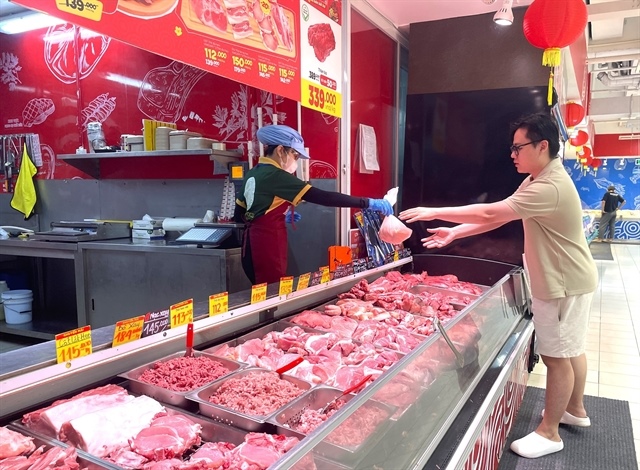
A consumer buys pork at GO! supermarket in HCM City. Average CPI growth in the January-October period reached 4.57 per cent, while core inflation rose by 4.24 per cent. — VNA/VNS Photo Hương Giang |
Việt Nam is facing significant challenges in keeping inflation within its 2026 target after consumer prices rose by 4.57 per cent in the first 10 months of the year, although recent cuts in electricity and fuel taxes are expected to help ease price pressures towards the end of the year.
The latest updates of the National Statistics Office (NSO) on November 3 showed that the consumer price index (CPI) rose by 0.2 per cent in October from the previous month, mainly due to higher domestic fuel prices in line with global energy markets. October's CPI was up 4.41 per cent from December 2025 and 5.09 per cent year-on-year.
Average CPI growth in the January-October period reached 4.57 per cent, while core inflation rose by 4.24 per cent.
Transport prices roseby 2.66 per cent in October, the sharpest increase among the groups, as petrol prices climbed by 6.86 per cent and diesel prices increased by 0.75 per cent.
However food and catering services prices fell by 0.24 per cent on an abundance of domestic supplies and a slight weakening in export prices. Foodstuff prices dropped by 0.32 per cent, mainly due to a 2.33 per cent fall in pork prices as domestic supply increased, consumption remained subdued and cheaper imported pork intensified competition.
Over the first 10 months, housing, electricity, water, fuel and construction materials recorded an average price increase of 6.66 per cent year-on-year, contributing 1.51 percentage points to headline inflation.
Transport prices rose by 6.98 per cent, contributing 0.7 percentage points, with fuel prices increasing by 13.09 per cent. Food and catering services prices climbed by 4.61 per cent, adding 1.65 percentage points to CPI.
Significant pressure
While the Government has set an average inflation target of around 4.5 per cent for 2026, the Ministry of Finance has outlined two inflation scenarios for the full year, at 4.5 per cent and 4.8 per cent. The State Bank of Vietnam forecasts average inflation of between 4.5 and 5 per cent, while projections by international organisations range from 4.2 to 5.5 per cent.
Deputy Prime Minister Nguyễn Văn Thắng recently called for stronger market monitoring and measures to prevent unreasonable increases in goods and service prices, particularly where input costs have declined.
From November 1, average retail electricity prices were reduced by 2 per cent, while the special consumption tax rate on petrol was cut to zero, a move expected to lower retail petrol prices by around VNĐ1,500-1,700 per litre.
Nguyễn Tiến Thỏa, chairman of the Vietnam Valuation Association, said the reductions could help curb inflation directly and indirectly while easing production costs for businesses and living expenses for households.
However, he noted that inflationary pressures remained significant as domestic consumption typically increases towards year-end, while faster public investment disbursement and credit growth could add to demand-side pressure on prices.
Externally, unpredictable movements in global energy and fuel prices, together with exchange-rate fluctuations amid a stronger US dollar, could also affect domestic inflation.
Thỏa also called for efforts to maintain stable prices of other state-regulated goods and services during the remaining months of the year, despite pressure from rising input costs.
Still, economist Vũ Đình Ánh said the recent electricity and fuel-related measures were positive but largely short-term solutions, with their effects likely to be concentrated in the final two months of 2026 and potentially extending into the first half of 2027.
More sustainable reductions in costs for businesses and households would require medium- and long-term policy measures, he said.
Tax reductions should be accompanied by measures to ensure adequate supply, flexible price management, stronger market inspections and monitoring and efforts to prevent abnormal price fluctuations, Ánh said.
- 11:02 03/11/2026