Transit-oriented development must look beyond station gate
Transit-oriented development must look beyond station gate
Vietnam’s push for transit-oriented development will succeed only if planners, investors, and city officials treat the land around each station as seriously as the railway itself.
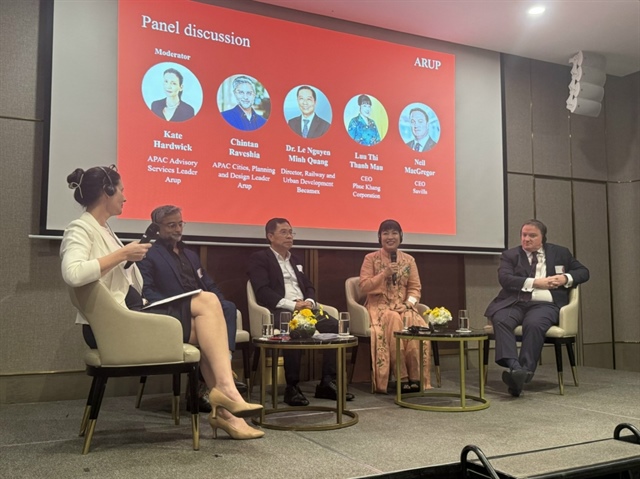
Panellists discussed on TOD development in Vietnam. Photo: VIR |
Speaking at a session titled “Connectivity to Value: The Next Phase of TOD in Vietnam,” part of the UK-Vietnam Business Forum 2026, on October 29, city officials, developers, property advisers, and urban designers discussed how to make the most of the country's spending on urban rail, as Ho Chi Minh City puts legal foundations under the transit-oriented development (TOD) model.
Dr. Jingfeng Xu, Vietnam country director of Arup, a London-headquartered engineering and urban design consultancy, opened by arguing that TOD is about daily life rather than density tables or land values.
“Choosing a new office for his own staff began as a property exercise but became a study of how a neighbourhood works, from safe walking routes in heat and rain to affordable lunches,” Xu said.
According to Xu, no single organisation by itself can do this alone. It requires government, transport authorities, developers, investors, planners, designers, and communities to work across traditional boundaries, and to think about the whole community and the whole place, rather than individual assets.
Huynh Pham Tuan Anh, deputy director of Ho Chi Minh City Department of Planning and Architecture, set out how the city is preparing.
“TOD must cover services and public space within a set radius of each station, and that underground and above-ground space around stations could also be developed. Land is the central constraint, he noted, and much of it must come from the state” Anh said.
On the legal side, Anh said the city has been working through a package of seven resolutions, of which four have been implemented and three are due soon while local authorities now carry responsibility for decisions.
“The role of the city council as well as the city administration is very important in building a policy that is compatible with the business experience,” he said. “I also hope that with the expertise of experts, such as investors on the ground, especially in the field of real estate development, it will help us a lot in the implementation of the legal regulations that we have built.”
Developers were quick to warn against shortcuts. Dr. Le Nguyen Minh Quang, director of railway and urban development at Becamex Group, said his company was not chasing fast returns.
“At Becamex, we are not looking for the quick win because we would like to build a long-term benefit for the city and for the country,” he said.
Quang, who ran the city’s urban railway management authority from 2016, was particularly critical of the build-transfer (BT) model, under which a private firm builds a line in exchange for land. He noted that China used the approach from 2000 to 2015 before stopping.
“With the BT, there is the risk of the misalignment between the construction and the operation,” he said. “At Becamex, we have a master developer who builds the line from the beginning, for the construction of the line, the development of the land, and the operation. This is the responsible way that we need to look at and try to advocate, rather than propose the BT model,” he added.
Luu Thi Thanh Mau, CEO of Phuc Khang Corporation said that Vietnam has strong fundamentals for TOD: rapid urbanisation, major investment in metro and transport infrastructure, and growing public expectations for healthier, more liveable urban environments.
“My confidence comes from the fact that TOD is no longer seen only as a transport or real-estate concept; it is increasingly understood to create complete, inclusive and resilient communities,” Mau said.
According to Mau, sustainability, housing quality and quality of place are not costs to be minimised; they are the foundations of long-term value. A development that is well-designed, energy-efficient, green, walkable and socially inclusive is more likely to retain residents, attract businesses, reduce operating risks and maintain its relevance as the city changes.
“For developers, this means designing for the whole life cycle of a project-not only the initial sale. It means investing in public space, landscape, shade, ventilation, community facilities, maintenance and management. It also means ensuring that housing serves different income groups and household needs, so that the place remains diverse and vibrant over time,” she said.
She added that if Vietnam is to accelerate TOD delivery over the next decade, the most important commitment is to design and deliver places around people, not around vehicles.
“That requires long-term collaboration among government, developers, investors and communities to align planning, infrastructure, housing, public space and operations from the earliest stage,” Mau added.
Neil McGregor, CEO of Savills Vietnam, said the market was already changing. After years of working in Vietnam, he said his confidence rests on its track record.
“Vietnam has a remarkable success rate at getting things done, breaking down barriers, getting through challenges, and making things happen,” he said. “We have a fantastic legal framework now (Vietnam’s Law on Urban Development, which took effect on October 1). We also have talk of evolving capital markets around the VIFC to bring more international capital in.”
McGregor also noted that buyers and tenants are gradually shifting away from a speculative mindset.
“People can see the infrastructure coming. It is real, it is happening, it is being finished largely according to timeframes that governments have provided,” he said. “Now, office occupiers now ask whether good food outlets and affordable gyms are close by, not just whether a building has green certification.”
- 18:02 02/11/2026