

Garment, textile industry looks to AI, robots to boost competitiveness
Garment, textile industry looks to AI, robots to boost competitiveness
AI should be viewed as a comprehensive tool for manufacturing transformation rather than simply a technology for automated production lines or smart factories.
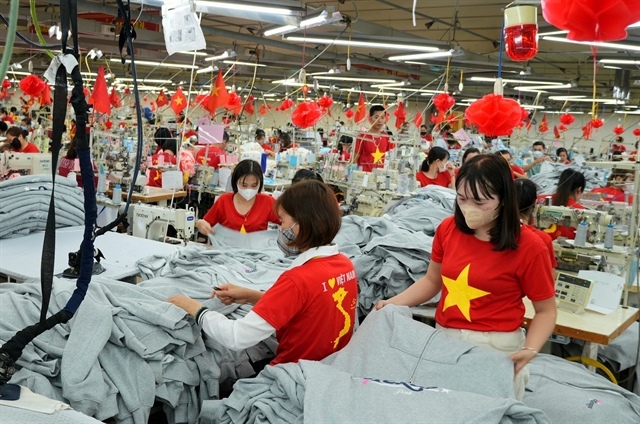
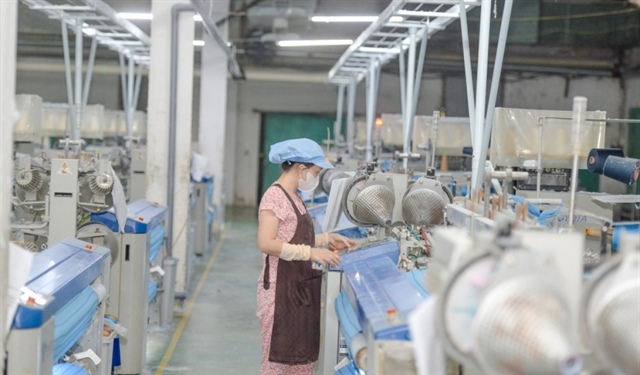
Production at a garment company in Bắc Ninh Province. Adopting AI can help garment and textile producers improve competitiveness. — VNA/VNS Photo Đồng Thúy |
The textile and garment industry is seeking to accelerate the adoption of artificial intelligence (AI), robotics and automation to improve productivity, meet increasingly stringent international standards and move towards higher value-added production.
Đỗ Nam Bình, deputy director of the Industry Agency under the Ministry of Industry and Trade, said textiles and garments remained a strategic sector of the Vietnamese economy with significant contribution to export earnings, job creation and the country’s integration into global supply chains.
However, the industry faces mounting international competition as major export markets impose increasingly demanding requirements on not only prices, quality and delivery schedules but also traceability, green production, emissions reduction and social responsibility.
The traditional growth model, which relies heavily on abundant labour and low production costs, is gradually reaching its limits, he said.
To maintain competitiveness and ensure sustainable development, the industry needs to shift towards a model driven by productivity, technological capabilities, product quality and greater participation in higher value-added segments.
Bình said AI should be viewed as a tool for comprehensive manufacturing transformation rather than simply a technology for automated production lines or smart factories.
AI can support businesses throughout their operations, from product design and market demand forecasting to production planning, material optimisation, order management, quality control and supply chain management.
Robots and automation solutions, meanwhile, can improve efficiency in material handling, fabric spreading and cutting, product inspection and packaging.
Nevertheless, the industry's diverse product range, frequently changing orders and the challenges of handling flexible materials and complex production processes require businesses to carefully select technologies suited to their specific needs.
For the majority of small- and medium-sized enterprises (SMEs) operating in the textile and garment sector, investment decisions must also take into account financial capacity, management expertise and the ability to adopt new technologies, Bình said.
Businesses do not necessarily need to invest immediately in large-scale or complex systems. They can begin with individual production processes or pilot projects, assess their effectiveness and gradually expand successful applications, he said.
The effectiveness of technological transformation should be measured through tangible improvements in labour productivity, product defect rates, material consumption, delivery times and production management, rather than simply the number of robots or AI systems installed in factories.
He also urged international cooperation to be enhanced to identify specific production challenges that require practical technological solutions, promote pilot research projects and strengthen workforce training to help domestic businesses master new technologies.
The priorities are in line with Việt Nam's broader policy under Politburo Resolution No. 57-NQ/TW on breakthroughs in the development of science and technology, innovation and national digital transformation.
Trương Văn Cẩm, deputy chairman of Vietnam Textile and Apparel Association, also emphasised that automation, digitalisation and AI were becoming key drivers of higher labour productivity, compliance with increasingly stringent international standards and sustainable development.
Alongside technological innovation, securing supplies of raw materials, particularly green materials with traceable origins, will be crucial to maintaining competitiveness amid global economic uncertainty and geopolitical tensions, Cẩm said.
Việt Nam remained among the world's three largest textile and garment exporters in 2025, with industry export turnover reaching US$46.2 billion, up 6 per cent year on year.
The sector recorded a trade surplus of approximately $21 billion, with products shipped to 138 international markets. Domestic value added accounted for around 52 per cent, reflecting greater domestic capacity in supplying materials and accessories.
In the first nine months of 2026, textile and garment exports reached $35.72 billion, an increase of 3.3 per cent compared with the same period last year and are heading to reach $49 billion this year.
- 09:15 02/11/2026