

Policy certainty can unlock oil and gas growth
Policy certainty can unlock oil and gas growth
With mature fields declining, new discoveries becoming increasingly difficult and costly to develop, and pressure mounting to diversify beyond conventional exploration and production, a consistent regulatory framework will be essential to sustaining domestic output, attracting long-term investment and strengthening national energy resilience

Oil rigs at the Bạch Hổ field. Large-scale energy projects require a more coherent policy environment, with consistency between the Petroleum Law, the Electricity Law and regulations governing land and the environment. — VNA/VNS Photo Huỳnh Sơn |
Stable and predictable policies will be critical to unlocking investment in Việt Nam’s oil and gas industry as it enters a more challenging phase, with mature fields declining, new discoveries becoming harder and more costly to develop, and the sector facing growing pressure to diversify beyond exploration and production.
While the new Petroleum Law is expected to provide a more flexible framework for difficult and marginal fields, industry experts say its effectiveness will depend on consistent implementation, timely decisions and clear commercial mechanisms that give investors confidence over the long term.
The challenge is becoming increasingly urgent as Việt Nam's remaining petroleum resources are concentrated in smaller, offshore and technically complex fields, requiring higher capital expenditure and more sophisticated technologies to maintain production.
Experts say many of the country's oil and gas fields are approaching the end of their production lives, while the remaining opportunities increasingly involve marginal fields and offshore locations with more challenging operating conditions.
Việt Nam's oil and gas output has fallen to around half its 2004 peak, while the Bạch Hổ field, one of the country's largest and most important producing assets, has been in operation for four decades.
This means the industry's next phase cannot rely on the development model that supported its earlier expansion. Instead, it will require a combination of more flexible investment policies, technological innovation and stronger international cooperation.
For investors, the question is whether resources can be developed profitably under a sufficiently predictable policy and commercial framework.
Oil rigs at the Bạch Hổ field. Large-scale energy projects require a more coherent policy environment, with consistency between the Petroleum Law, the Electricity Law and regulations governing land and the environment. — VNA/VNS Photo Huỳnh Sơn |
Major incentives
The new Petroleum Law, passed by the National Assembly on August 23, 2026 and scheduled to take effect on March 1, 2027, replacing the 2022 Petroleum Law, is expected to address some of the structural barriers facing the industry.
Phan Đức Hiếu, a member of the National Assembly's Economic and Financial Committee, said the new law was designed not only to facilitate petroleum exploration and production but also to strengthen the industry's technological capabilities and support national energy security.
He highlighted five major changes under the new law: greater decentralisation and delegation of authority, administrative reform and simplification, stronger investment incentives, development of petroleum services and measures to improve operational efficiency.
The legislation introduces differentiated incentives based on project characteristics and risks, rather than applying uniform conditions across fields with substantially different geological and economic prospects.
For marginal fields, the incentive framework can include a corporate income tax rate of 25 per cent, an export tax rate of 5 per cent and full cost recovery, according to Hiếu.
These provisions are significant because small reserves, difficult geological conditions and remote offshore locations can make projects substantially less attractive than conventional developments.
The law also introduces an integrated procedural framework for interconnected petroleum projects, covering facilities both offshore and onshore. Previously, such projects could require separate decisions at different levels of government. The new approach is expected to streamline approvals and facilitate coordinated development across entire project chains.
Hiếu said oil and gas remained important energy sources for Việt Nam, making it essential to maximise the efficient exploration, extraction and use of domestic resources. However, the country's ambition should extend beyond production towards developing its own petroleum science and technology capabilities.
Oil rigs at the Bạch Hổ field. Large-scale energy projects require a more coherent policy environment, with consistency between the Petroleum Law, the Electricity Law and regulations governing land and the environment. — VNA/VNS Photo Huỳnh Sơn |
The most important long-term objective, he stressed, was mastering strategic technologies, enabling domestic companies to participate more deeply in the international oil and gas industry.
A draft implementing decree is also expected to clarify the treatment of exploration and investment risks for Vietnam National Oil and Gas Group (PetroVietnam), an issue considered important for encouraging the group and its partners to undertake more challenging exploration activities.
The new framework should provide clearer economic incentives, particularly for projects in marginal fields and strategically important locations, while giving investors greater confidence about the risks they are taking.
However, incentives alone cannot guarantee investment. Accurate reserve assessments, effective cost management, appropriate technology and sound project governance will remain decisive factors.
A fresh model
Alongside improvements to the investment framework, the industry needs to diversify its sources of value creation as conventional petroleum resources become more difficult to exploit.
Đặng Thanh Tùng, deputy head of the Strategy Department at PetroVietnam, said increasingly limited resource potential required the group to transform its development model around three pillars: energy, industry and high-quality technical services.
He highlighted five strategic development priorities for the group: improving the efficiency of its core businesses, developing integrated value chains, establishing industrial-energy hubs, selectively expanding into new energy sectors and strengthening its technological and international capabilities.
Maintaining domestic production remains a priority, particularly through the application of new technologies and more flexible policy mechanisms to develop small and marginal fields and improve recovery rates from mature assets.
The group is also focusing on major gas projects, including the Ô Môn B and Cá Voi Xanh developments, while expanding overseas exploration and production opportunities.
|
Oil rigs at the Bạch Hổ field. Large-scale energy projects require a more coherent policy environment, with consistency between the Petroleum Law, the Electricity Law and regulations governing land and the environment. — VNA/VNS Photo Huỳnh Sơn |
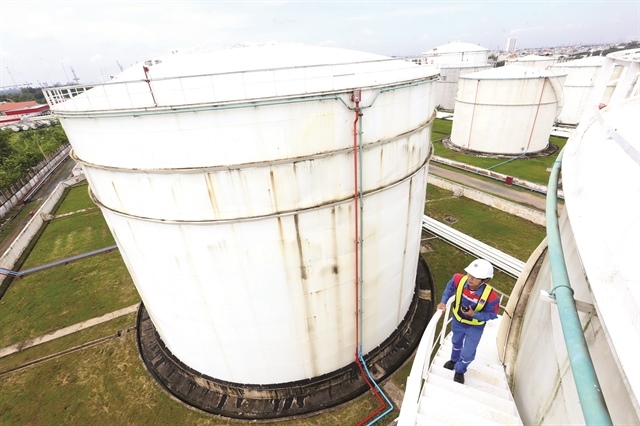
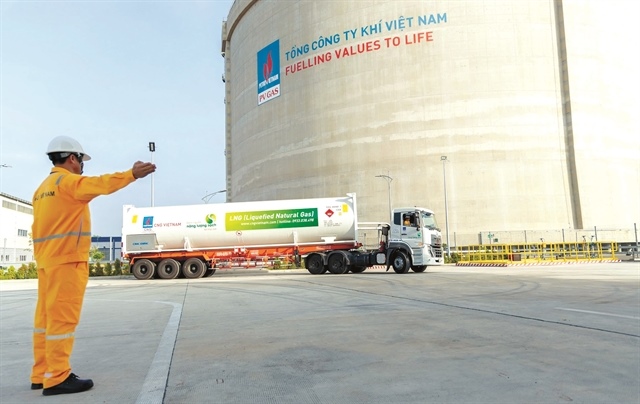
Developing the liquefied natural gas (LNG) value chain is another priority, despite considerable implementation challenges. Tùng said LNG would remain an important component of the energy mix over the longer term as electricity demand grows and pressure to reduce emissions increases.
PetroVietnam is also preparing to develop an offshore wind energy ecosystem and participate in nuclear power development, alongside opportunities in hydrogen and other emerging energy technologies.
These ambitions reflect a broader transition from a predominantly petroleum-oriented business towards an integrated energy and industrial group.
However, Tùng said large-scale energy projects would require a more coherent policy environment, with consistency between the Petroleum Law, the Electricity Law and regulations governing land and the environment.
They would also need appropriate risk-sharing mechanisms, long-term offtake agreements and transparent pricing frameworks to attract long-term financing.
Planning must be integrated, connecting energy supply with consumer markets, ports, storage facilities, pipelines and industrial parks. A delay in one component could hold up an entire project chain, particularly for LNG developments involving multiple investors and infrastructure operators.
Oil rigs at the Bạch Hổ field. Large-scale energy projects require a more coherent policy environment, with consistency between the Petroleum Law, the Electricity Law and regulations governing land and the environment. — VNA/VNS Photo Huỳnh Sơn |
Investment certainty
The gap between policy design and implementation remains a major concern.
Nguyễn Hùng Dũng, general secretary of the Việt Nam Petroleum Association, said Việt Nam had considerable opportunities to develop its remaining petroleum resources, but many projects were still struggling to attract investment.
An appropriate pricing mechanism was essential for making projects viable, he said, noting that investors could be reluctant to commit capital while waiting for clarity on electricity prices and power purchase agreements.
Delays in decisions on pricing and power purchase agreements could hold up project implementation and undermine investment efficiency, he said.
The issue was particularly relevant to gas projects and associated infrastructure, where upstream development, gas transportation, power generation and electricity sales must be coordinated.
Even when resources had been identified and investment plans prepared, uncertainty over commercial arrangements could delay final investment decisions and affect the financial viability of projects.
Dũng welcomed greater autonomy for PetroVietnam but said the group's overlapping roles as an investor and contractor could create management challenges if responsibilities and decision-making mechanisms were not clearly defined.
He also called for greater opportunities for domestic contractors to participate in major energy and petroleum projects. Nationally important projects should identify areas where Vietnamese companies have the capacity to participate, with international contractors brought in where domestic capabilities are insufficient, while maintaining fair competition.
For an industry characterised by high capital requirements and long development cycles, policy predictability extends beyond tax incentives. Investors need clarity over project approvals, contractual terms, cost recovery, pricing and the division of responsibilities among stakeholders.
Phạm Trường Giang, from the Việt Nam Petroleum Institute, said small and marginal fields held considerable remaining in-place reserves but faced significant risks associated with investment costs and economic returns.
He called for policy and institutional barriers to be removed to enable more projects to move into the development stage.
Đặng Thị Thu Hoài, head of the Department of Sectoral and Local Economic Research under the Institute for Policy and Strategy Research, emphasised the strategic importance of oil and gas and the wider energy sector to economic growth, technological development and national sovereignty.
She said the industry needed to make a greater contribution in line with its strategic role while shifting its focus from resource extraction towards developing and mastering technology.
Ultimately, the next phase of Việt Nam's oil and gas industry would be determined by how effectively the country can mobilise investment, master technology and turn existing industrial capabilities into new sources of value, Hoài said.
- 08:09 07/11/2026