Rising AI demand, data centre growth underscore need for reliable energy supplies in Việt Nam
Rising AI demand, data centre growth underscore need for reliable energy supplies in Việt Nam
Việt Nam needs to accelerate investment in reliable energy supplies and sustainable infrastructure to support the rapid expansion of artificial intelligence and data centres.
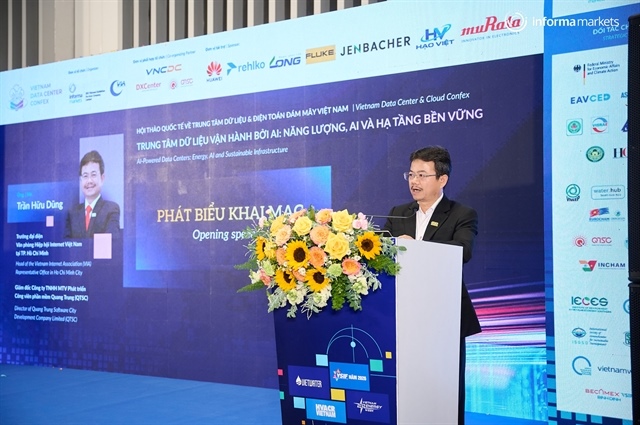
Trần Hữu Dũng, head of the Vietnam Internet Association’s representative office in HCM City and director of Quang Trung Software City Development Co Ltd, speaks at the event. — Photo courtesy of the organiser |
Việt Nam needs to accelerate investment in reliable energy supplies and sustainable infrastructure to support the rapid expansion of artificial intelligence (AI) and data centres, industry insiders said.
Speaking at the Vietnam Data Center & Cloud Confex 2026 in HCM City on November 4, Trần Hữu Dũng, head of the Vietnam Internet Association’s representative office in HCM City and director of Quang Trung Software City Development Company Limited, said the growing adoption of AI was reshaping global digital infrastructure, driving demand for computing capacity, data storage, connectivity, electricity and cooling systems.
Citing international research, he said McKinsey estimated that global investment in computing infrastructure would reach US$6.7 trillion by 2030, including $5.2 trillion for AI-related infrastructure.
Meanwhile, the International Energy Agency projected that electricity consumption by data centres would nearly double by 2030 to around 950 billion kWh, while consumption by AI-focused data centres was expected to triple over the same period.
"These figures reaffirm that AI development must go hand in hand with reliable energy supplies and sustainable infrastructure," Dũng said.
He said Việt Nam was emerging as a promising data infrastructure market, driven by demand for AI, cloud computing, the commercialisation of 5G and digital transformation.
The country's regulatory framework was also creating favourable conditions for investment. The Telecommunications Law allows foreign investors to hold up to 100 per cent ownership in data centre and cloud computing businesses, opening up opportunities to attract international capital, technology and management expertise.
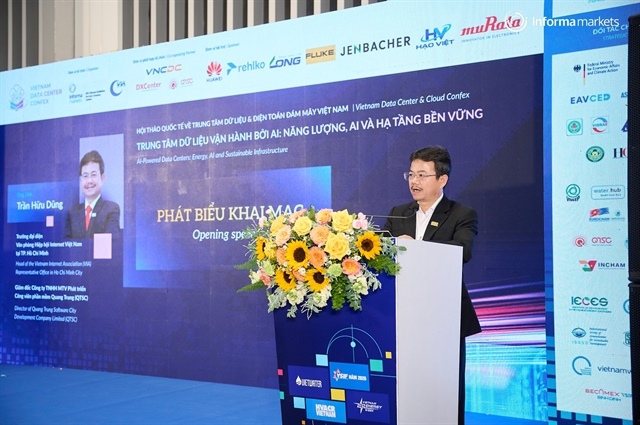
Trần Hữu Dũng, head of the Vietnam Internet Association’s representative office in HCM City and director of Quang Trung Software City Development Co Ltd, speaks at the event. — Photo courtesy of the organiser |
Meanwhile, the Law on Personal Data Protection, which took effect on January 1, 2026, establishes stricter requirements for data security and the responsibilities of organisations processing personal information.
The development of data centres and digital infrastructure is also aligned with the Politburo’s Resolution 57-NQ/TW, which identifies science and technology, innovation and national digital transformation as key drivers of development.
The resolution encourages domestic enterprises to develop data infrastructure while attracting foreign corporations to invest in data centres and cloud computing in Việt Nam, creating further opportunities to expand the country's digital infrastructure and computing capacity.
To capitalise on these opportunities, Việt Nam needs coordinated investment in green power supplies, international submarine cable connectivity and operational capabilities that meet global standards, Dũng said.
Jason Wu, chief executive officer of Huawei Southeast Asia Digital Power, said energy was fundamental to economic development and that Việt Nam's rapid economic growth would further increase electricity demand.
He said renewable energy could help address the growing power demand, reduce dependence on imported fossil fuels and support the country's carbon neutrality goals. However, a higher proportion of renewable energy in the power mix could create grid stability challenges.
Wu highlighted the importance of grid-forming technology, saying integrated photovoltaic, wind and battery energy storage systems could help stabilise the grid and replace conventional thermal power generation.
He also noted that Việt Nam's data centre capacity was expected to increase by more than 500MW by 2030, according to third-party research.
"Reliable energy supplies will affect the sustainable development of the AI industry. Therefore, Việt Nam's AI development and energy transition are inseparable. The synergy between computing and power will be a future development trend," he said.
The conference also featured discussions on AI-ready infrastructure, thermal management, modular data centre design, and backup power solutions, alongside practical experience in developing green and sustainable data centres and building and operating large-scale AI facilities.
The conference was held as part of the Vietnam Energy Week, taking place at the Saigon Exhibition and Convention Centre from November 4 to 6.
- 10:12 06/11/2026