

HCM City seeks to become international logistics hub
HCM City seeks to become international logistics hub
HCM City is accelerating port infrastructure investment, multimodal transport connectivity and green logistics development to establish itself as an international logistics hub and regional supply chain centre.
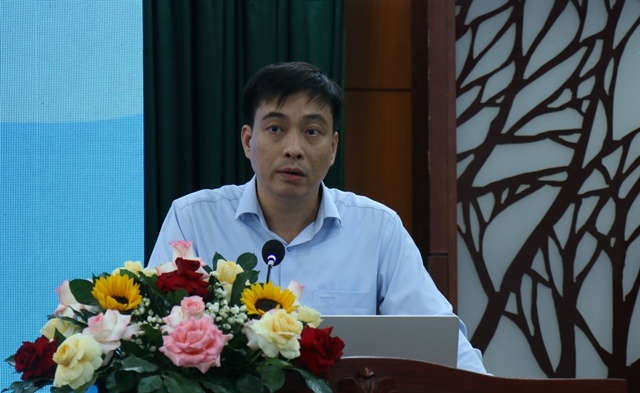
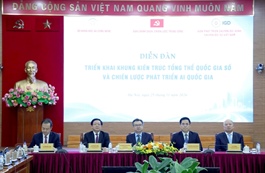
Dr. Bùi Nguyễn Anh Tuấn, deputy director of the Agency for Domestic Market Surveillance and Development under the Ministry of Industry and Trade, speaks at the event. — VNS Photo Văn Châu |
HCM City is stepping up efforts to become an international logistics hub by improving multimodal transport connections, expanding port capacity and attracting investment in high-value logistics and maritime services.
Following its merger with Bình Dương and Bà Rịa-Vũng Tàu, the city has gained a larger economic space linking major industrial centres, deep-water seaports, airports and regional transport networks.
Speaking at a seminar on Thursday, Lê Văn Danh, deputy director of the municipal Department of Industry and Trade, said the city needed to move beyond basic transportation and warehousing services towards developing stronger capabilities in supply chain organisation, connectivity and coordination, in line with Việt Nam's logistics service development strategy for 2025-35, with a vision to 2050.
Despite its advantages, HCM City still faces challenges, including inadequate transport connections, an imbalance between transport modes and limited value-added logistics services.
Domestic businesses also need to strengthen their participation in international supply chains.
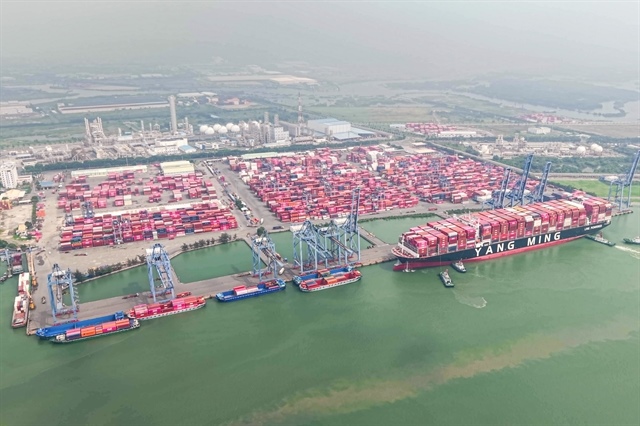
The Cái Mép-Thị Vải port complex offers a major competitive advantage.
Cái Mép ranked 11th globally in the 2025 Container Port Performance Index, while cargo throughput across the city's port system reached nearly 356 million tonnes.
Trần Ngọc Thanh, a logistics expert from a consulting consortium comprising the National Institute of Urban and Rural Planning and Boston Consulting Group, said the city's master plan for 2025-50, with a 100-year vision, was studying three logistics spatial layers and five multimodal transport corridors.
The Cái Mép Hạ Free Trade Zone is expected to become a key development driver.
He called for better connections between seaports, airports, roads, railways, inland waterways, industrial parks and logistics centres.
Meanwhile, Trịnh Tú Anh, director of the Institute of Smart Cities and Management at the University of Economics HCM City, proposed establishing an inter-agency coordination body and developing a shared data platform and digital twin for the Cái Mép, Cần Giờ and Cát Lái port clusters.
She said an international logistics hub should move beyond being a gateway for goods to become a centre for coordinating regional supply chains.
Đặng Minh Phương, chairwoman of the HCM City Logistics and Seaports Association, said the city should focus on three pillars: multimodal transshipment and distribution, high-value supply chain services and global support services.
She also highlighted the need to accelerate infrastructure investment, promote green finance, develop skilled logistics personnel and strengthen international cooperation.
Bùi Nguyễn Anh Tuấn, deputy director of the Ministry of Industry and Trade's Agency for Domestic Market Surveillance and Development, said HCM City had been identified as the core of the southeastern logistics growth pole under the proposed national logistics centre development scheme.
Dr. Bùi Nguyễn Anh Tuấn, deputy director of the Agency for Domestic Market Surveillance and Development under the Ministry of Industry and Trade, speaks at the event. — VNS Photo Văn Châu |
Major maritime projects
Alongside its logistics strategy, the city is accelerating major maritime infrastructure and renewable energy projects in its eastern area.
On November 25, municipal Party Committee Secretary Trần Lưu Quang and Chairman of the municipal People's Committee Lê Quốc Phong led a delegation to inspect key projects in the Cái Mép-Thị Vải area.
At Gemalink deep-water port, representatives of Gemadept said the company was developing an integrated port-logistics ecosystem connecting seaports, river ports, inland container depots and logistics centres.
Gemalink is among 19 ports worldwide capable of accommodating container vessels of up to 250,000 DWT, equivalent to approximately 24,000 TEUs.
During 2026-30, Gemadept plans to invest around VNĐ100 trillion (roughly US$4 billion) in HCM City to expand port capacity and develop logistics and maritime services.
It also proposed accelerating the second phase of Gemalink to raise annual handling capacity to more than four million TEUs.
The Cái Mép Hạ International General Port and Container Terminal project covers approximately 351.2 hectares, with estimated investment of VNĐ50.8 trillion and designed annual capacity of 10.8 million TEUs.
|
Dr. Bùi Nguyễn Anh Tuấn, deputy director of the Agency for Domestic Market Surveillance and Development under the Ministry of Industry and Trade, speaks at the event. — VNS Photo Văn Châu |
Its first phase, covering 123.2 hectares, began construction in July 2026 and is expected to become operational in the fourth quarter of 2028.
However, the project is facing obstacles involving land procedures, marine areas and the treatment of dredged material.
Trần Lưu Quang said the city should aim to establish an international transshipment hub and a regional maritime economy and logistics centre.
He also called for stronger connections between deep-water ports, river ports and inland logistics facilities to reduce road congestion and transport costs.
The delegation also inspected the PTSC Renewable Energy Industrial and Service Complex and Port project (REHub) in Rạch Dừa Ward.
PetroVietnam Technical Services Corporation (PTSC) plans to develop infrastructure across approximately 83 hectares, linked to its existing 181-hectare facility, with estimated infrastructure investment of nearly VNĐ7 trillion.
The total investment in the proposed complex is expected to reach around VNĐ30 trillion, including facilities for training, research, high-voltage subsea cable manufacturing and wind turbine tower production.
The project is expected to support the offshore renewable energy supply chain, attract international investors and facilitate technology transfer.
Trần Lưu Quang called on relevant agencies to coordinate with PTSC to resolve planning, land and investment procedures, stressing the need to remove bottlenecks and unlock the city's maritime economic potential.
HCM City aims to build an integrated logistics ecosystem that combines modern port infrastructure, multimodal transport, digital services and renewable energy development, strengthening its position as a regional trade and supply chain hub.
- 10:15 27/11/2026