FTAs push businesses to build sustainable supply chains
FTAs push businesses to build sustainable supply chains
Turning tariff preferences into export orders requires businesses to meet import standards, ensure transparent origin documentation and build competitive supply chains.
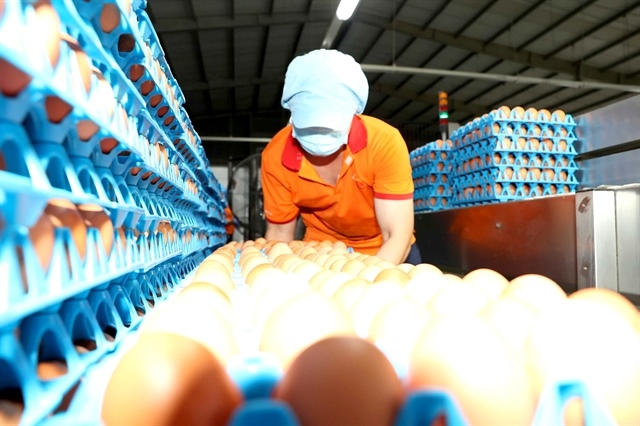
Workers at QL FARMS Co Ltd (Tây Ninh) inspect the quality of chicken eggs. Tây Ninh Province is developing high-tech poultry farming with the goal of exporting chicken eggs to markets under FTAs, including markets requiring Halal certification. — VNA/VNS Photo |
As Việt Nam expands its network of free trade agreements (FTAs), businesses must build sustainable supply chains and establish strong brands for key export products to secure orders in new markets.
The growing number of FTAs is creating new opportunities for domestic goods to enter international markets. However, turning tariff preferences into export orders requires businesses to meet import standards, ensure transparent origin documentation and build competitive supply chains.
As of October 2026, Việt Nam had signed and implemented 18 FTAs, broadening market access for domestic goods. But access to new markets does not guarantee more orders. Tariff preferences are of limited value if products lack the required certification, cannot prove their origin or fail to meet quality standards.
The Comprehensive Economic Partnership Agreement between Việt Nam and the United Arab Emirates (CEPA) illustrates this gap. After around eight months in force, the agreement has opened up further opportunities for Vietnamese goods in the Middle East. However, exporters must still navigate technical barriers, quarantine regulations and stringent food safety requirements in the UAE.
Phạm Bình An, former deputy director of the Hồ Chí Minh City Institute for Development Studies, said businesses should not confuse tariff preferences with smooth customs clearance.
The UAE maintains stringent technical barriers to trade (TBT), sanitary and phytosanitary (SPS) measures and food safety requirements, according to An.
Halal certification involves more than ensuring products contain no pork. It requires strict compliance throughout the supply chain, from tracing raw materials and preventing cross-contamination during production to meeting requirements for storage and transportation.
"A company's Halal certification must be officially recognised by the competent authorities in the UAE before its goods can be legally marketed," An said.
To minimise risks, An recommended that exporters establish a six-step internal control process covering the identification of Harmonised System (HS) codes, reviews of tariff reduction schedules, completion of certificates of origin (C/Os), assessment of Halal requirements, product testing and verification of business partners' legal capacity.
Businesses should also identify market requirements and compliance costs at an early stage, when selecting products, sourcing materials and negotiating contracts. Focusing solely on tariff reductions could leave them overlooking high costs, he said.
Another point to consider is that Vietnamese goods re-exported through the UAE do not automatically qualify for preferential treatment in third countries. According to An, businesses must check the rules of origin applicable in the final destination market.
Building market presence
From a market development perspective, Trương Xuân Trung, head of the Vietnam Trade Office in the UAE, recommended that businesses prioritise the UAE's domestic market to test products, assess their suitability and build brand positioning.
Vietnamese products with competitive strengths include fresh agricultural produce, processed foods, textiles and garments, footwear and furniture.
"Once they have established a foothold in the UAE, businesses can expand into other countries of the Gulf Cooperation Council (GCC), depending on their ability to meet standards and demand in each market," Vnbusiness.vn quoted Trung as saying.
The challenge, therefore, extends beyond finding importers. Businesses need to target the right market segments, understand consumer demand and identify their products' competitive advantages. Production, certification and distribution strategies must then be tailored to individual markets and customer groups.
Workers at QL FARMS Co Ltd (Tây Ninh) inspect the quality of chicken eggs. Tây Ninh Province is developing high-tech poultry farming with the goal of exporting chicken eggs to markets under FTAs, including markets requiring Halal certification. — VNA/VNS Photo |
While CEPA offers further opportunities in the Middle East, the Vietnam-European Free Trade Association (EFTA) Free Trade Agreement (VEFTA), offers prospects for access to Switzerland, Norway, Iceland and Liechtenstein following its signing in Hà Nội in mid-October 2026.
Associate Professor Đào Ngọc Tiến, PhD, vice rector of Foreign Trade University, said VEFTA would not only open up new markets but also encourage businesses to upgrade production, build brands and improve their ability to meet international standards in response to the EFTA countries' demanding requirements.
Businesses need to factor in rules of origin when selecting suppliers and signing contracts. Raw material sourcing, production processes and origin documentation must be managed in a coordinated manner to avoid losing preferential tariff benefits after goods have been produced.
Meeting green standards
Beyond rules of origin, environmental, social and governance (ESG) standards are increasingly influencing market access.
Đỗ Thiên Anh Tuấn, PhD, head of Public Policy and Management at Fulbright, said businesses should use new FTAs to diversify export markets, particularly by tapping into promising niche markets.
However, major markets were tightening requirements on ESG, carbon emissions and traceability, requiring businesses to invest in green transformation to remain competitive.
Tuấn said textile and garment, footwear, wood processing and food processing businesses needed to invest in renewable energy, reduce emissions and strengthen traceability systems to meet export market requirements.
"Businesses should proactively pursue green and digital transformation, particularly by investing in ESG standardisation and meeting traceability requirements to overcome the technical barriers," Tuấn said.
Businesses could start by reviewing energy and material consumption, defect rates and the origins of their inputs. Data on product quality, traceability and emissions control, combined with reliable delivery performance, could help convince importers and secure long-term orders.
Meanwhile, Phan Tấn Đạt, vice chairman of the Vietnam Young Entrepreneurs Association, said even high-quality products could struggle to expand into international markets without stable raw material sources, capable suppliers, distribution networks and suitable technology and financial partners.
To achieve this, exporters needed to work with raw material suppliers and production areas to standardise quality, ensure traceability and maintain reliable supplies.
Industry associations should also help businesses keep abreast of rules of origin and import standards, while connecting them with partners capable of placing long-term orders.
- 08:17 21/11/2026