World Bank raises Vietnam's 2026 GDP growth forecast to 7.4 per cent
World Bank raises Vietnam's 2026 GDP growth forecast to 7.4 per cent
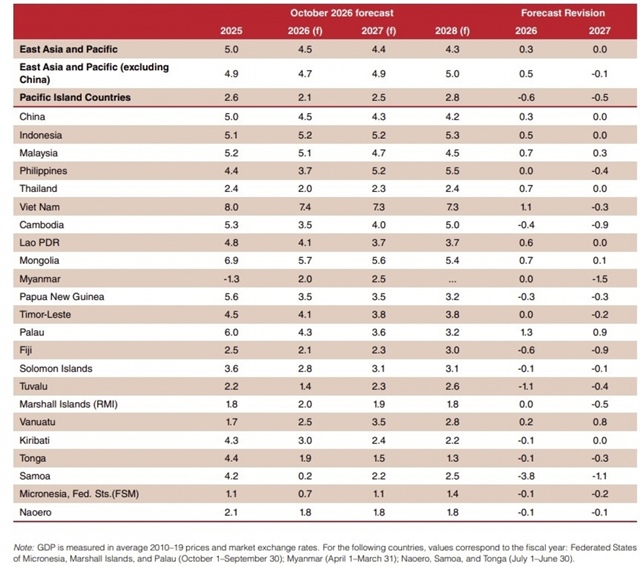
The World Bank has raised its forecast for Vietnam's economic growth in 2026 by 1.1 percentage points to 7.4 per cent, the largest upward revision among Asia-Pacific economies.
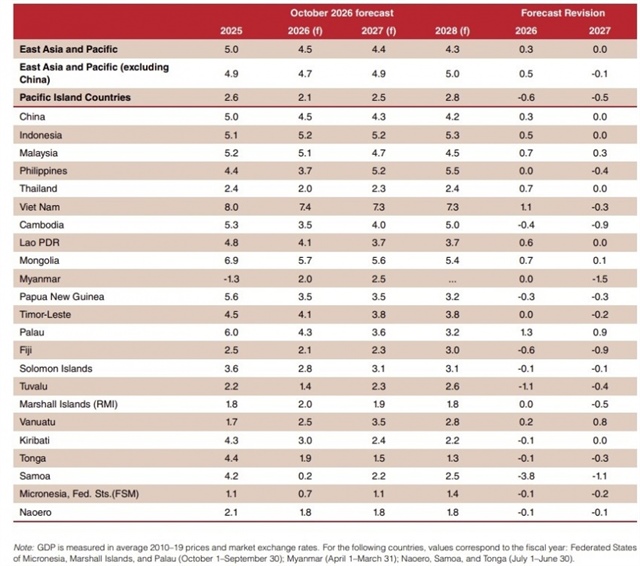
Photo: World Bank |
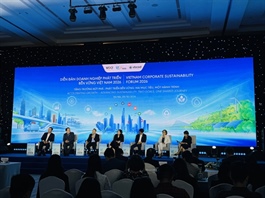
The projection was released at an online briefing on October 6 to present the World Bank's East Asia and Pacific Economic Update. The report noted that some regional economies are expected to grow faster than previously forecast in 2026, driven by manufacturing and exports of high-tech goods underpinning the global AI boom.
Vietnam’s 2026 growth forecast was raised by 1.1 percentage points to 7.4 per cent. Malaysia’s forecast was increased by 0.7 percentage points to 5.1 per cent, while Thailand’s was also raised by 0.7 percentage points to 2 per cent.
The Pacific Island economies are projected to grow by 2.2 per cent, 0.5 percentage points lower than the previous forecast. China, the region’s largest economy, is expected to grow 4.4 per cent, as domestic purchasing power remains constrained by a weak labour market and ongoing adjustments in the property sector.
With projected growth of 7.4 per cent, Vietnam received the largest upward revision among economies in Asia-Pacific, at 1.1 percentage points. The 7.4 per cent projection also puts Vietnam at the top of the regional growth forecast.
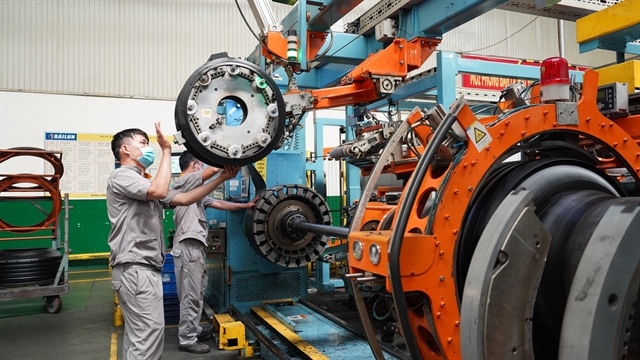
According to the World Bank, manufacturing, exports, and public investment are the key drivers of Vietnam’s growth. The country’s growth outlook is expected to remain strong in 2026.
Economic activity is expected to benefit from domestic stimulus measures through structural reforms and expanded public investment. Inflation is projected to average 4.2 per cent in 2026, driven by higher fuel, housing, and utility costs.
In a dedicated analysis of AI in the region, the report noted that many economies are benefiting from supplying goods that underpin the global surge in AI investment.
Carlos Felipe Jaramillo, World Bank vice president for the East Asia and Pacific Region, said, "Deep integration into global value chains and dynamic economies put the Asia-Pacific region in a strong position to capitalise on the global boom in AI-related activity."
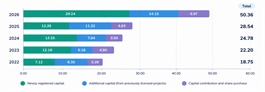
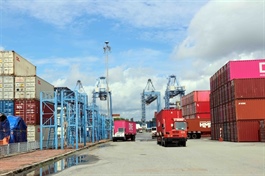
In Vietnam, goods exports rose 22 per cent on-year in August, with particularly strong growth in electronics and machinery. Investment in these sectors has remained high, while foreign direct investment inflows into Vietnam in the first half of the year reached their highest level in five years.
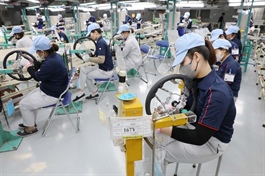
The World Bank report noted that manufacturing and exports of high-tech and AI-related goods had provided a foundation for Vietnam’s stronger-than-expected growth, and the trend is expected to continue in the coming period. Exports of AI-related goods from several economies, including Vietnam and Malaysia, have at least doubled compared with the 2020-2022 average.
However, this is also creating a new risk for Vietnam. The World Bank warned that growing dependence on AI-related manufacturing and trade, which is currently a source of strength for the region, could become a vulnerability if global AI activity slows or reverses.
A downturn in AI demand would have a more direct impact on downstream economies such as Vietnam and Thailand, where exports are more heavily dependent on final demand for AI-related products.
Franziska Ohnsorge, World Bank chief economist for the Asia-Pacific region, said Vietnam’s growth outlook in the coming period would depend significantly on developments in the external environment.
“As one of the world’s most open economies, Vietnam is deeply integrated into AI-related supply and value chains. If the trend of strong AI demand continues, Vietnam will have significant opportunities to benefit and sustain high growth. However, this is also a risk factor because if the AI trend reverses, Vietnam’s growth could be affected,” she said.
While the current AI wave is supporting Vietnam’s growth through exports of high-tech goods, the report stated greater potential lies in integrating AI into the domestic economy.
According to the World Bank, Vietnam’s next challenge is to continue attracting investment into manufacturing products serving AI-related value chains while enhancing the economy’s capacity to absorb and apply technology.
The report shows that individual use of generative AI in Vietnam is among the highest in emerging Asia-Pacific economies, alongside Malaysia, the Philippines, and China. The World Bank estimates that the level of individual GenAI use in Vietnam is now comparable to the global average.
AI tools are helping small hotels and travel businesses create promotional images and adjust prices more flexibly at lower costs. An AI training tool designed for Vietnamese-language users has become one of the popular language-learning tools in the country.
In healthcare, AI-powered medical imaging systems are helping resource-constrained hospitals improve their diagnostic capabilities.
- 11:41 07/10/2026