VIR seminar focuses on taking domestic suppliers into global supply chains
VIR seminar focuses on taking domestic suppliers into global supply chains
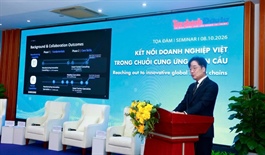
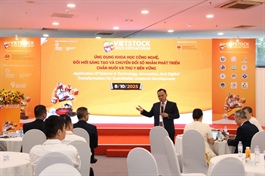
Comprehensive reform enhancing the absorption capacity of domestic enterprises to join global supply chains was the focus of a panel discussion at a seminar, organised by VIR in Hanoi on October 8.
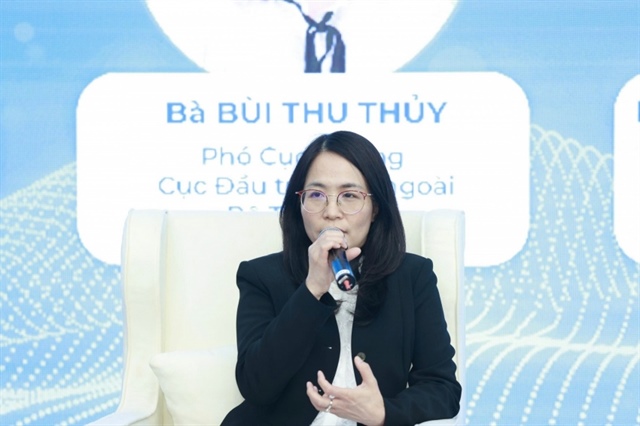
Photo:VIR |
The discussion also focused on the new requirements arising from Resolution No.10-NQ/TW on the development of the foreign-invested economic sector, while exploring ways to create a more favourable environment for Vietnamese businesses to enhance their competitiveness and participate more deeply in global value chains. Here, several expert panellists give their outlook on the next stage:
|
Bui Thu Thuy, deputy director general of the Foreign Investment Agency under the Ministry of Finance
One of the major shifts in thinking regarding foreign direct investment (FDI) attraction in Resolution 10 is the change from attracting foreign investment to developing an economy with foreign investment, shifting from attracting FDI in isolation to developing a comprehensive investment and business ecosystem.
This requires a change in thinking and methods of FDI management, both at the central and local levels. Agencies must shift from an administrative management mindset to a development-oriented mindset, accompanying investors throughout the entire project lifecycle. To effectively utilise FDI, ministries, sectors, and localities need to prepare the following conditions:
The first is the institutional framework. The institutional framework, procedures, and national and local governance capacity are crucial factors in attracting high-quality capital.
The second factor is strategic infrastructure and the industry ecosystem. To allow FDI flows to spread and for domestic businesses to leverage the internal strengths of the economy, it must prepare the complete infrastructure and industry ecosystem, which includes not only traditional infrastructure but also digital infrastructure, and the capacity to supply clean and stable energy sources.
The quality of human resources is also important. Attracting good projects also requires a readily available, high-quality workforce. This is also a major challenge. To anticipate high-tech projects, we must prepare a high-quality workforce, especially in the fields of semiconductors, AI, automation, among others.
Finally, it is about enhancing the absorption capacity of domestic enterprises. Resolution 10 provided strong direction, and currently the Ministry of Finance is proposing superior investment incentives and support mechanisms, close to the practices of other countries, to encourage foreign-invested enterprises to transfer technology and increase spillover effects into the domestic economy. However, domestic enterprises also need to improve their capacity and prepare well to participate in the supply chain when having opportunities.
|

Truong Thi Chi Binh, deputy chairwoman of the Vietnam Association for Supporting Industries (VASI)
For export-oriented manufacturing, multinational companies almost always rely on their existing global supply chains when they set up production in Vietnam. High-end mobile phones are an example; to guarantee consistent quality, producers must bring in their trusted suppliers rather than simply switching to local ones.
If local firms want to enter global supply chains, they need to have clear and specific support from the government. Other countries have taken different paths. Thailand, Malaysia and China each developed deliberate strategies for electronics. In China, large production sites often benefit from significantly lower land costs.
In Vietnam, industrial land near major hubs can cost around $170 per square metre; even in more distant locations the cost is even about $90. Combined with interest rates of 12 per cent for seven-to-ten-year loans, these conditions discourage investment. A manufacturer can earn nearly the same return simply by placing money in a bank at 10 per cent with less risk.
Developed countries such as Japan and Germany still offer free or heavily subsidised land in many areas.
Vietnam already has more than 500 capable supporting-industry suppliers. With the right policies, these firms - and the members of our association - can expand together. In the past ten years, strong export growth and rising domestic demand have helped many former SMEs become substantial companies. VASI now includes a number of large enterprises, and our goal is to develop 10 to 20 leading companies that can pull smaller partners into their supply chains and share the experience they have gained through years of challenges.
|
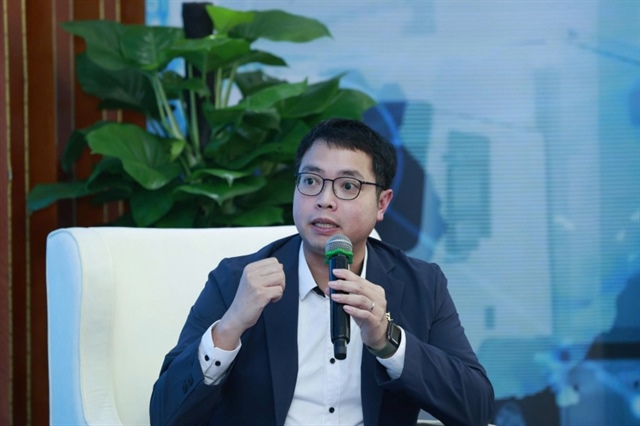
Nguyen Thu Ha, national director of executive Search & Selection and Hanoi Total HR Solutions Business Development at Talentnet
After nearly twenty years of recruitment work for both foreign-invested and local companies, we repeatedly hear the same observations from foreign employers.
First, the skills of new graduates remain limited. Vietnam still lacks a strong vocational-education system, and university curricula often fail to match the competencies companies actually need. Second, while the technical level of engineers has improved in recent years, foreign-language proficiency lags that of peers in the Philippines, Thailand, and Malaysia. This restricts career development and makes it harder for Vietnamese professionals to learn from and communicate with international partners. Leadership and management capabilities are also generally weaker than in neighbouring countries, limiting the ability to operate effectively in a global context and to understand complex international supply chains.
The practical question, therefore, is how Vietnam can prepare its talent for global roles. At Talentnet, we support extensive recruitment for FDI firms and work equally closely with local companies. We work with business owners to design remuneration policies, competency frameworks and detailed skill-mapping exercises so that local enterprises can attract, develop and retain the people they need to compete internationally.
|
Jackson Woo, managing director of SGS Vietnam
I would like to return to a fundamental issue, namely trust. Without trust, global buyers will simply not engage Vietnamese suppliers. The majority of my clients in Vietnam are foreign-invested companies that already serve as tier-one, tier-two or tier-three suppliers to major international buyers. Global buyers tend to stay with these established FDI partners because the products must meet worldwide quality and regulatory standards.
Although the country has a large domestic consumer market of more than 100 million people, the export and domestic tracks are still distinct.
In addition to stimulating internal demand, we must help Vietnamese suppliers enter global supply chains by building an innovative ecosystem grounded in trust. I do not see major technical quality barriers among existing local suppliers; most are willing to learn, listen and seize opportunities. The real question is where they should allocate limited capital - land, technology, people, materials or quality systems. Clear government direction for the next five to ten years is therefore essential. The localisation strategy and the focus on high-tech industries announced earlier this year are positive steps. Society as a whole - universities, industrial parks, energy suppliers - must align curricula and infrastructure with future demand.
In the past, Vietnam treated FDI mainly as a source of capital. The government is now taking a better approach: FDI is viewed as a catalyst that can help local firms generate domestic value. Besides that, one thing is international standards, including environmental, social, and governance. ESG requirements are no longer optional; they are demanded both by global buyers and by the regulations of destination markets. Companies that want their products sold overseas must implement at least minimum ESG practices.
- 14:50 08/10/2026