

Việt Nam seeks to help businesses adopt greener production
Việt Nam seeks to help businesses adopt greener production
Vietnamese businesses need better access to technology, research and finance to adopt greener production methods and cut carbon emissions, officials and experts said at an international conference in HCM City on Monday.
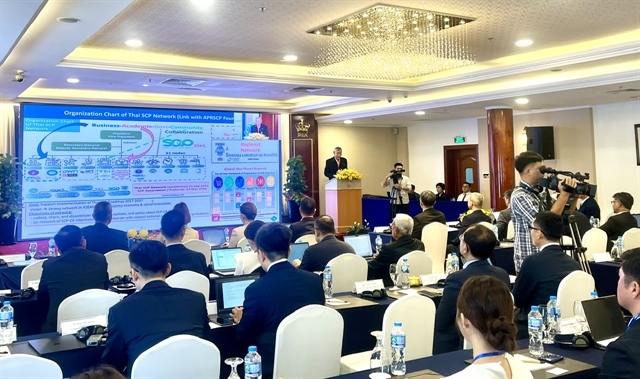
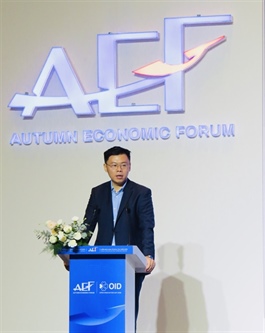
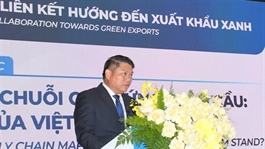
A speaker addresses the 18th Asia Pacific Roundtable for Sustainable Consumption and Production in HCM City on Monday, held as part of the Autumn Economic Forum 2026. — VNS Photo Bồ Xuân Hiệp |
Vietnamese businesses need better access to technology, research and finance to adopt greener production methods and cut carbon emissions, officials and experts said at an international conference in HCM City on Monday.
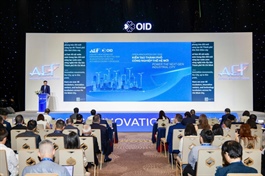
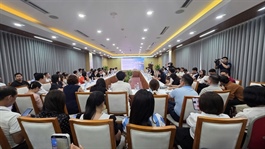
The 18th Asia-Pacific Roundtable for Sustainable Consumption and Production, held as part of the Autumn Economic Forum 2026, brought together government officials, researchers, businesses and international organisations to discuss how to accelerate the shift towards a circular, digital and low-carbon economy.
The discussions focused on the need to translate scientific research into practical solutions for businesses, improve resource efficiency and strengthen cooperation among policymakers, universities and industry.
The challenge is particularly important for small and medium-sized enterprises (SMEs), which need access to appropriate technologies, technical expertise and finance to change production processes and reduce waste.
Turning research into business solutions
Hoàng Văn Tâm, head of the General Affairs Division at the Ministry of Industry and Trade’s Department for Science, Technology and Digital Transformation, said science, technology and innovation were essential to making the green transition more effective.
“Data, digital tools and innovation are what make green transformation measurable, bankable and scalable,” he said.
He said that policies should be based on scientific evidence and reliable data, while closer links were needed between research institutions, government agencies and businesses.
“Good policies must be built on scientific evidence and reliable data,” he added.
The Ministry of Industry and Trade is leading the National Action Programme on Sustainable Consumption and Production for 2021-30 and developing circular economy criteria and models under the national circular economy scheme.
Sustainable consumption and production aims to use natural resources more efficiently, reduce waste and pollution, and minimise environmental impacts throughout the life cycle of products and services.
A circular economy takes this approach further by keeping materials and products in use for longer through reuse, repair and recycling, reducing dependence on virgin resources.
For businesses, the transition can involve changes to manufacturing processes, supply chains, product design and waste management. Digital technologies and traceability systems can also help companies monitor resource use and demonstrate the environmental performance of their products.
Việt Nam has pledged to achieve net-zero emissions by 2050, making the adoption of lower-carbon production methods an important part of its longer-term development goals.
However, turning these ambitions into action requires cooperation across sectors, including efforts to ensure that businesses can access the knowledge and tools needed to make changes.
Assoc. Prof. Dr. Nguyễn Minh Tâm, vice-chancellor of Việt Nam National University HCM City, said universities should strengthen their engagement with businesses and government agencies to ensure research could address real-world needs.
“Our purpose is not only to exchange ideas, but also to turn research into practical applications that strengthen enterprises and support sustainable development,” he said.
He said cooperation among universities, businesses, public agencies and international partners could help identify technological needs, develop solutions and move research towards commercial and industrial applications.
SMEs should receive particular attention because their ability to participate in the green transition depends partly on access to technology, skills and finance.
“Particular attention should be given to enabling small and medium-sized enterprises to participate, through access to technology, skills and finance,” he added.
Helping smaller businesses make the transition is important because environmental improvements need to extend beyond large companies to achieve wider changes across production networks and supply chains.
Regional cooperation to accelerate change
Dr. Yasuhiko Hotta, president of APRSCP and programme director at the Institute for Global Environmental Strategies (IGES), said regional cooperation should focus on practical action as well as the exchange of knowledge.
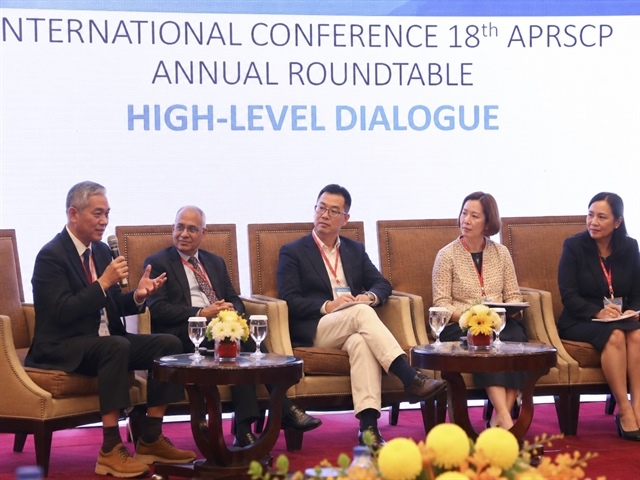
A speaker addresses the 18th Asia Pacific Roundtable for Sustainable Consumption and Production in HCM City on Monday, held as part of the Autumn Economic Forum 2026. — VNS Photo Bồ Xuân Hiệp |
“The challenge is to move beyond sharing knowledge and create practical cooperation that helps businesses adopt circular and low-carbon solutions,” he said.
He said policymakers, researchers and companies needed to work together to test successful approaches, improve them and expand their use across the region.
SMEs were an important part of the transition but needed technical knowledge, practical tools and partnerships to change how they produced goods and used resources, he said.
The roundtable examined a range of issues related to the transition, including circular solutions for plastics and textiles, smart manufacturing, digital traceability, resource efficiency, industrial cooperation and the circular bioeconomy.
These areas reflect the links between environmental goals and industrial competitiveness. Better resource management can help companies reduce waste and material costs, while digital tools can improve production monitoring and supply-chain transparency.
It also sought to strengthen cooperation among research institutions, businesses and policymakers across the Asia-Pacific region, where economies face different challenges but share the need to use resources more efficiently and reduce environmental impacts.
Organisers expect the discussions to produce policy recommendations and a set of key messages for the Ministry of Industry and Trade and HCM City, while identifying potential pilot projects and partnerships.
The outcomes are expected to contribute to wider regional discussions on sustainable consumption and production, including the Asia-Pacific Forum on Sustainable Development in 2027.
- 16:58 26/10/2026