Online sellers face shakeout despite market expansion
Online sellers face shakeout despite market expansion
Gross merchandise value across the four major platforms (Shopee, TikTok Shop, Lazada and Tiki) reached about VNĐ291.6 trillion (US$11.2 billion) in the first half of 2026, up 44.1 per cent from a year earlier.
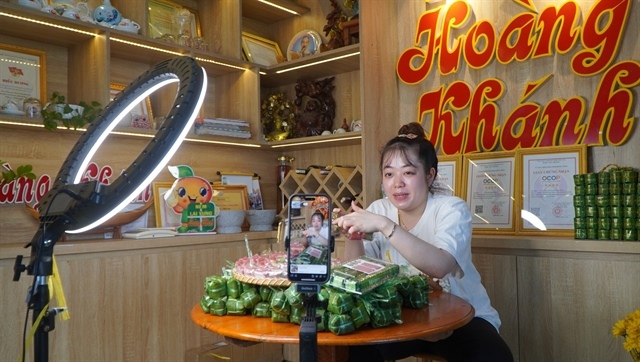
A seller livestreaming to sell products from Lai Vung Commune, Đồng Tháp Province. About 436,000 stores on major e-commerce platforms generated sales during the first half of this year, down from 600,000 a year earlier. — VNA/VNS Photo Nhựt An |
The domestic e-commerce market is growing rapidly, but the expansion is increasingly being driven by a smaller pool of sellers as rising platform fees, tighter regulation and intensifying competition force smaller merchants out of the market.
Gross merchandise value (GMV) across the country's four major platforms — Shopee, TikTok Shop, Lazada and Tiki — reached about VNĐ291.6 trillion (US$11.2 billion) in the first half of 2026, up 44.1 per cent from a year earlier, according to a recent report by e-commerce solution company YouNet ECI.
However, the number of active stores fell sharply.
About 436,000 stores generated sales during the first six months of the year, down from nearly 600,000 a year earlier, suggesting that the online retail market is entering a period of sweeping restructuring.
The number of non-mall stores fell about 27 per cent year-on-year to roughly 417,000, while mall stores declined by about 25 per cent to around 20,000.
Meanwhile, average GMV per active store increased substantially. On Shopee, average GMV per store reached about VNĐ831.7 million in the first half, up 44 per cent year-on-year. TikTok Shop recorded about VNĐ532.7 million per store, an increase of 65 per cent.
The increase in GMV does not mean easier conditions for sellers, however, as revenue is mainly concentrated among larger retailers.
Nguyễn Mạnh Tấn from the Vietnam E-commerce Association said sellers are facing higher platform charges alongside stricter tax and legal requirements.
Fees for transactions, services, payments, shipping and promotional programmes have increased across major platforms, while sellers must also comply with greater requirements for invoices, product documentation and tax transparency.
He said the combined costs can reach around 40 per cent of revenue, leaving little room for profit or for small merchants.
Competition is also intensifying as manufacturers and major brands increasingly sell directly to consumers through their own stores on e-commerce platforms. Cross-border sellers, particularly those sourcing products from China, add further pressure to intermediaries whose business models depend largely on buying products cheaply and reselling them.
Consumers are also showing greater preference for established brands and official stores, increasing the advantage of merchants able to demonstrate product quality, reliable supply and brand credibility.
The Law on E-commerce, effective from July 1, requires verification of sellers' identities before allowing them to sell through livestream activities using payment accounts.
Tấn said businesses are increasingly adopting multichannel strategies, combining marketplace stores with Facebook, Zalo, branded websites and physical shops, to reduce dependence on platforms, build direct relationships with customers and gain greater control over marketing, customer data and repeat purchases.
The market restructuring is also reflected in the growing dominance of the two leading platforms.
Shopee and Tiktok Shop together accounted for a share of almost 98 per cent of GMV of the four major platforms. Shopee generated about VNĐ144.3 trillion in GMV in the first half, or a share of 54.5 per cent. TikTok Shop generated about VNĐ115 trillion, or 43.4 per cent.
Nguyễn Phương Lâm, director of market consulting and analysis at YouNet ECI, has said the period of easy growth driven largely by increased advertising spending is coming to an end. The withdrawal of smaller sellers is creating more room for brands and professional merchants.
The next phase of market development is likely to be less about adding more stores and orders and more about improving business efficiency, he said.
Việt Nam’s e-commerce market reached about $31 billion in 2025, equivalent to roughly 10 per cent of total retail sales of goods and consumer services, according to statistics from the Ministry of Industry and Trade.
A report by SHS forecast that e-commerce revenue would reach $37 billion this year.
- 08:14 21/10/2026