Digital transformation brings traditional markets closer to consumers
Digital transformation brings traditional markets closer to consumers
Phạm Thị Nụ, 70, in HCM City, no longer finds shopping for food and other household necessities as difficult as she once did.
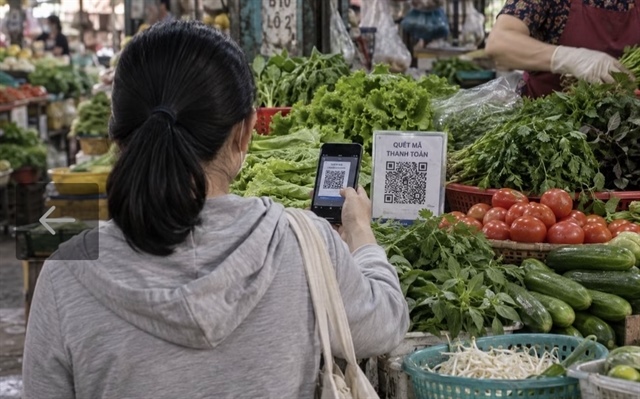
Using QR code is now popular payment method in traditional markets. At many traditional markets in HCM city, QR codes have become as familiar as weighing scales, calculators and notebooks. — VNA/VNS Photo |
Phạm Thị Nụ, 70, who lives in HCM City, no longer finds shopping for food and other household necessities as difficult as she once did.
Instead of going to the market, Nụ can now stay at home and order what she needs. The convenience is particularly valuable when she is unwell or the weather is bad.
The change has been made possible by the increasing use of technology by traders at traditional markets and by online marketplaces and modern supermarkets, allowing customers to shop without leaving home.
The trend is in line with Resolution No. 57 on breakthroughs in science and technology development, innovation and national digital transformation.
Traditional markets and household businesses in HCM City are adopting digital payments, online sales and digital data management. Initiatives implemented at markets and by small businesses show that digital transformation is most effective when the tools are simple, affordable and suited to users’ actual needs.
At many traditional markets in the city, QR codes have become as familiar as weighing scales, calculators and notebooks. Shoppers can scan a code with their phones to make payments, while vendors receive transaction notifications immediately. This speeds up transactions and reduces the risk of vendors running out of change or giving customers the wrong change.
The changes go beyond payment methods. Many vendors now use Zalo, Facebook and TikTok to promote products, receive orders and stay in touch with customers. Some create their own videos, livestream their sales and offer same-day delivery.
Stalls that once mainly served customers visiting the market can now reach shoppers in different parts of the city.
Nụ said that on days when she does not go out, she contacts sellers through Zalo or Facebook to order food for home delivery.
She can also order products through supermarket applications, some of which provide shopping and delivery services.
Nguyễn Đan Thùy, a vendor at Bến Thành Market, said digital payments made buying and selling more convenient, particularly for customers who did not carry cash.
The use of technology also helped give the market a more modern and professional image while preserving its traditional commercial character, she said.
Livestreaming allows sellers to showcase products and prices while answering customers’ questions directly.
Recently, the Vietnam E-Commerce and Digital Economy Agency under the Ministry of Industry and Trade, together with relevant organisations, organised training programmes for market management boards and vendors.
The training covered operating online stores, livestreaming, electronic payments, product promotion and online customer service.
Rather than simply listening to presentations, participants were able to create accounts, practise recording videos and try selling products online themselves.
Management boards at many markets have also worked with banks, e-wallet providers and technology companies to help vendors install applications, open accounts and display QR codes at their stalls.
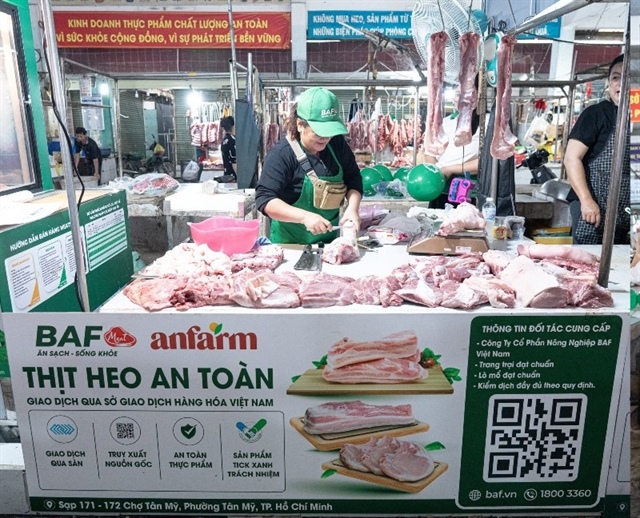
Using QR code is now popular payment method in traditional markets. At many traditional markets in HCM city, QR codes have become as familiar as weighing scales, calculators and notebooks. — VNA/VNS Photo |
Beyond traditional markets
Digital transformation in HCM City is expanding beyond traditional markets, with initiatives also gaining momentum in wards and communes.
In Tân Tạo Ward, a programme introducing artificial intelligence applications attracted representatives of approximately 500 households, business households and small enterprises.
Participants were shown how to use AI to draft content, support communications, manage tasks and find customers.
A representative of the Tân Tạo Ward People’s Committee said that for small businesses, the value of AI did not necessarily lie in complex systems.
Vendors could use digital tools to create product descriptions, design simple images, answer frequently asked questions and compile orders.
Using technology to meet specific needs could save time and reduce the cost of hiring outside services, the representative said.
Meanwhile, in An Lạc Ward, the B2B e-commerce platform An Lạc Business Hub was developed to facilitate business-to-business connections.
The ward is home to more than 5,400 enterprises and approximately 6,800 business households. While these businesses represent a significant source of goods and services, many still have limited capacity to build connections and access markets.
The platform is expected to provide a space for businesses to showcase their production capabilities and seek suppliers, customers and logistics partners.
Local industries with strong potential, including apparel, footwear and leather goods, packaging, processed food and supporting industries, will gain an additional channel for promotion, brand building and participation in supply chains.
Lê Trương Hải Hiếu, secretary of the Party Committee and chairman of the People’s Council of An Lạc Ward, said the B2B platform was more than a technological tool.
Its key value lay in creating an environment where local businesses could find one another, share information about their supply needs and expand their markets instead of operating in isolation, he said.
HCM City aims for the digital economy to account for approximately 30–40 per cent of its GRDP by 2030.
To achieve this goal, digitalisation needs to reach market vendors, business households and small enterprises — large groups that often have limited technology expertise and investment capacity.
Nguyễn Nguyên Phương, deputy director of the HCM City Department of Industry and Trade, said digital transformation at traditional markets and among business households and small enterprises must be implemented based on actual needs.
Platforms should be simple, user-friendly and affordable, with ongoing support rather than one-off training sessions, he said.
The Department of Industry and Trade will continue working with ward and commune authorities, market management boards and technology companies to organise training sessions and provide guidance on electronic payments, revenue management, online sales and account security.
Digital transformation should be assessed against measurable outcomes, including the number of households regularly using digital services, transaction volumes, customer reach and cost savings.
- 10:09 20/10/2026