Implementation key to Vietnam’s post-upgrade capital inflows
Implementation key to Vietnam’s post-upgrade capital inflows
Investors say institutional confidence and a wider pool of quality stocks will decide how much overseas money stays in Vietnam after the FTSE Russell upgrade.
Vietnam’s market reforms are now being judged on how well they work in practice. That was one of the central messages at the UK-Vietnam Business Forum 2026, held by the British Chamber of Commerce in Vietnam in Ho Chi Minh City on October 29.
The discussion came weeks after the first tranche of Vietnam’s inclusion in the FTSE Global Equity Index Series took effect on September 18, lifting the country to Secondary Emerging Market status. About $20 trillion of assets worldwide are benchmarked to FTSE Russell indices.
In a keynote earlier, Wanming Du, director of index policy for Asia-Pacific at FTSE Russell, warned that investors do not allocate capital on market classification alone.
“Index inclusion creates the opportunity for capital to flow. It does not guarantee that capital will stay,” Du said. “The upgrade has given Vietnam greater visibility. The next phase is about competitiveness.”
She called for simpler account opening, more efficient trading, settlement, and foreign exchange arrangements, stronger governance, and a bigger base of domestic institutional investors.
Gary Harron, head of securities services at HSBC, said the most significant change was the quality of dialogue between officials and the brokers and custodians that execute trades for overseas clients. About a year and a half ago, he recalled, international participants were asking what would happen next, and communication largely ran one way.
“The forum has since evolved into a constructive, practical, two-way discussion,” Harron said. “When we can raise an issue with the State Securities Commission and the State Bank of Vietnam and see guidelines come out just a few weeks later, that is a really powerful message to the international community.”
He added that the State Securities Commission should keep briefing investors on policy changes and listening to their feedback, so the market stays in front of decision makers.
For asset managers, however, access is only the starting point. Nguyen Quoc Dung, CEO of Eastspring Investments, said the market had moved from intention to implementation, but he urged caution about how quickly money would follow the headlines.
“I would like to distinguish between attention, confidence, and actual asset allocation. The change is gradual, it is not immediate,” Dung said.
“What investors continue to look at are fundamentals, liquidity, transparency, corporate governance, and whether we have enough sizeable listed companies of high quality to invest in at scale. If we continue the momentum, we will attract the growth.”
Dung described the FTSE upgrade as a milestone rather than a destination, and said the country is now aiming for MSCI recognition. He argued that the economy cannot depend only on bank lending and needs a deeper capital market to draw patient, long-term funders.
On whether Vietnam lacks money or lacks places to put it, Dung was clear. He said demand for the growth story is strong, but supply of suitable assets is the constraint.
“What we need to do is create more investable assets for financial investors. We need more equities, and more sensible, quality listings across sectors, not concentrated in just a few,” Dung said.
“With clear and investable structures, especially for infrastructure, I believe Vietnam is not short of capital. The key is how we connect capital with those opportunities to attract long-term financial investors.”
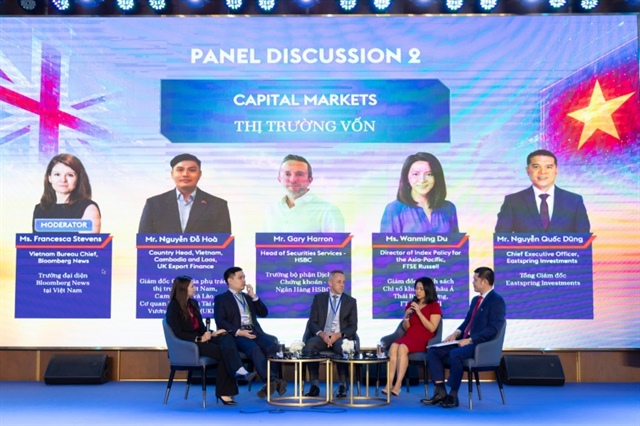
Experts discussed the capital market. Photo: VIR |
- 18:26 30/10/2026