VN shifts from supporting to developing SMEs
VN shifts from supporting to developing SMEs
The Government has proposed a Law on Development of SMEs to replace the Law on Support for SMEs 2017 which was discussed at the National Assembly’s Standing Committee on August 28.

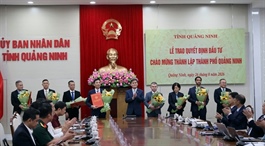
The National Assembly’s Standing Committee discuss a Law on Development of SMEs on Friday. — VNA/VNS Photo Doãn Tấn |
Việt Nam is moving to shift its policy approach for small- and medium-sized enterprises (SMEs) from direct support to creating conditions for them to grow under a draft law proposed to replace legislation adopted in 2017.
The Government has proposed a Law on Development of SMEs to replace the Law on Support for SMEs 2017 which was discussed at the National Assembly’s Standing Committee on August 28.
Minister of Finance Ngô Văn Tuấn said although the 2017 law had provided an important legal foundation for policies supporting SMEs over nearly a decade, some policies are proved not to be sufficiently effective while support remained fragmented. Access to support programmes also faced barriers and mechanisms for assessing results after support remained unclear.
Tuấn said in a new development phase, the private sector needs not only to expand in number but also improve its quality, competitiveness, innovation capacity and digital transformation, while participating more deeply in global value chains and scaling up.
The proposed legislation reflects a fundamental shift in policy thinking from 'supporting businesses' to 'creating favourable conditions for businesses to develop', he said.
Comprising of five chapters and 35 articles, the draft law proposes a number of major policy changes.
It is moving away from broad-based support towards targeted measures with clear priorities, time limits and output-based results. The approach will support businesses along a development path from household businesses to enterprises, and from micro and small businesses to medium-sized and larger companies.
The effectiveness of support will be measured not simply by the number of beneficiaries but by their ability to absorb support and their subsequent development, Tuấn said.
The draft also seeks to shift from process-based management to data-driven management by promoting digitalisation, connectivity and data sharing throughout the receipt, implementation, monitoring and evaluation of support programmes.
Another key change will be a shift from direct State support towards a broader business ecosystem, with the State playing a role in mobilising resources and sharing risks through the State budget, while connecting universities, research institutes, investment funds, incubators and large enterprises.
Support will also be based more closely on actual needs of businesses through mechanisms such as support vouchers, commissioned services and assigned tasks.
|
The National Assembly’s Standing Committee discuss a Law on Development of SMEs on Friday. — VNA/VNS Photo Doãn Tấn |
The draft law proposes two major groups of policies. The first provides general support to address bottlenecks in access to capital, production premises, technology, markets and other resources while the second targets priority groups with the potential to drive breakthroughs, including innovative start-ups, businesses participating in value chains, sustainable businesses and household businesses transitioning into enterprises.
The National Assembly's Standing Committee on Economic and Financial Affairs broadly backed the need for the new law and the proposed change in its name, the committee’s Chairman Phan Văn Mãi said.
However, the committee called for a comprehensive review of the draft to ensure its provisions clearly reflected the new approach of enabling and developing businesses.
On access to credit, the committee said the proposed provisions remained general and did not fully address the core difficulties businesses face in accessing financing. It also called for further consideration of the proposed interest-rate support fund mechanism.
Regarding tax, accounting, science and technology and digital transformation policies, the committee said some provisions were not aligned with the Law on Corporate Income Tax and that some proposed incentives were even less favourable than existing regulations.
Tax incentives for SMEs should therefore be stipulated consistently under specialised tax legislation to ensure they receive the highest applicable level of incentives, the committee said.
For innovative start-ups and private venture capital funds, the draft should clarify criteria for identifying eligible funds. Where State capital is used for equity investment or entrusted investment, it should also clearly define the State's authority and scope of participation, as well as risk-sharing mechanisms, management responsibilities and safeguards for public funds.
Regarding public procurement, the committee raised concerns about the feasibility of commissioned procurement and direct contracting involving SMEs, saying the mechanisms must comply with bidding laws, avoid prolonging procurement procedures and comply with international commitments.
For household businesses transitioning into enterprises, the committee agreed with the objective of reducing market-entry costs but called for clearer criteria for identifying eligible businesses, as well as the duration and funding sources for support to ensure the policy is practical and effective.
The committee also stressed that the draft law must establish clear principles of transparency and disclosure and must not create additional administrative procedures.
- 15:28 28/08/2026