Vietnam enters new phase of capital market competition
Vietnam enters new phase of capital market competition
As Vietnam prepares to open its first trading session as an emerging market on September 21, leading global financial institutions have gathered in Hanoi to mark a milestone that signals a new era for the country’s capital market and its deeper connection to global capital.
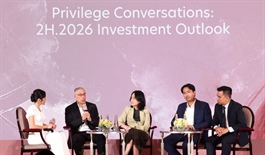
On September 18, SSI brought together an unprecedented gathering of leading global financial institutions, investment organisations and financial groups in Vietnam for its celebration event, “A Celebration - Vietnam Into EM.”
The event came just days before Vietnam is set to enter its emerging market chapter with its first trading session in the new status on September 21.
The gathering marked not only a celebration of a long-awaited milestone, but also a powerful symbol of Vietnam’s growing place on the global capital markets map, as the country prepares to open a new chapter of deeper integration with international capital.
For Bob McCooey, vice chairman of Nasdaq, Vietnam has already established itself as one of the region’s most active markets by trading volume. He noted that Vietnam had surpassed Singapore and Thailand in trading volumes, while more recent growth had strengthened the market.
“Vietnam was the largest market by volume in ASEAN,” said McCooey. “Yet the competition for capital extends well beyond ASEAN. Korea, Taiwan (China) and Japan are attracting substantial investor attention on the back of semiconductor and artificial intelligence-related demand, creating a highly competitive environment for markets across Asia.”
"Vietnam will therefore need compelling growth stories to sustain investor interest and translate them into greater trading activity, according to Nasdaq’s representatives."
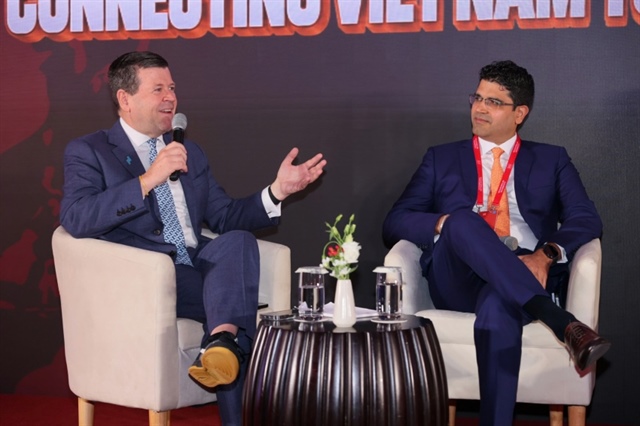
Bob McCooey, vice chairman of Nasdaq (left) and Pankaj Mataney, Asia Head of Platform Sales and Index Strategy at Morgan Stanley (right). Photo: SSI Securities |
Peter Stein, CEO of the Asia Securities Industry & Financial Markets Association and Global Financial Markets Association, pointed to the broader competition now taking place across global and regional capital markets.
“Competition for capital is intense. Several markets are attracting significant attention because of their roles in the global AI supply chain, while investors are also looking to diversify their exposure across different markets,” Stein said.
“Vietnam has effectively moved beyond the broader ASEAN group and into this more competitive tier. Although it is not currently benefiting from the broader AI-driven investment story to the same extent as some other markets, it has a strong longer-term growth proposition. That creates a different challenge for Vietnam: converting its improving market fundamentals into an environment where international investors can deploy capital efficiently and at sufficient scale."
Stein said Vietnam already had the necessary market-infrastructure fundamentals and that these were continuing to improve. The priority, he argued, should be to consolidate the progress already made rather than move too quickly to introduce measures that have not been sufficiently considered.
As Vietnam moves into this more competitive tier, the composition and destination of incoming foreign capital will become increasingly important.
Pankaj Mataney, Asia Head of Platform Sales and Index Strategy at Morgan Stanley, expects the FTSE upgrade to broaden the investor base, with index-oriented capital likely to provide an initial impetus.
“Some of the more fundamental, dedicated foreign investors are likely to enter the market,” said Mataney. “The FTSE upgrade will broaden the investor base, with passive investors naturally at the forefront.”
He also expected hedge funds and liquidity providers to become more active as the upgrade takes effect, meaning the impact could extend beyond passive funds tracking the relevant indices.
“Initially, however, flows are likely to be more closely linked to index inclusion. For listed companies, securing inclusion in relevant indices will therefore be important, while foreign ownership limits will also influence their ability to absorb overseas capital,” he said.
He also noted that the initial concentration of capital would likely be determined more by individual companies and their characteristics than by sectors.
“The composition of the investor base could then broaden further as hedge funds and systematic strategies enter the market,” said Mataney. “But index eligibility alone will not determine where capital ultimately goes. Company fundamentals, government policies and broader market conditions as additional factors that will shape investor decisions."
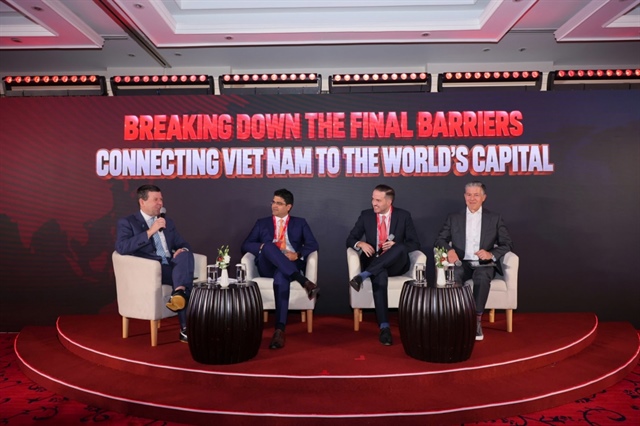
Photo: SSI Securities |
Phil Chevalier, co-head of Virtu Execution Services APAC at Virtu Financial, offered a perspective from the market-making and execution side.
The firm subsequently executed its first trade using a global broker model, making the Vietnamese market more accessible to its clients. The necessary infrastructure was established within days, with Virtu initially focusing on the agency institutional side.
“We wanted to be among the first to do so,” Chevalier said. “The firm is now looking at further opportunities, including transaction cost analysis and broader market access. SSI has also played an important role in making the process easier for Virtu.”
Chevalier identified liquidity as the fundamental issue that will determine how far the market can develop.
“Market makers will not establish operations in markets where there is insufficient liquidity. At the same time, liquidity will not develop without market makers and other service providers,” he said. “That creates a circular dynamic: greater liquidity attracts market makers and other participants, while greater participation is itself needed to deepen liquidity.”
The introduction of a CCP, according to Chevalier, could help break that cycle by making different components of the trade lifecycle more efficient and accessible, thereby allowing more market participants to participate.
“For Vietnam, the FTSE upgrade is therefore not simply about attracting a new category of investors. It is about turning greater international recognition into sustained participation, deeper liquidity and a market infrastructure capable of supporting increasingly sophisticated global investors,” said Chevalier. “The next phase of Vietnam’s capital-market development will be shaped not only by how much foreign capital enters, but also by how effectively the market can absorb, trade and retain that capital."
- 17:48 18/09/2026