Việt Nam’s electronics industry faces demands from greening global supply chains
Việt Nam’s electronics industry faces demands from greening global supply chains
The green transition is not simply about meeting a set of standards, but is directly linked to the ability of Vietnamese electronics companies to enter and maintain their position in global supply chains.
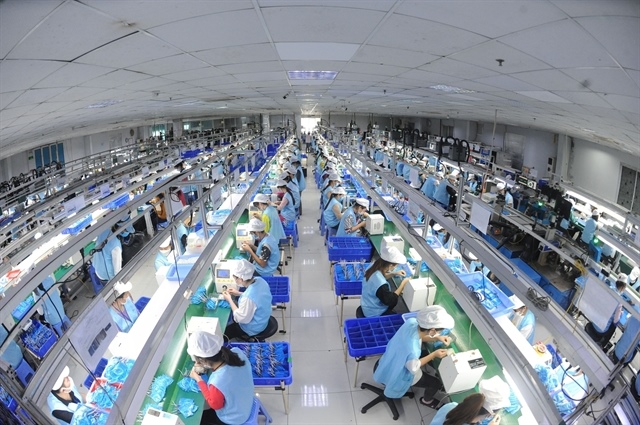
Electronic production line at Suntech Company in Bắc Giang. Pressure to green supply chains is also spreading throughout the entire electronics supply network. — VNA/VNS Photo Việt Hùng |
Vietnamese electronics companies are increasingly required to meet standards on ESG, carbon emissions, traceability, clean energy and sustainable packaging, alongside quality, pricing and production capacity, to maintain their position in global supply chains.
As part of the international manufacturing business matching event FBC ASEAN 2026, held from September 16-18, the Vietnam Electronic Industries Association (VEIA), in collaboration with the testing, inspection and certification company SGS, organised a seminar on the electronics industry in green supply chains, covering environmental, social and governance (ESG), sustainable packaging, and global market requirements.
Speakers at the event said the way international corporations select suppliers is changing. While quality, price, production capacity and delivery schedules were previously the key criteria, sustainability, emissions reduction, data transparency and supply chain controls are increasingly becoming important requirements.
ESG becomes a condition for joining supply chains
Đỗ Thị Thuý Hương, VEIA Vice President and General Secretary, said ESG standards and frameworks for assessing a company’s sustainability and responsibility towards the community and society are no longer simply a future-oriented goal, but are becoming a condition for companies to be included on supplier lists.
The green transition needs to begin with factory management, operating processes, energy and raw-material management, while being closely linked to digital transformation, she said.
Pressure to green supply chains is also spreading throughout the entire supply network. Requirements on recycled packaging, labelling and chemical management mean companies need to prepare from the design stage. Slow adaptation could increase remediation costs and the risk of losing orders.
Trần Nhật Anh, ESG project manager and SGS representative, said Việt Nam has become an important link in the global electronics industry, driven by investment from international corporations. However, alongside the opportunities comes pressure as brands and original equipment manufacturers (OEMs) shift towards net zero models. According to the SGS representative, the four main bottlenecks currently facing Vietnamese factories are energy, data, the circular economy and green finance.
Companies still face difficulties in accessing 100% clean electricity, lack systems for collecting quantitative data, have an incomplete understanding of recycled-material content and face challenges in accessing green credit, he said.
Rather than undertaking a full-scale transformation at once, Nhật Anh suggested that companies could begin with a key product line to calculate its carbon footprint and establishing a standardised reporting database before gradually expanding the process across the entire factory.
Proactive transition key to maintaining supply-chain position
Huỳnh Lâm Diễm Mi, head of the technical division at SGS’s chemical testing centre, said sustainability is becoming a technical requirement for companies seeking access to international markets.
Electronic products exported to the EU will be subject to the European Commission’s Ecodesign for Sustainable Products Regulation (ESPR), as well as the Packaging and Packaging Waste Regulation (PPWR), under EU Regulation 2025/40, concerning packaging and packaging waste. The PPWR regulates three levels of packaging – sales packaging, grouped packaging and transport packaging, while also setting requirements on hazardous chemicals, recyclability, excessive packaging and labelling.
From September, controls on heavy metals and compliance documentation officially came into effect. By 2030, packaging with a recyclability rate of below 70 per cent will be prohibited from being circulated in the market.
Therefore, companies preparing to export to the EU need to develop technical documentation, declarations of conformity and register for extended producer responsibility (EPR) fees.
Experts at the seminar said companies did not necessarily have to begin with a large-scale transformation programme. For businesses exporting to the EU, material analysis, controls on four heavy metals, packaging design in line with PPWR requirements, and preparation of technical documentation and declarations of conformity should be incorporated into their export preparations.
The green transition is therefore not simply about meeting a set of standards, but is directly linked to the ability of Vietnamese electronics companies to enter and maintain their position in global supply chains.
- 10:14 19/09/2026