Textile sector faces challenges to sustain export growth
Textile sector faces challenges to sustain export growth
In the final months of the year, the textile and garment sector faces a double squeeze from costs, exchange rates and price competition.
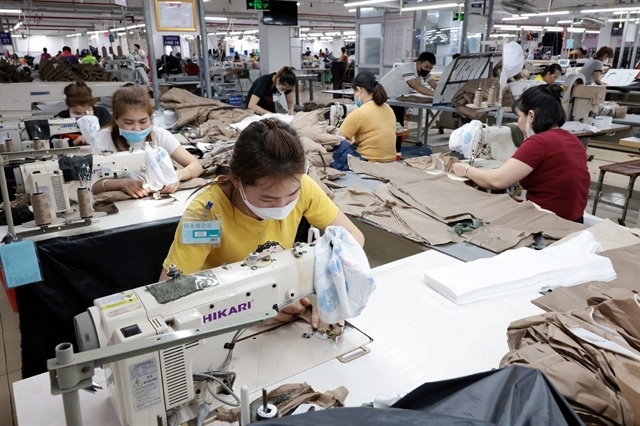
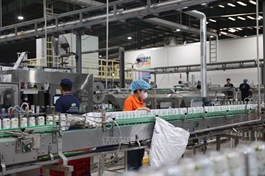
Production at TDT Thái Nguyên garment company. In the final months of the year, Vietnam's textile and garment sector faces a double squeeze from costs, exchange rates and price competition. VNA/VNS Photo |
The textile and garment industry is entering the final quarter of 2026, facing increased pressure from costs, pricing and market conditions to meet export growth targets.
To move beyond price-based competition, companies will need to meet a new set of requirements through greener production, clean energy and new technologies, including artificial intelligence, data systems and digital traceability, to move up the value chain.
Cao Hữu Hiếu, chief executive of the Vietnam National Textile and Garment Group (Vinatex), said the final months of 2026 would remain fraught with risks. Cotton and fibre prices continued to fluctuate, while movements in the Vietnamese đồng against the US dollar could affect export profitability.
According to Hiếu, pressure was also coming from weakening demand in the United States and Europe. Logistics, raw material and other production costs continued to squeeze profit margins, while Vietnamese companies faced intense competition from Bangladesh, China and other suppliers.
The pressure is not limited to demand. Requirements on origin, traceability and trade remedies are becoming stricter. Environmental, emissions and social responsibility standards are also increasingly becoming conditions for participation in global supply chains.
These requirements are also changing how brands assess suppliers. Speaking recently with suppliers in HCM City, Alen Wei, chief financial officer of H&M Production in China and Southeast Asia, said Việt Nam's textile and garment industry had built significant advantages in manufacturing capacity, international integration and its ability to improve over the past two decades. But the industry's 'next chapter' would be different.
Global brands are increasingly looking for supply chains that are not only commercially capable, but also sustainable, innovative, resilient and able to create long-term value, Wei said.
In other words, strong production capabilities at competitive costs are still necessary, but they are no longer enough. H&M currently works with more than 40 suppliers and more than 70 factories in Việt Nam, employing more than 60,000 people. The scale of its operations shows that Vietnam remains an important part of the group's manufacturing network.
But the shift in supplier selection criteria is what matters most. Wei identified three key pillars: sustainability, renewable energy and industrial upgrading. These are no longer issues limited to a handful of pioneering companies. They are becoming part of the competitive requirements for Việt Nam's textile and garment industry.
In the remaining months of the year, the textile and garment sector faces a double squeeze from costs, exchange rates and price competition. Requirements on origin, traceability and greener production are also becoming a new filter for global supply chains.
If going green is treated only as a mandatory cost, companies will struggle to cope when profit margins are thin. But combining clean electricity, energy efficiency and technology can turn the cost of the transition into an investment in competitiveness, while also changing the way the entire production chain is managed.
Technology is also opening up new approaches to traceability. Rajkishore Nayak, a professor specialising in fashion enterprise management at RMIT University, was quoted by vnbusiness.vn as saying that traceability had traditionally involved stacks of paper records and manual checks. Digital systems and artificial intelligence now allow Vietnamese textile manufacturers to monitor key stages of production and detect anomalies more quickly, improving the reliability of information.
This is also attracting growing attention from global brands. They want to know not only where a product was made, but also where its raw materials came from, which factories were involved and what standards and production processes were used.
When data is connected, companies can proactively provide evidence of their capabilities while optimising the use of materials, energy and quality controls. The 'new filter' therefore need not be viewed only as a cost, but can become an advantage that helps companies move beyond price competition. Technology then becomes more than an investment for technical departments; it becomes a tool for strengthening competitiveness.
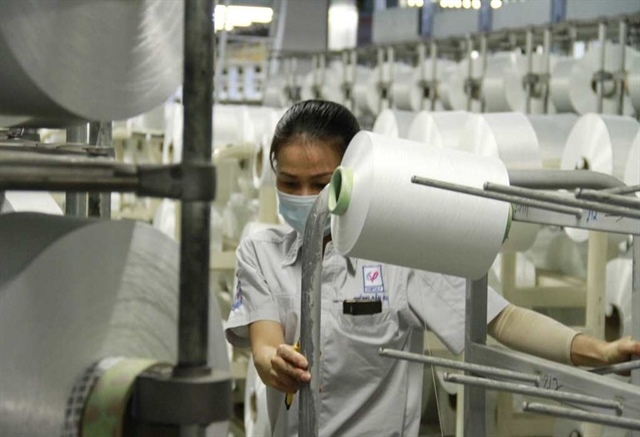
Production at TDT Thái Nguyên garment company. In the final months of the year, Vietnam's textile and garment sector faces a double squeeze from costs, exchange rates and price competition. VNA/VNS Photo |
Keeping more value at home
One of the weaknesses of Việt Nam's textile and garment industry is its heavy reliance on imported inputs, particularly fabric. This creates additional obstacles to taking full advantage of free trade agreements because of rules of origin, while Vietnamese companies continue to focus largely on cut-and-make operations.
According to Wei, Việt Nam needs to shift its goal from simply producing more to creating and retaining more value. This will require expanding domestic fabric production, strengthening local supply chains, adopting advanced technologies and improving the quality of its workforce.
At the company level, the immediate priority is also to protect efficiency rather than pursue volume. For the final months of the year, Hiếu has instructed Vinatex's member companies to protect profit margins and the quality of growth. The focus is on managing cash flow, receivables and payables, and inventories, while improving productivity and cutting costs.
Vinatex is also accelerating the development of its management dashboard, a system for monitoring and consolidating data for management purposes, and standardising data. This will allow the group to manage operations more closely and proactively prepare scenarios for 2027.
For its yarn business, Hiếu has told units to closely monitor cotton and fibre prices and exercise caution when purchasing raw materials. In garment manufacturing, member companies are required to review product lines and low-efficiency customers, coordinate production capacity, retain strategic customers and prepare resources for next year.
To retain more value, companies need to go deeper into localisation, data, AI and clean energy. These will also provide a foundation for lowering costs, improving efficiency and moving into higher-value segments.
Data can do more than support management. It can also help Vietnamese textile companies retain more value in the supply chain. Nayak stressed that reliable traceability data could help differentiate Việt Nam. When data on materials, factories and production processes are connected, companies can proactively demonstrate their capabilities and reduce the time needed to process information.
AI can also help with quality control and optimise the use of materials and energy. This provides a basis for reducing waste, responding more quickly to market changes and improving production efficiency.
Renewable energy offers another opportunity to cut costs and emissions. Wei said a stable supply of renewable electricity at reasonable prices would become increasingly important in supplier selection. Alongside the direct power purchase agreement (DPPA) mechanism, companies can accelerate the electrification of equipment and improve energy efficiency.
Another option is to reuse or recycle fabric scraps and other waste. Combined with digital traceability, this can help companies reduce resource waste while providing clearer evidence of how materials are being used efficiently.
With cost and competitive pressures concentrated in the final months of the year, the textile and garment industry needs to focus on areas that can deliver clear efficiency gains: increasing localisation, digitising traceability, improving data management and saving energy.
- 08:19 28/09/2026