Temenos powers Vietnam’s banking shift from core systems to AI
Temenos powers Vietnam’s banking shift from core systems to AI
Over more than two decades, Temenos has accompanied the banking sector from the digitisation of basic transactions and the modernisation of core banking systems to the development of cloud-based banking platforms, data-driven operations, and AI applications.
Temenos' latest success with Sacombank offers a compelling illustration of how technology can translate into tangible operational outcomes, while also creating new opportunities for growth as Vietnamese banks move deeper into their digital transformation journeys.
One of the most significant milestones has been Sacombank's upgrade of its core banking system to the latest Temenos Core Banking platform and its transition to a hybrid cloud architecture.
According to Luu Danh Duc, deputy chief executive officer of Sacombank, the upgrade represents an important milestone in the bank's digital transformation journey, enhancing flexibility and scalability while accelerating innovation.
Luu Danh Duc, deputy CEO of Sacombank, at Temenos Regional Forum Asia-Pacific 2026 from August 25 to 26. Photo courtesy of Temenos |
The results following the upgrade demonstrate a clear operational impact. Sacombank's application performance has increased by 200 per cent, deployment cycles have become three times faster, and server infrastructure capacity has been reduced by 50 per cent.
The new platform supports millions of customers and approximately 13 million transactions per day, providing a foundation for Sacombank to develop real-time banking services and data-driven solutions.
For Sacombank, the transformation extends beyond core banking. The bank is expanding its collaboration with Temenos through Temenos Payments Hub to support cross-border payment transactions. Core banking technology is evolving beyond its traditional role as the backbone of banking operations into an integrated platform connecting multiple layers of the banking ecosystem, from transactions and payments to data and digital services.
Takis Spiliopoulos, global CEO of Temenos, said, “The developments at Sacombank also reflect a broader trend within Vietnam's banking industry. Banks are increasingly required to modernise their technology infrastructure while simultaneously ensuring operational continuity, security, and regulatory compliance throughout the transformation process.”
|
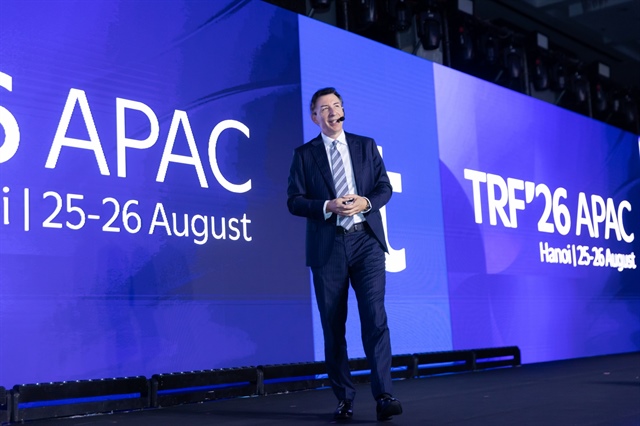
Takis Spiliopoulos, global CEO of Temenos, at Temenos Regional Forum Asia Pacific 2026. Photo courtesy of Temenos |
One approach being promoted by Temenos is “progressive modernisation.” Rather than replacing an entire system at once, banks can begin by transforming a specific business line, product, or geographic area before gradually expanding the transformation to other parts of the organisation.
“They start with one part, migrate that, move to the next one, and then perhaps expand into another geography or business line. For example, they may start with retail banking and then move to corporate banking,” Spiliopoulos said.
This approach enables banks to reduce the risks associated with large-scale transformation programmes. It also addresses one of the most important challenges facing banks as they modernise their core banking infrastructure: how to innovate without disrupting systems that serve millions of customers every day.
Cloud as transformation
Cloud computing is emerging as one of the most important drivers of the next phase of digital transformation.
Spiliopoulos said, “Over the past three years, Temenos has observed a growing number of banks moving workloads from on-premises infrastructure to cloud environments. The primary rationale is the significantly greater scalability and flexibility that cloud technology can provide.”
“More and more banks in Vietnam are moving workloads from on-premises systems to the cloud, giving them greater control and flexibility in their operations.”
Sacombank represents a clear example of this trend. Its transition to a hybrid cloud architecture is not simply about changing where the system is hosted. Rather, it represents a move towards a more scalable technology architecture capable of supporting the next generation of banking services.
The benefits of this transformation are reflected in measurable performance indicators: application performance has increased by 200 per cent, deployment speed has tripled, and server infrastructure capacity has been reduced by half. These figures suggest that digital transformation is gradually moving beyond a narrative centred on technology investment towards one focused on measurable business and operational performance.
AI a major opportunity, not a race
The next phase of banking transformation will extend beyond cloud computing. According to Spiliopoulos, AI presents substantial opportunities for the banking sector, but its adoption must be approached with an appropriate degree of caution.
“We see tremendous potential for growth in banking. Many banks want to increase the use of AI across their operations. However, how AI is applied appropriately is something that needs to be carefully considered. If the pace of AI adoption is too fast, it could potentially lead to failures,” he said.
This perspective illustrates Temenos' approach to AI. Rather than introducing AI indiscriminately across every banking process, the technology should be deployed in areas where the underlying data, processes, and risk profile allow it to generate meaningful value.
One example cited by Spiliopoulos is FCM AI Agent, a solution designed to support customer classification and assessment. Temenos began developing the capability approximately one year ago and subsequently introduced it to customers at an event in Copenhagen in May, before bringing it to customers across the Asian market.
The localisation advantage
According to Spiliopoulos, one of the factors that has enabled Temenos to maintain a strong position in Vietnam is its ability to adapt its technology to the specific characteristics of individual markets.
For a banking platform operating across multiple countries, technology cannot rely solely on common global standards. Each market has its own requirements relating to data, taxation, currency, language, reporting, and operational practices.
Spiliopoulos noted that Temenos has extensive experience in complying with stringent data requirements across markets, including Switzerland and Germany, as well as other jurisdictions that impose specific requirements concerning domestic data storage.
“We have always placed a strong emphasis on localisation. Vietnam is now a relatively mature market for us. However, when we enter a new market, we need to build the appropriate localisation layer,” he said.
According to Spiliopoulos, this represents one of Temenos' key competitive differentiators. Its solutions are localised to accommodate market-specific requirements relating to regulation, taxation, language, currency, and operational frameworks. In Vietnam, these localised capabilities have already been deployed and successfully operated across approximately 30 banks.
This established localisation also helps reduce the risks faced by banks considering Temenos in the future. Rather than building market-specific functionality from scratch, new customers can leverage a platform and localisation layer that have already been tested and validated in real-world banking environments.
The Sacombank case illustrates how Vietnam's banking technology is entering a new phase. If the previous stage of digital transformation focused primarily on moving banking services into digital channels, the next stage is about rebuilding the underlying technology infrastructure so that banks can operate faster, more flexibly, and increasingly on a data-driven basis.
For Temenos, its success with Sacombank provides tangible evidence of the company's technological capabilities after more than two decades in Vietnam. More importantly, however, it may represent the beginning of a new growth cycle, as core banking, cloud computing, data, payments, and AI increasingly converge within a single banking modernisation journey.
As Vietnam pursues a highly competitive digital economy, the pace of transformation within its banking sector will remain an important indicator of the country's broader technological progress. If Spiliopoulos' assessment proves correct, over the next five years Vietnam may evolve from being primarily a technology-adopting market into one of the leading markets for AI adoption and digital transformation.
- 15:12 04/09/2026