Grab pricing, fees under scrutiny in Việt Nam
Grab pricing, fees under scrutiny in Việt Nam
The key issue for drivers is how the fare paid by customers is divided between the platform, the driver and other costs, and how much they retain after all deductions.
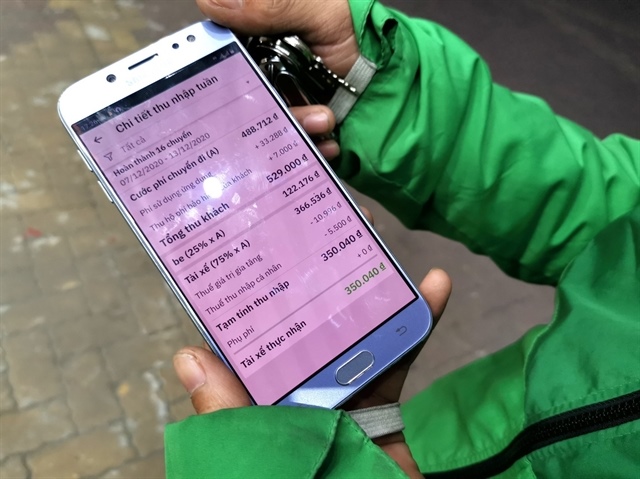
A Grab driver checking his weekly income. The National Competition Commission is reviewing Grab's pricing and fee policies for passengers and drivers. — VNA/VNS Photo Thành Đạt |
The National Competition Commission is reviewing Grab's pricing and fee policies for passengers and driver partners, after drivers raised concerns over impacts of the pricing mechanism on their actual earnings.
The commission told Vietnam News Agency on September 14 that the case remains under investigation and that authorities are collecting, verifying and assessing relevant information and documents before reaching any conclusion.
Early last week, the commission asked the ride-hailing service app to provide information and documents on its fares, fees and discounts applied to passengers and drivers.
The move followed complaints from Grab drivers who said the fares for some rides have been reduced, while drivers continue to bear rising fuel and vehicle operating costs.
In some cases, the platform’s charges for drivers can add up to 40 per cent of the fare paid by customers and can even reach 50 per cent, affecting drivers' actual earnings.
The authority has also asked other ride-hailing companies in Việt Nam to provide information for comparison and assessment.
Under Grab's current model, the platform does not apply one fixed deduction rate across all trips, but uses a flexible mechanism in which fees can vary from trip to trip depending on operational factors. Drivers say the system makes their income harder to predict.
Grab currently lists different platform fees depending on its services. For example, GrabBike has a platform fee of VNĐ3,000, while four-wheel services, excluding GrabTaxi, have platform fees ranging from VNĐ5,000 to VNĐ19,000 depending on the pick-up area and trip distance. The company says such fees are used to operate, maintain and improve its platform.
Grab also applies additional charges, including weather surcharges, waiting fees, insurance and carbon-neutrality contributions, as well as fees related to additional stops or changes in destination.
The key issue for drivers is how the fare paid by customers is divided between the platform, the driver and other costs, and how much they retain after all deductions.
A recent survey based on individual drivers' data found that drivers receive anywhere from 50 to 75 per cent of the total fare paid by customers, down from 75 to 80 per cent in 2016. The average is about 62 per cent for two-wheel drivers and nearly 66 per cent for four-wheel drivers.
The investigation comes as Grab has expanded significantly in Việt Nam. According to Grab Holdings' 2025 annual report, revenue from Việt Nam rose to $255 million in 2025 from $228 million in 2024 and $185 million in 2023, making Việt Nam the company's fifth-largest revenue market after Indonesia, Malaysia, Singapore and the Philippines.
Grab began operating in Việt Nam in 2014 and has since expanded from ride-hailing into motorcycle and car transport, food delivery, parcel delivery and other services.
Market research company Mordor Intelligence estimates that Grab accounted for 42.6 per cent of gross merchandise value (GMV) in Việt Nam’s four-wheel ride-hailing market in the fourth quarter of 2025, behind Xanh SM’s 51.5 per cent share.
In food delivery, Momentum Works said GrabFood accounted for 48 per cent of Việt Nam’s market GMV in 2025, on par with ShopeeFood.
Transparency urged
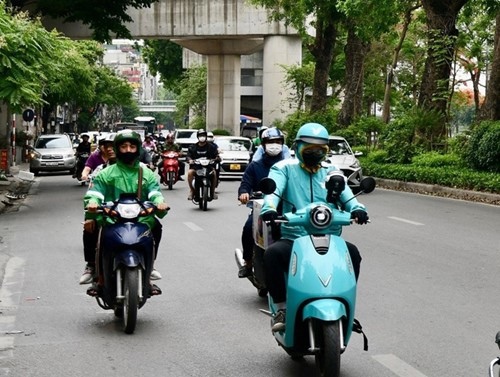
A Grab driver checking his weekly income. The National Competition Commission is reviewing Grab's pricing and fee policies for passengers and drivers. — VNA/VNS Photo Thành Đạt |
According to lawyer Trần Xuân Tiến from Đồng Đội Law Office, the issue is transparency, with a lack of clear understanding by relevant parties.
For a flexible pricing mechanism, passengers should be able to know the total amount they will pay before accepting a service, while drivers should receive sufficient information to understand the amount they will actually earn and the fees applied.
Experts have also proposed the platforms provide partner drivers with a standardised statement for each trip, detailing the fare paid by the passenger, additional fees, taxes, the amount retained by the platform and the amount received by the driver.
The issue extends beyond Việt Nam.
Among eight Southeast Asian markets in which Grab operates, Indonesia introduced a particularly significant change this year after the Indonesian government pushed to reduce the share of drivers’ earnings that ride-hailing companies are allowed to deduct.
From July 1, Grab Indonesia adopted a revenue-sharing mechanism under which the platform's share is capped at 8 per cent for motorcycle passenger transport, allowing drivers to retain up to 92 per cent of the fare subject to the applicable calculation. Before the new policy, platform fees for motorcycle drivers in Indonesia were around 20 per cent.
In Thailand, the service fees for driver partners are up to 25 per cent of the fare, unless another rate is notified and accepted.
The maximum fee is 20 per cent in Malaysia, the Philippines and Myanmar.
Singapore and Cambodia, meanwhile, use more flexible arrangements rather than a single rate applicable to all drivers.
In Singapore, Grab says its service fee varies by trip and can be adjusted according to factors including the distance and time required for a driver to reach a passenger.
In Cambodia, the service fee is flexible and adjusted from time to time, subject to local law.
- 07:27 16/09/2026