Funding and asset quality to sharpen divide across Vietnam’s banks
Funding and asset quality to sharpen divide across Vietnam’s banks
Vietnam’s banking sector is entering the second half with the gap between stronger and weaker lenders widening, as funding costs, liquidity pressures and asset quality increasingly separate banks with resilient balance sheets from those reliant on more expensive and short-term funding.
In its banking sector update published on August 24, VIS Rating said credit profiles among Vietnamese banks were becoming increasingly differentiated as interest rates remain elevated and business conditions continue to face challenges.
While large and state-owned banks have delivered stronger operating performance, supported by solid funding bases and improved profitability, smaller banks are facing greater pressure from credit costs, funding competition, and narrowing margins. VIS Rating expects this divergence to continue in the second half of the year, with three key areas warranting close attention: asset quality, funding, and liquidity.
“The banking sector’s tangible common equity-to-total assets ratio edged down from 8.4 per cent at the end of Q1 to 8.3 per cent in the first half of the year, mainly due to cash dividend payments by several large and mid-sized banks, including ACB, LPBank, VPBank, and VIB,” stated the report. “Meanwhile, demand for funding to support credit growth remains high. The sector-wide current account savings account (CASA) to total loans ratio remained at around 18 per cent, supported by growth in demand deposits at state-owned and large banks with strong funding franchises.”
“VIS Rating expects Techcombank, ACB, and HD Bank to continue diversifying their funding sources through long-term offshore borrowings to support credit growth. In contrast, small and mid-sized banks are facing more pronounced pressure as funding competition drives up their cost of funds.”
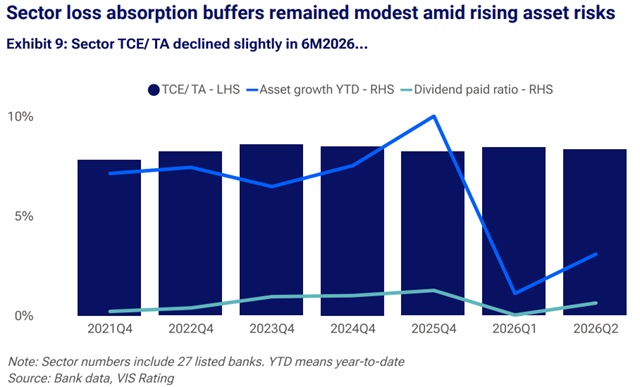
Source: VIS Rating |
Liquidity risks also warrant attention, as the report noted that the sector-wide loan-to-deposit ratio remains high despite improvements in deposit growth. Some smaller banks continue to rely heavily on market-based funding, including short-term interbank funding, to meet their asset growth needs.
“The banking sector outlook for the second half is not simply a story of earnings growth. Differentiation is likely to become increasingly pronounced between banks with strong deposit franchises, improving net interest margins, diversified revenue streams, and well-controlled asset quality, and those that rely heavily on short-term funding, face high funding costs, or have expanded rapidly into riskier lending segments,” said Simon Chen, Head of Ratings & Research at VIS Rating.
“Against this backdrop, the ability to maintain asset quality, control funding costs, and strengthen capital buffers will be key variables determining the financial health of individual banks through the remainder of 2026,” he added.
Entering 2026 with a relatively optimistic outlook, MB CEO Pham Nhu Anh said with VIR developments in the first half of the year had presented greater-than-expected challenges, as geopolitical tensions, interest rates, and international capital flows continued to weigh on financial markets.
MB CEO Pham Nhu Anh. Photo: MB |
“Earlier this year, we expected the Russia-Ukraine conflict to be resolved in 2026 and the US Federal Reserve to deliver deep rate cuts, which would help attract international capital back to Vietnam. However, these expectations have not materialised as anticipated. While the Russia-Ukraine conflict remains unresolved, new tensions involving the US, Israel, and Iran have added further volatility to commodity and financial markets,” said Anh.
Another issue highlighted by the MB CEO was CASA, which came under pressure in the first half of the year in line with the broader banking sector.
“When interest rates rise, businesses and customers tend to deploy funds previously held in current accounts for business activities or shift them towards higher-yielding investment and term-deposit channels. This puts pressure on CASA,” Anh said.
“MB is therefore focused on maintaining its customer base while deepening customer engagement. As market conditions stabilise and customers become less inclined to shift liquidity towards financial investments, we expect CASA to have room to recover.”
MB also sees significant potential in improving the value generated from each customer, rather than simply pursuing customer-number growth.
Responding to questions about banks’ growing focus on cross-selling, Anh stressed that MB does not seek to push customers into purchasing additional products. Instead, the bank aims to provide services that are genuinely useful and aligned with customers’ needs.
“MB will continue to improve the quality of each service. When customers have a positive experience, they will naturally use more of MB’s ecosystem. With a relatively comprehensive ecosystem spanning banking, insurance, and other financial services, MB expects to increase product utilisation, improve business efficiency, and support CASA,” he said.
Anh described the first half as a particularly challenging period for the financial sector and the broader economy. Nevertheless, he said MB remained confident in its ability to achieve its full-year pre-tax profit target of $1.58 billion. Under better conditions, profit could reach approximately $1.60 billion.
MB reported consolidated pre-tax profit of $807.6 million in the first half, up 27 per cent on-year and equivalent to 51.2 per cent of its full-year target. Its customer base expanded to around 38 million, adding 2.8 million customers from the end of 2025.
As of the end of June, MB’s consolidated total assets exceeded $69.2 billion, up 7.3 per cent, while credit outstanding reached $50.24 billion, an increase of more than 13 per cent. Customer loans stood at approximately $49.08 billion. Total funding reached nearly $46 billion, up 8.2 per cent, while customer deposits stood at around $38.56 billion.
“Overall, MB’s strategy for the next phase is to maintain growth while placing greater emphasis on efficiency, risk management, and the quality of customer engagement. Rather than pursuing scale alone, the bank is focused on increasing value per customer, leveraging the strength of its ecosystem, and selectively pursuing new opportunities in FDI, international financial centres, and digital financial services,” Anh said.
- 08:00 26/08/2026