Carlsberg Vietnam shows how resource efficiency can shape green industrial growth
Carlsberg Vietnam shows how resource efficiency can shape green industrial growth
At the Green Industries Summit 2026, Carlsberg Vietnam shared how investments in efficient production, renewable energy and circular resource use are translating its Brewing Tomorrow ambitions into measurable progress, while highlighting the collaboration required to accelerate Vietnam’s green transition.
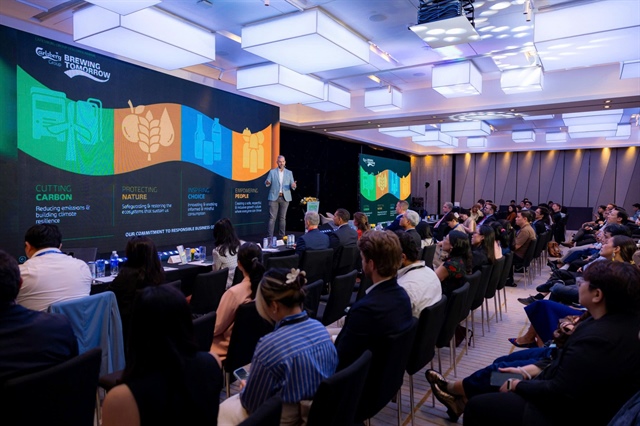
Peter Wachenschwanz, senior director of Integrated Supply Chain at Carlsberg Vietnam shares how Carlsberg Vietnam is translating its Brewing Tomorrow ambitions into practical action across production, resource efficiency and circularity. Photo courtesy of Carlsberg Vietnam |
As Vietnam advances towards net-zero by 2050, industrial growth must increasingly be supported by more efficient resource use, lower-carbon energy and circular production models. At the Green Industries Summit 2026, Carlsberg Vietnam shared how it is integrating these principles into brewery operations and the wider conditions needed to scale progress across industry.
Organised by the Nordic Chamber of Commerce in Vietnam (NordCham) and the Vietnam Chamber of Commerce and Industry (VCCI), the summit took place in Ho Chi Minh City on September 10 under the theme “Powering Vietnam’s Green Industry 4.0.” It brought together more than 200 business leaders, policymakers and Nordic experts to explore the green and digital transitions shaping Vietnam’s growth agenda.
Representing Carlsberg Vietnam, Peter Wachenschwanz, senior director of Integrated Supply Chain, delivered the keynote “Brewing Tomorrow: Innovations Shaping the Future of Green Industries” and joined the panel “Building Vietnam’s Green Energy Ecosystem.” Across both sessions, he shared how the company is increasing production capacity while reducing the resource intensity of its operations.
“Green transformation begins inside the brewery, with the discipline to use less water, less energy and fewer materials for every unit we produce. But its next stage extends beyond the brewery gate. Scaling renewable energy and circular solutions requires clear policy, viable commercial models and closer collaboration across the ecosystem. The opportunity is to connect operational efficiency with system-level change, so that industrial growth can create more value with a lower environmental footprint,” Wachenschwanz said.
Translating ambition into operational progress
Carlsberg Vietnam’s sustainability journey is guided by Brewing Tomorrow, Carlsberg Group’s sustainability programme built around four pillars: Cutting Carbon, Protecting Nature, Inspiring Choice and Empowering People.
The group aims to reduce emissions from its own operations by 90 per cent and source all its electricity from new renewable assets by 2032, before achieving a net-zero value chain by 2040. In Vietnam, these ambitions are being translated into investments in production technology, energy efficiency, water stewardship and circular packaging.
Phu Bai Brewery in Hue demonstrates how sustainability can be embedded in industrial expansion. Following an approximately $90 million investment inaugurated in August 2025, the brewery increased its installed capacity by more than half, becoming Carlsberg’s largest beer production site in Asia.
Despite this expansion, its new brewing line uses approximately 20 per cent less water and 15 per cent less energy than its predecessor. The brewery consumes around 2.1 hectoliters of water per hectoliter of beer, placing it among Carlsberg Asia’s most water-efficient breweries. It also captures and reuses the carbon dioxide generated during fermentation.
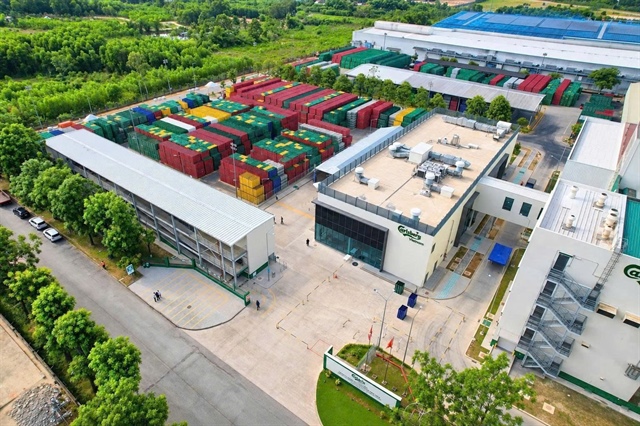
Phu Bai Brewery in Hue became Carlsberg’s largest brewery in Asia following a major expansion inaugurated in August 2025. Photo courtesy of Carlsberg Vietnam |
Advancing circularity and lower-carbon energy
Since early 2026, Carlsberg Vietnam has achieved Zero Waste to Landfill across its brewery operations. Its approach begins with reducing waste at source and strengthening on-site segregation. Recyclable materials are recycled, remaining waste is directed to waste-to-energy solutions, and wastewater sludge is converted into agricultural fertiliser.
Circularity also extends beyond the brewery. Carlsberg Vietnam reports a 98.5 per cent collection and reuse rate for returnable glass bottles and uses plastic crates made from 100 per cent recycled material.
Energy efficiency remains the first step in Carlsberg Vietnam’s decarbonisation pathway. Efficient brewing technology and heat recovery are combined with biomass-generated steam, while its electricity roadmap includes I-REC-backed sourcing since 2022, a rooftop solar project being implemented from Q3 2026, expected to supply up to 10 per cent of the brewery’s electricity needs, and a pathway towards direct power purchase agreements from 2028.
Wachenschwanz further explored the wider energy challenge during the panel “Building Vietnam’s Green Energy Ecosystem,” alongside representatives from REE Energy and VinEnergo. The discussion connected the perspectives of renewable energy developers, industrial users and market facilitators.
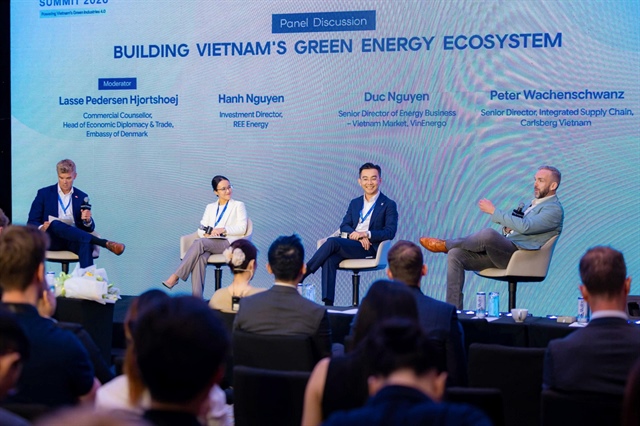
Representatives from Carlsberg Vietnam, REE Energy and VinEnergo discuss how industrial users, renewable energy developers and market facilitators can work together to build Vietnam’s green energy ecosystem. Photo courtesy of Carlsberg Vietnam |
For manufacturers to make credible long-term renewable energy commitments, they need regulatory certainty, workable commercial structures, reliable grid infrastructure and transparent verification. Developers and investors, in turn, need sufficient visibility of industrial demand to plan and finance new renewable capacity. Early collaboration can help translate this demand into projects that are bankable, reliable and scalable.
From food-loss prevention to higher-value resource use
Carlsberg Vietnam also contributed to the workshop “From Evidence to Action: Unlocking Circular Economy Solutions for Food Loss and Waste Reduction in Vietnam,” held in Hanoi on August 19 by the Ministry of Agriculture and Environment, the Food and Agriculture Organization of the United Nations and the Embassy of Denmark in Vietnam.
Through advanced extraction technology, yeast-recovery systems and real-time process controls, Carlsberg Vietnam has achieved raw-material efficiency of approximately 97.4 per cent. Spent grain are supplied for use in animal feed, while opportunities are being explored to convert spent yeast into higher-value applications.
Across both forums, Carlsberg Vietnam demonstrated that greener industrial growth is not about producing less, but producing better – using fewer resources, recovering more value and building the partnerships needed to scale lower – carbon solutions. Through Brewing Tomorrow, the company is translating that principle into practical action while contributing to a more efficient, circular and resilient industrial economy in Vietnam.
- 09:03 18/09/2026