Vietnam real estate M&A shifts from rescue deals to strategic restructuring
Vietnam real estate M&A shifts from rescue deals to strategic restructuring
Against increasingly stringent market screening, M&A is moving beyond a lifeline for distressed businesses to become a strategic restructuring tool, where valuation capabilities, long-term thinking, and the resolve of both buyers and sellers determine value.
On August 22, the Real Estate M&A Forum was held in Hanoi under the theme “Unlocking Capital - Restructuring Projects - Unlocking Transaction Value.”
Experts at the event said Vietnam’s real estate market was entering a new, more pragmatic and challenging chapter. The era of easy money and speculative, herd-driven investments has effectively come to an end. As broad-based market consolidation accelerates, mergers and acquisitions (M&A) are no longer merely a short-term solution, but are evolving into a strategic restructuring tool that requires knowledge, rational decision-making, and long-term vision from both buyers and sellers.
Pham Huy Trung Hieu, general director of Danco Land, likened a business to a living organism.
“One of the most common mistakes among Vietnamese businesses is turning to M&A only when the illness has become too severe or when cash flows are completely constrained and the company is struggling to survive. At that point, M&A negotiations put the company in a passive position, forcing its value down to a bargain price,” said Hieu. “M&A should be planned in advance and considered from the point at which the expected lifespan of the business extends beyond the period that the business owner is willing to devote to it.”
Hieu suggested that Vietnamese businesses should look at how foreign companies prepare for M&A transactions.
“Within the boards of directors of our companies, disagreements often arise when facing an M&A decision. This lack of alignment undermines negotiating power. By contrast, the charters of foreign companies clearly specify who has the final decision-making authority and what negotiating parameters are permitted to achieve optimal outcomes,” he said.
Hieu likened waiting until a company becomes weak before pursuing M&A to seeking medical treatment only after an illness has become severe when the cost is extremely high.
“If we use M&A like a daily health supplement and prepare an appropriate strategy in advance, the cost will be much lower and the value of the business can be optimised,” he said. “Businesses also need to clearly distinguish between selling an equity stake and transferring actual management control. A company may sell 60 per cent of its shares while retaining key powers, such as control over the corporate seal or authority to approve expenditures; conversely, it may sell 40 per cent while transferring significant decision-making powers.”
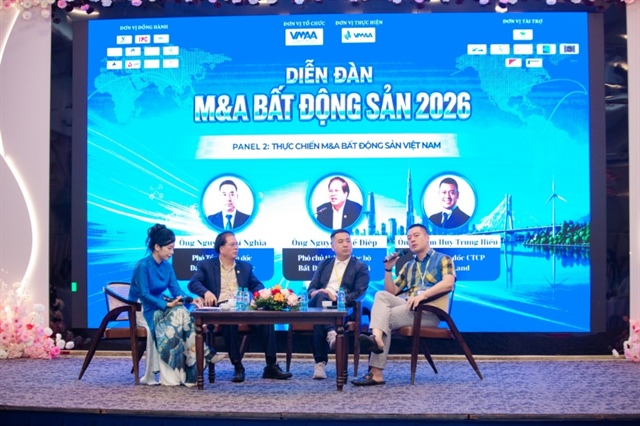
Real Estate M&A Forum. Photo: VMAA |
Agreeing that businesses need to take a proactive approach to M&A from an early stage, Nguyen Chi Nghia, deputy general director of Dat Xanh Mien Bac, shared practical experience gained from 16 years of operating a real estate business and navigating two major market cycles in Vietnam.
He said the era of projects being sold based on promises or investment decisions driven by sentiment and herd behaviour has come to an end.
“I define this period as the market’s coming of age. There will no longer be real estate based on promises, herd-driven real estate investments, or emotional decisions. Instead, this is an opportunity for businesses to make more professional decisions. Even amid these challenges, genuine investors are still making decisions at an early stage. An M&A perspective needs to be adopted now, rather than waiting until a business becomes weak, fails, or falls into crisis before taking action,” said Nghia.
“Today, many developers fail because they cannot distinguish between a product and a commercially viable asset. Some build a building and sell all the apartments but still suffer heavy losses because they are left carrying an unviable commercial podium,” he added. “It is time for consultants and M&A professionals to put emotions aside and bring greater rationality into their advice to identify the underlying value of an asset.”
Nguyen The Diep, vice chairman of the Hanoi Real Estate Club, said the real estate market’s completely shift is essentially a necessary process of restructuring.
“After a period of overheated growth, when almost any investment could generate returns thanks to financial leverage and speculative sentiment, smart capital is now becoming more concentrated and flowing towards areas that genuinely create surplus value for society,” he said.
He noted that the concept of a centre is broad, encompassing major urban centres and tourism hubs such as Quang Ninh, Danang, Nha Trang and Phu Quoc, as well as industrial centres such as Phan Xa and Hoang Hoa.
“If investors lack knowledge and expertise today, they will lose immediately and potentially permanently, unlike in the past,” said Diep.
Diep emphasised that Vietnamese businesses are predominantly small and medium-sized enterprises, making M&A likely.
“One party may be strong in project development and legal matters, while another may have stronger access to capital and contribute funding for construction and operations. That is how both sides can win. Vietnam is going through a golden demographic period and rapid urbanisation. Although foreign capital is substantial, in reality it is still comparable to the scale of remittances. Most importantly, government policies need to remove existing bottlenecks and unlock resources.”
|
Lawyer Nguyen Van Thai Vice chairman of the Vietnam M&A Association (VMAA)
Real estate M&A is entering a new phase as regulatory reforms, planning, infrastructure development, and increasingly selective capital reshape how investors assess opportunities. With the legal framework for land, housing, and real estate business continuing to evolve, investors are looking beyond projects to acquire and increasingly seeking assets that can be restructured and generate new value. The value of an M&A transaction therefore lies not only in the purchase price, but also in the ability to resolve legal issues, restructure finances, address outstanding obligations, strengthen governance, and return projects to the investment and business cycle. In this context, M&A should be viewed not simply as a transfer of ownership or control, but as a tool for restructuring and unlocking capital and resources. This is where VMAA can play a more clearly defined role. Rather than representing buyers or sellers, VMAA seeks to encourage a transparent, professional, and sustainable M&A market. For real estate, the Association aims to bring together not only investors and developers, but also lawyers, financial institutions, banks, auditors, investment advisers, valuation firms, planners, construction professionals, and other specialists involved in M&A transactions. VMAA seeks to connect projects, investors, capital, and professional expertise; share market practices and identify transaction risks; and consolidate practical obstacles to make policy recommendations to competent authorities. Ultimately, protecting members means more than resolving disputes after they arise. It means helping them identify risks before signing, choose appropriate transaction structures, and operate in a professional environment where parties can build trust and pursue sustainable cooperation. |

- 15:40 26/08/2026