Rubber industry explores carbon market opportunities
Rubber industry explores carbon market opportunities
The rubber industry has significant opportunity to participate in the carbon market, given the trees' long growth cycle, large biomass and ability to absorb and store carbon.
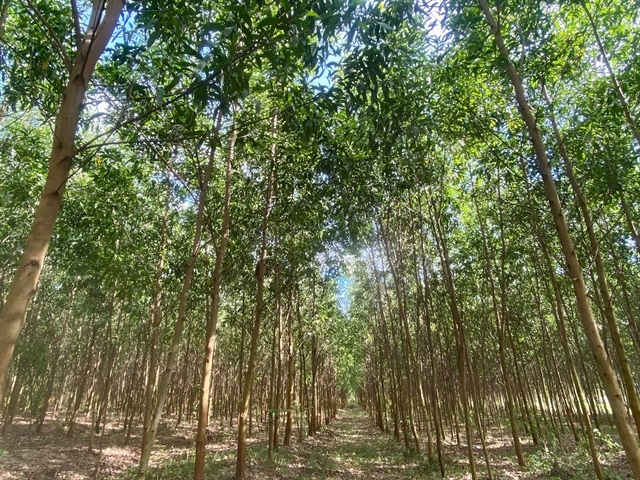
A rubber forest. The industry's 25-35 year business cycle, large biomass and commercial timber output at the end of the cycle give rubber plantations significant carbon-storage potential. — VNS Phoôt Tố Như |
The rubber industry is looking to tap the emerging carbon market to create new value and strengthen its global competitiveness, but legal, technical and financial hurdles must be tackled before carbon credits can become a viable revenue stream.
This was part of discussions at a workshop on carbon market opportunities on August 11.
Nghiêm Phương Thuý from the Forestry and Forest Protection Department said that Việt Nam has two main channels for carbon credit transactions, international and domestic markets.
International transfers can be carried out through cooperation mechanisms between countries under Article 6 of the Paris Agreement, including Articles 6.2 and 6.4, while companies can also participate in voluntary carbon standards.
For the domestic market, Việt Nam has established mechanisms for the exchange, trading and offsetting of emissions allowances, with the country's carbon exchange launched in late June 2026.
Experts pointed out that the rubber industry has significant opportunity to participate in the carbon market, given the trees' long growth cycle, large biomass and ability to absorb and store carbon.
However, carbon performance needs to be assessed across the entire production chain, from planting and cultivation to harvesting, transport and processing.
Measures to improve carbon performance could include optimising fertiliser and fuel use, improving cultivation, transport and processing practices and planting additional timber trees where appropriate.
Hoàng Bảo Luân, from Dong Nai Rubber Corporation (DONARUCO) which manages about 31,000 ha of rubber, the industry's 25-35 year business cycle, large biomass and commercial timber output at the end of the cycle give rubber plantations significant carbon-storage potential.
Growing requirements on sustainable development, carbon footprints, the EU Deforestation Regulation (EUDR) and net-zero commitments are also prompting companies to pay greater attention to carbon solutions.
But businesses face a number of hurdles in developing carbon projects.
One of the main issues is the legal status and classification of land, he said, adding that much of DONARUCO's rubber area is leased from the State and classified as land for perennial crops rather than forest land.
Companies therefore need clarity on whether rubber planted on perennial-crop land can qualify for improved forest management (IFM) methodologies and whether enterprises leasing such land have sufficient legal standing to register carbon projects.
Land-use planning poses another risk. Some rubber areas could be converted to other uses, while carbon projects generally require long-term commitments.
It is necessary to develop clearer rules on responsibility for credits already issued or transferred if project areas are reclaimed by the State or their land-use purpose changes.
Enterprises also need take into account the economics of carbon projects, he said.
DONARUCO has already improved its plantation management and production processes, meaning any additional carbon absorption compared with current practices must be quantified and weighed against the costs of consulting, measurement, monitoring, assessment and verification.
Market demand and carbon credit prices will also determine whether projects are commercially viable, Luân said.
He said that companies are seeking clarity on how credits will be recognised, allocated and transferred after accounting for the nationally determined contribution (NDC).
Luân has called on authorities to develop appropriate guidance for long-cycle industrial crops such as rubber, clarify the legal status of companies using perennial-crop land and establish responsibilities if project areas are reclaimed by the State.
The company also proposed developing carbon projects at the Vietnam Rubber Group level rather than through numerous small projects.
A larger project could spread the costs of consulting, measurement, assessment and verification and increase the scale of credits, potentially reducing transaction costs, he said.
However, large-scale project would also require stronger management, monitoring and coordination among participating units.
Vũ Tấn Phương, director of the Vietnam Forest Certification Office, said a carbon project must go through a series of stages, including project documentation, assessment, registration, implementation of technical measures, measurement and reporting. The report must then be assessed and verified before carbon credits can be issued.
"Not all carbon stored in trees can be converted into carbon credits," Phương said, stressing that projects must demonstrate emissions reductions or increased carbon absorption under an applicable methodology and have the results verified.
For rubber plantations that already have substantial biomass and are relatively well managed, the scope for generating additional credits from biomass may be limited, he said, urging companies to decide whether their main objective is to sell carbon credits or use carbon management to promote low-emission production and strengthen their brands.
Carbon credits could provide another source for creating value in the rubber industry but should not be viewed as a source of short-term revenue, he stressed.
- 11:08 13/08/2026